

This is the third post in our Risk & Resilience series.
March 9 is Panic Day, a day loosely defined as an opportunity to stress about everything under the sun — or, more wisely, to pause and remove unnecessary stressors.
In organizational life, though, real panic isn’t scheduled. It arrives uninvited: system failures, market shifts, safety incidents, public scrutiny, sudden change. And in those moments, people don’t just follow procedures.
They follow leaders.
In a crisis, emotional intelligence matters more than polish. Leaders who can read the room, manage their own responses, and communicate clearly give people what they need most: trust, direction, and momentum. Trying to be perfect misses the point.
Because in a crisis, fear spreads fast. But so does calm.
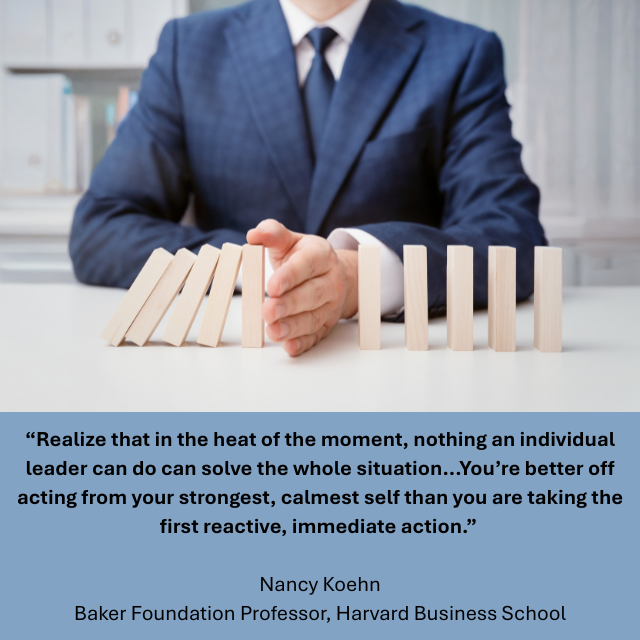
Panic doesn’t just affect individuals; it can spread across an entire organization. When communication is inconsistent, decisions lack clarity, and leaders seem reactive instead of steady, fear intensifies.
As a result:
At that point, the response to the crisis can cause more damage than the original event itself.
Emotionally intelligent leadership interrupts that cycle. It slows the emotional escalation and replaces it with steadiness, structure, and shared understanding.
During stable periods, leadership skills can hide behind structure. Plans are clear. Timelines exist. Decisions can be debated.
Crisis strips that away.
Uncertainty rises. Cognitive load increases. People worry about outcomes, job security, safety, and whether leadership truly understands what’s happening on the ground.
This is where emotional intelligence becomes operational, not optional.
Emotionally intelligent leaders:
In other words, they don’t eliminate fear. They prevent fear from taking control.
What Emotionally Intelligent Leadership Looks Like in Practice
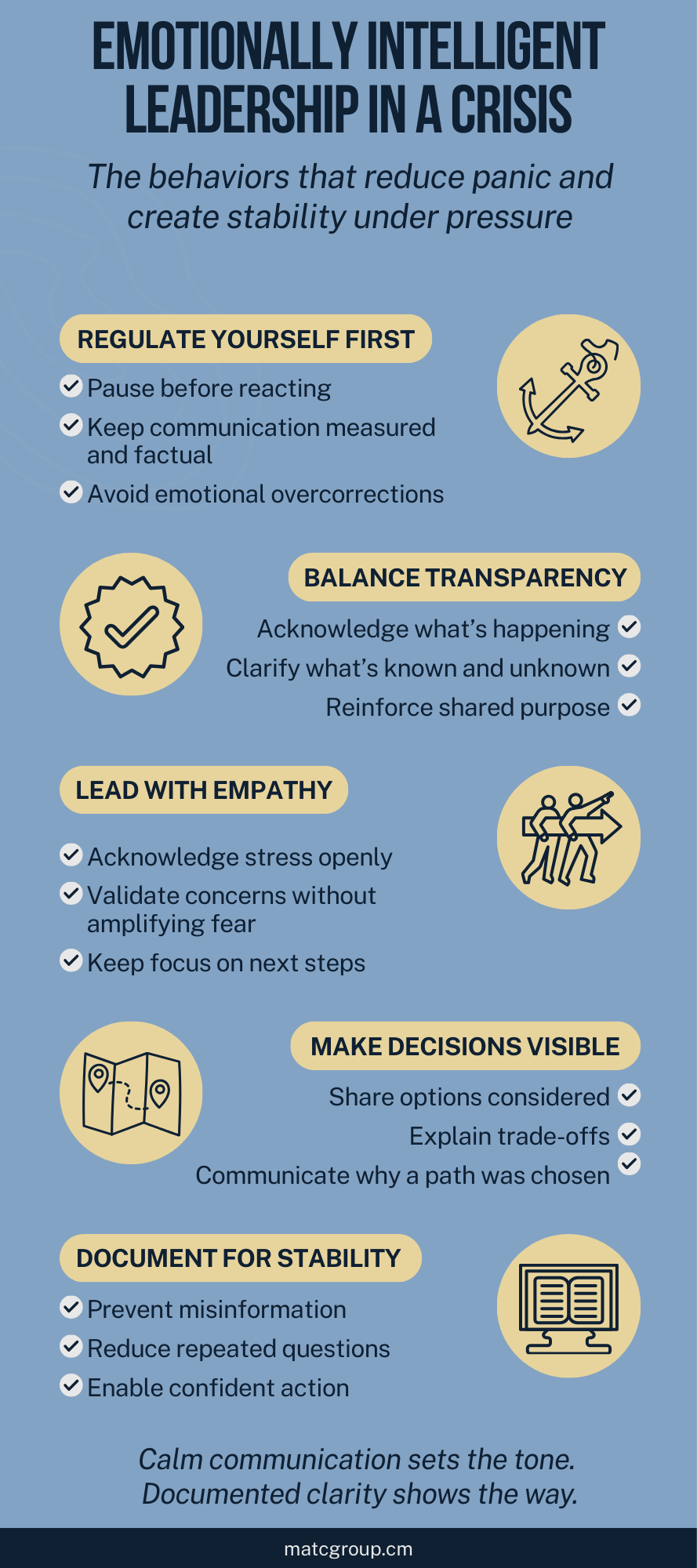
Emotional intelligence is most visible under pressure. In a crisis, leadership is defined by observable behavior. Intentions or values statements at this time are not helpful. The following behaviors show how emotionally intelligent leaders create steadiness, reduce fear, and keep organizations functioning when uncertainty is high.
People read leaders constantly during a crisis. Facial expressions, word choice, pace of speech, and even email tone become signals. If leaders appear reactive, defensive, or visibly overwhelmed, employees interpret that as danger. Uncertainty becomes alarm.
Emotional intelligence starts with self-regulation:
Projecting calm means you have yourself under control. A steady leader gives people a solid anchor
One of the fastest ways to erode trust in a crisis is silence. The second fastest is vague reassurance without substance.
Emotionally intelligent leaders balance honesty with stability:
Don’t pretend everything is fine, as your team will immediately see through that. Instead, demonstrate that the situation is understood and being actively managed.
People can handle hard news. What they struggle with is ambiguity and rumor; if you don’t tell them what they need to know, they will fill in the gaps themselves – often with bad information.
Crisis affects people differently. Some focus on tasks. Others worry about family, workload, or job security. Empathetic leadership means recognizing the human side without letting the organization drift.
Effective leaders:
Empathy answers the question, “Do you see what this is like for us?”
Direction answers the question, “What do we do now?”
You need answers to both.
In uncertain environments, invisible decision-making feels like inaction.
Emotionally intelligent leaders communicate not just outcomes, but reasoning:
This transparency builds credibility. Even when people disagree, they are more likely to trust decisions they understand.
Clarity reduces the emotional toll of uncertainty.
Emotional intelligence isn’t only interpersonal. It also shows up in systems.
When leaders ensure that procedures, updates, and expectations are documented and accessible, they reduce the cognitive and emotional burden on employees.
Documentation:
Panic Day may invite us to dramatize stress. Crisis leadership requires the opposite.
People don’t expect leaders to have all the answers immediately. They expect:
When leaders communicate calmly – and back that communication with documented clarity – they remove one of the most dangerous variables in any crisis: confusion.
Plans matter. Systems matter.
But in the storm, people look first to the person at the helm.
Leading Through Uncertainty: The New Core Competency
Crisis Management: What Went Wrong — and Right — During Major Disasters
How Mental Health can Make or Break Your Business in a Crisis
Miller, Kelsey. “Leadership Under Pressure: 3 Strategies for Keeping Calm During a Crisis.” Harvard Business School. 12/19/19. Accessed 2/10/26. https://online.hbs.edu/blog/post/leadership-under-pressure