An employee can follow a demonstration, pass a knowledge check, and still struggle when the next customer request looks slightly different. That gap deserves attention during learning design: What did the employee actually practice? How much help did they receive? Did the assessment require the same judgment the job demands?
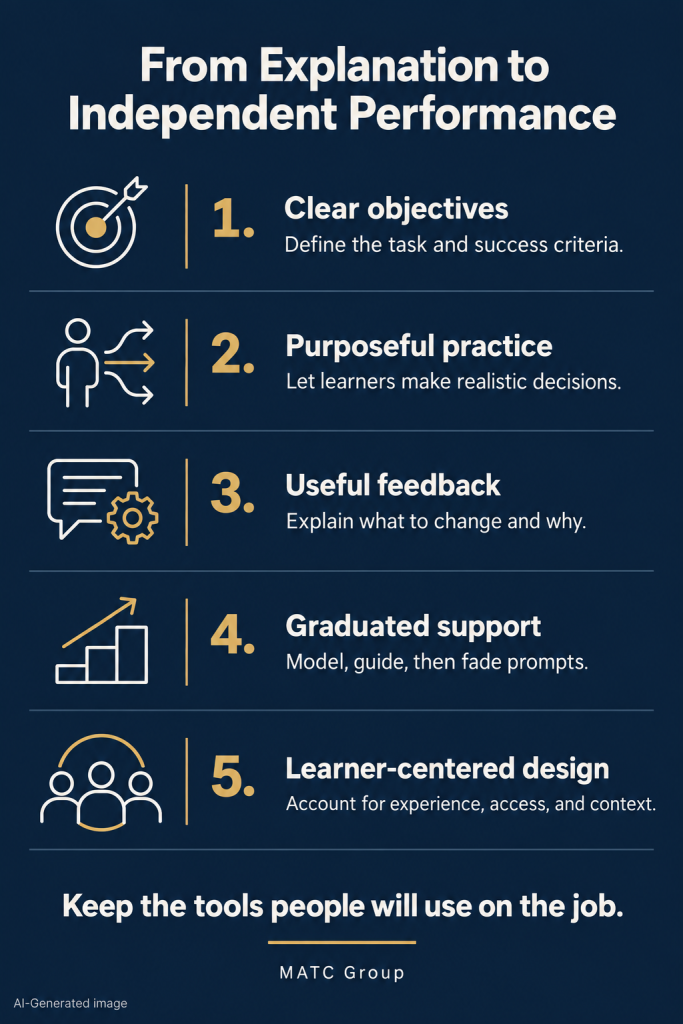
Good educational design offers useful ways to answer those questions. Clear objectives, purposeful practice, actionable feedback, scaffolding, and learner-centered design can help L&D teams build a more deliberate path from explanation to application. Consider how those principles could shape training for a support team learning to resolve customer requests.
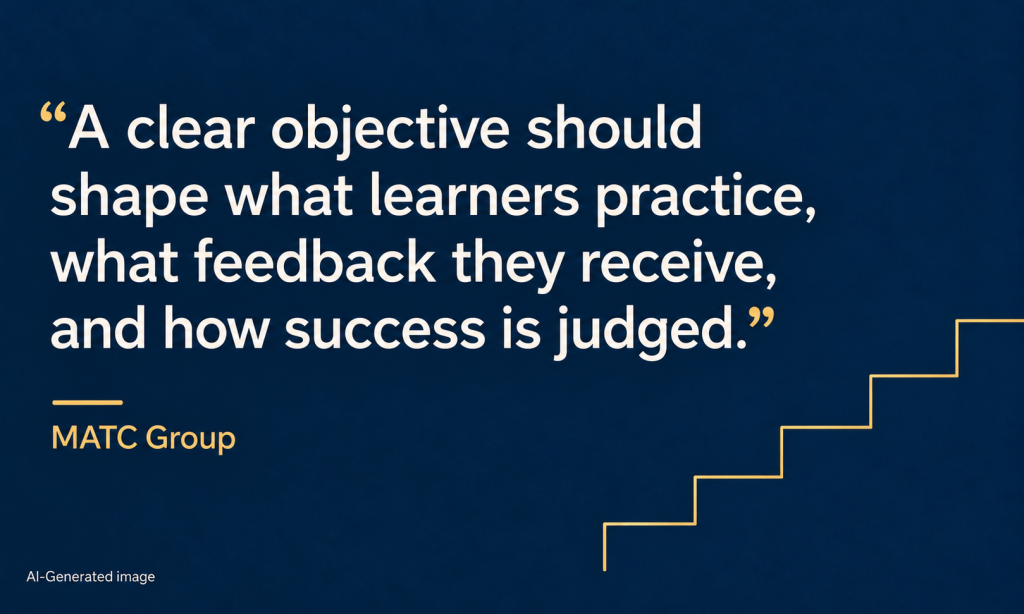
“Understand the escalation process” leaves considerable room for interpretation. A more useful objective would ask employees to review a customer request, select the appropriate escalation route using the current decision guide, and document the reason for their choice. That wording gives both learners and designers something observable to work toward.
Carnegie Mellon University’s Eberly Center emphasizes alignment among learning objectives, instructional activities, and assessment. Applied to this example, that means employees should practice routing requests and explain their decisions during assessment. A quiz asking them to recall department names would provide limited evidence that they can do the work.
Give Learners Decisions to Make
A demonstration can introduce the process, but employees also need opportunities to use it. Give learners sample requests with enough detail to make a decision, including information they must interpret or recognize as missing. Ask them to select a route, explain their reasoning, and identify what they would confirm before proceeding.
Research offers a useful reminder about the value of that work. In a 2025 Carnegie Mellon report, researchers described a statistics-learning experiment in which practice with feedback produced learning output per unit of time that was three times as efficient as lecture alone. Combined lecture and practice produced the strongest post-test performance. These were academic learning conditions, so the results do not establish a workplace-training return; they do support examining how training time is divided between explanation and application.
For the support team, start with a straightforward request, then introduce a case where two routes initially seem plausible. The added difficulty should come from the judgment employees need to develop, rather than obscure wording or a trick question.
When a learner chooses the wrong escalation route in a customer-service scenario, “Incorrect. Try again.” tells them the result while leaving them to diagnose the problem. More useful feedback identifies the relevant evidence and explains how it affects the decision. For example: “This request includes an account-access concern, which requires identity verification before billing review. Check the verification step, then reconsider the escalation route.”
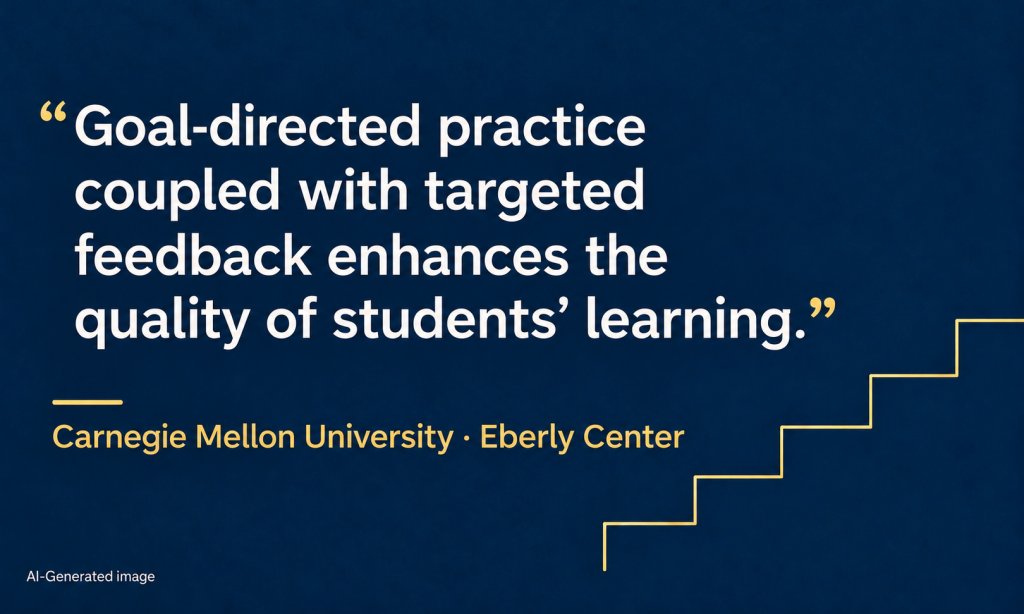
The Eberly Center describes effective practice as goal-directed and paired with feedback tied to specific performance criteria. In workplace training, that suggests giving learners a chance to apply the feedback while the reasoning is still relevant. A revised attempt can show whether they understood the correction or simply selected another answer.
Scaffolding provides structured assistance while learners develop competence, then gradually reduces that assistance. The University at Buffalo describes this process as adjusting guidance and support as learners become more capable. The practical design question is when employees are ready to take responsibility for more of the task.
For the support team, that progression might include:
Remove temporary teaching prompts as performance improves, while keeping legitimate work tools available. If employees are expected to consult an escalation guide during customer interactions, using that guide belongs in practice and assessment. Independence can include knowing when and how to use a reliable resource.
A new employee and an experienced support specialist may need different starting points. Someone unfamiliar with the organization might need help interpreting internal terminology; a veteran employee learning a revised process may need practice distinguishing the new rules from the old ones. Treating both learners identically can make training unnecessarily difficult for one and repetitive for the other.
CAST’s Universal Design for Learning Guidelines 3.0, released in 2024, emphasizes reducing barriers and supporting learner agency. For workplace learning, useful applications include accessible materials, clear navigation, meaningful choices, and support that reflects learners’ existing knowledge and working conditions.
Before building the full experience, test a sample task with representative employees. Observe where they hesitate, which instructions they misinterpret, and whether the available resources help them proceed. Their behavior can reveal design problems that a subject matter expert, already fluent in the process, may overlook.
Review the Whole Learning Path
These principles become most useful when they work together. A specific objective guides the practice; practice reveals where feedback is needed; feedback informs the next attempt; scaffolding adjusts the support; and learner-centered design makes the experience usable for the intended audience.
Choose one existing training activity and trace that path. Look for places where learners watch without trying, receive corrections without another attempt, or face an assessment that differs from the work itself. Those are concrete opportunities to improve the design. MATC’s learning and development services can help organizations connect those decisions into training that prepares people for the tasks ahead.
Understanding the Standards of Instructional Design
What Good Instructional Design Looks Like in 2026
From Learning Analytics to Action: Turning Feedback into Performance Improvement
Microlearning and In-the-Flow Training: The New Standard for Distributed Teams
Why More Content Is Usually the Wrong Fix for a Skills Gap
“About the Guidelines 3.0 Update.” CAST. Accessed 10/27/26. https://udlguidelines.cast.org/more/about-guidelines-3-0
“Learning Principles.” Eberly Center, Carnegie Mellon University. Accessed 10/27/26. https://www.cmu.edu/teaching/principles/learning.html
“Scaffolding Content.” University of Buffalo. Accessed 10/27/26. https://www.buffalo.edu/catt/teach/develop/build/scaffolding.html
“Teaching Principles.” Eberly Center, Carnegie Mellon University. Accessed 10/27/26. https://www.cmu.edu/teaching/principles/teaching.html
Williams, Marylee. “Practice Makes Perfect.” Carnegie Mellon University. 6/5/25. Accessed 10/27/26. https://hcii.cmu.edu/news/practice-makes-perfect