

A shift changes. A system goes down. An experienced employee leaves. Suddenly, the organization discovers whether its knowledge can survive a handoff.
These moments expose the distance between having information and being ready to use it. They also help explain why veterans’ experience deserves closer attention in conversations about knowledge management and change leadership. Experience maintaining equipment, coordinating logistics, training colleagues, or planning operations can offer practical insight into how teams prepare, communicate, and learn.
Veterans Day is an opportunity to recognize those contributions with some specificity. Military service encompasses many occupations and responsibilities; no single description fits everyone who has served. The useful question is what an individual has learned, and how that experience can strengthen the organization.
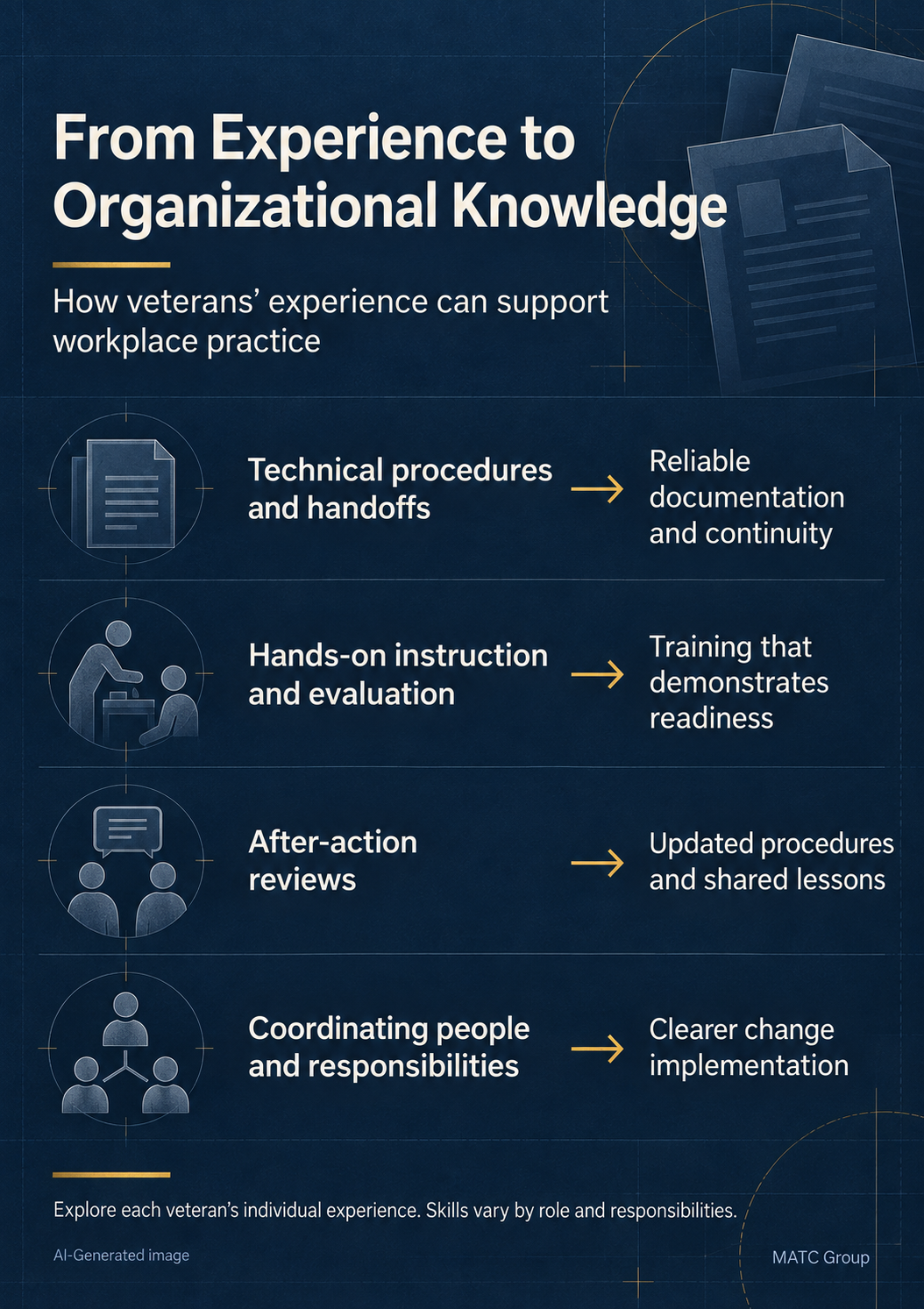
Consider a veteran whose responsibilities included equipment maintenance. Their experience may involve following technical instructions, recording completed work, identifying unresolved issues, and handing responsibility to another person. In a civilian organization, those activities connect directly to procedure development, service records, troubleshooting guidance, and operational continuity.
The value lies partly in understanding the consequences of an incomplete handoff. “Checked the system” tells the next person very little. A useful record explains what was checked, what was found, what remains unresolved, and who owns the next action.
Employers can uncover this experience by asking concrete questions: What information did someone else need before taking over? How did you communicate exceptions? What made an instruction reliable enough to use? Those answers reveal knowledge-management skills that a job title alone may not convey.
An employee can finish a course and still struggle to perform the task. Veterans with experience delivering or evaluating hands-on training may bring a useful perspective here: preparation should include opportunities to practice, receive feedback, and demonstrate performance.
The Army’s 2025 explanation of its after-action review guidance connects training evaluation to specific observations, task standards, and opportunities to adjust performance during subsequent practice. That offers a practical model for civilian learning programs.
Before a software rollout, for example, employees could rehearse a realistic customer request using the new workflow. The exercise might reveal an unclear approval rule, missing system access, or instructions that omit an exception. Discovering those problems before launch gives the organization time to address them.
Turning a Review Into a Change in Practice
An after-action review can help a team examine what it intended to accomplish, what occurred, and what should be sustained or improved. Its usefulness depends on the quality of the discussion and what follows.
The Army’s guidance explicitly connects follow-up to retraining, revised standard operating procedures, and the recording and sharing of lessons. The review feeds the next round of work.
Civilian organizations can apply that discipline after a launch, service interruption, customer implementation, or difficult project. Suppose a review identifies confusion about escalation responsibilities. A useful response would assign an owner to revise the escalation guide, test it with employees, and communicate the change.
A lesson becomes organizational knowledge when someone else can use it. Meeting notes provide a record; updated guidance and changed behavior show that learning has reached the work.
Change creates questions that broad announcements rarely answer. What changes for my role? Which decisions can I make? Where do I raise a problem? What happens if the new process does not work as expected?
A veteran who has coordinated work across teams may have relevant experience clarifying responsibilities, communicating dependencies, and adjusting plans as conditions change. Employers should explore those capabilities through examples rather than assume them from military rank or service history.
Consider a new purchasing process. Employees need to understand its purpose, but they also need clear approval limits, realistic practice, current instructions, and a way to report problems. A change leader who checks those conditions can identify obstacles that a launch announcement would miss.
Veterans already contribute across a broad range of civilian occupations. In the Bureau of Labor Statistics’ 2025 estimates, 44.7% of employed veterans worked in management, professional, and related occupations*. That figure describes occupational participation; understanding an individual’s capabilities still requires a conversation about their work.
Employers share responsibility for making that conversation productive. Ask about experience building procedures, teaching others, coordinating transitions, or improving work after a review. Provide the industry context, tools, and development opportunities needed to apply those skills in a new setting. Invite veterans to contribute their expertise without expecting them to represent everyone who has served.
This Veterans Day, recognition can include a practical commitment: take veterans’ experience seriously enough to understand it. Give that experience room to influence how knowledge is documented, how people prepare, and how organizations respond to change.
MATC helps organizations connect documentation, training, knowledge transfer, and change support so employees can put experience into practice.
* Statistical note: BLS’s 2025 annual estimates use 11 months of data because October data were not collected during the federal government shutdown.
Knowledge Management’s Role in Change
How to Capture Institutional Knowledge Before It Walks Out the Door
Knowledge Management and Workplace Transitions
Securing Buy-In and Building an Effective Process for Your KMS
Knowledge as a Product: How to Design Information People Will Actually Use
“Employed people 18 years and over by occupation, sex, veteran status, and period of service, 2025 annual averages.” U.S. Bureau of Labor Statistics. https://www.bls.gov/news.release/vet.t04.htm
“TMD publishes training circular to augment FM and ADP 7-0.” U.S. Army. 2/20/25. Accessed 10/21/26. https://www.army.mil/article/283214