

Somewhere in your organization, three people are updating the same explanation in three different courses. A fourth person has already copied it into an onboarding guide. Nobody knows about the fifth version, which lives in a presentation someone helpfully emailed to everyone.
Yesterday was America Recycles Day, observed each November 15. In that spirit, let’s consider a workplace resource worth reusing: good training content. Unlike an aluminum can, however, an old learning asset needs more than enthusiasm and the correct bin. It needs someone to check whether it still makes sense.
Thoughtful reuse can reduce duplicate work and help teams maintain consistent information. Careless reuse gives outdated instructions a larger distribution network. The difference comes down to how content is built, governed, and updated.
Modular content organizes information into components that serve a clear purpose: explaining a concept, demonstrating a task, presenting a rule, or providing practice. A useful module contains enough context to make sense wherever it is approved for use. “As discussed earlier” is a small phrase with a remarkable ability to ruin that arrangement.
Imagine training about employee expenses. The reimbursement rules could be maintained separately from system instructions, employee examples, and manager approval exercises. Those components change for different reasons. Keeping them distinct lets the team update a revised approval limit without excavating an entire course.
The right size depends on the content. Turning every sentence into a separately managed component can create more administration than it saves. Start with information that appears repeatedly, remains consistent across uses, and has a recognizable owner.
Single sourcing means maintaining shared content in an authoritative source and using it to support multiple outputs. Structured-content standards such as DITA build reuse into the authoring process, but the underlying principle is useful even without a specialized system: know where the approved content lives and how other materials depend on it.
A template can standardize layout. A shared component can standardize maintained information. Copying approved wording into six files produces six independently editable copies, even if every file started in the same respectable folder. That resource pressure is not unique to training teams. Content Marketing Institute’s 2026 research found that 42% of enterprise marketers identified resource constraints as a content marketing challenge. Although the finding concerns marketing rather than training, it reinforces the value of concentrating limited effort on content that is genuinely reusable.
Copying content is easy. Keeping every copy correct is the expensive part. If your tools cannot maintain live reuse relationships, keep a register of where shared material appears and assign responsibility for updating those locations.
A reusable library needs enough governance to help people make decisions without convening a committee over every paragraph. Each shared component should have a few practical details attached:
Approval also has boundaries. An explanation approved for experienced technicians may assume knowledge that new employees lack. A global policy statement may need a clearly identified local variation. “Approved” should tell authors where content belongs, rather than function as a universal travel visa.
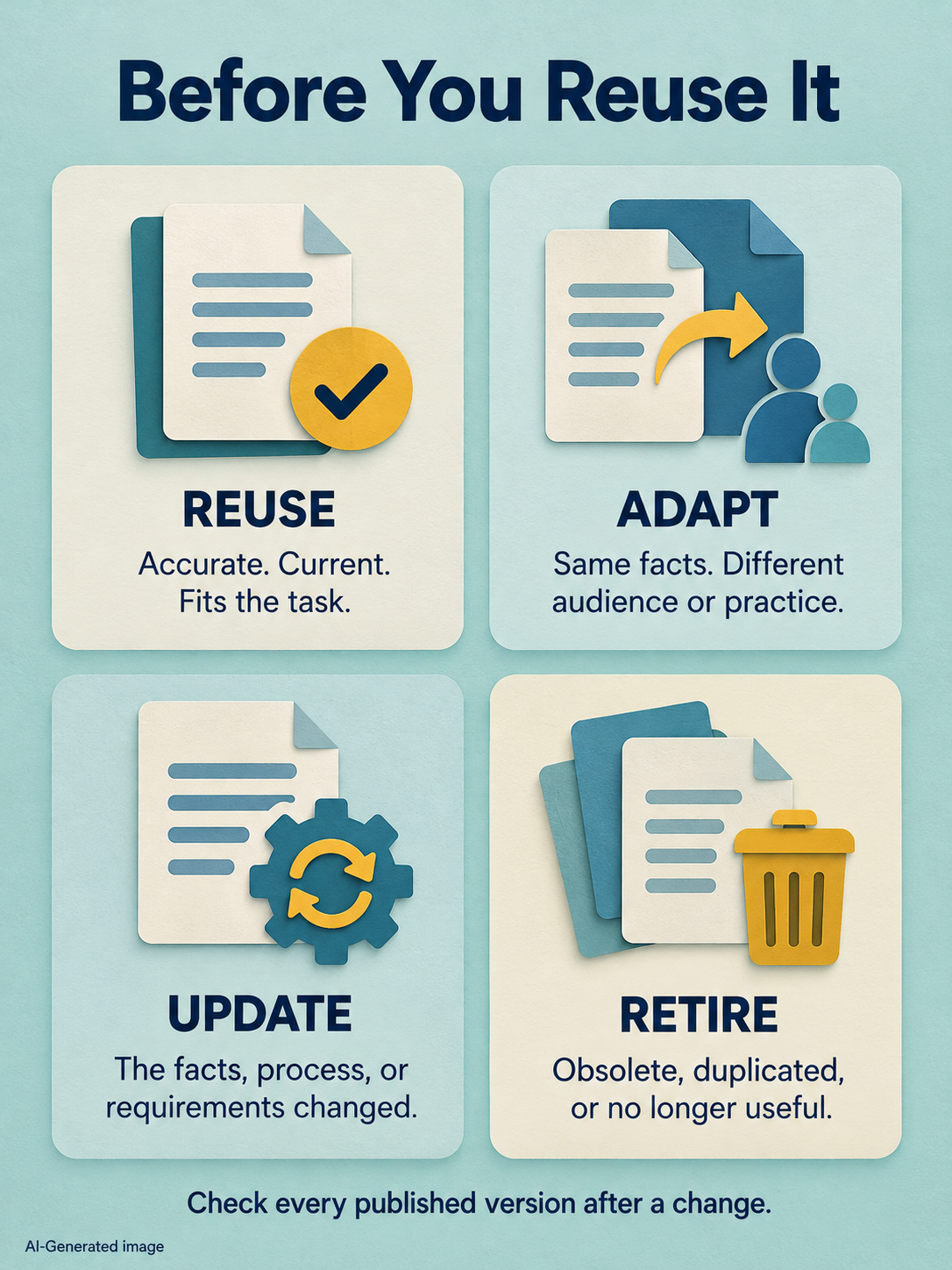
Before inserting an existing asset into something new, make a deliberate choice. These four options keep “we already have something” from ending the discussion prematurely:
These choices can overlap. Updated reimbursement rules may also require new manager practice scenarios. Conversely, a new audience may need additional explanation without any change to the policy itself.
The distinction matters because cosmetic changes can conceal substantive problems. Replacing the logo does very little for an exercise that teaches employees to seek approval from a department that no longer exists.
Return to that expense-training example. The policy owner changes the approval threshold, and the shared source is updated. Good progress—but the exported course package, downloadable job aid, narrated video, and instructor slides may still contain the previous amount.
What happens next depends on the publishing system. Some uses may update through shared references; others require rebuilding, republishing, or manual replacement. Someone must check the affected outputs, including scenarios and assessments, and withdraw superseded versions from active use. Preserve historical records where required.
The task is complete when learners receive the correct guidance. A perfectly maintained source cannot help someone by opening last year’s PDF.
Choose a piece of information your team keeps rebuilding. Identify its approved source, separate the stable explanation from audience-specific material, and record where it appears. Then test the arrangement through an actual update.
Measure whether the change reduced duplicate editing, shortened review time, or prevented conflicting instructions. A reuse percentage alone tells you how often content traveled; it says little about whether it arrived in useful condition.
Good content deserves a second life. Give it an owner, check its condition, and make sure it still belongs in the lesson. That is considerably more useful than putting a fresh cover on the same confusion.
MATC helps organizations structure, maintain, and adapt training and documentation so useful content can support more people with less unnecessary rebuilding.
5 Signs Your Training Materials Need a Refresh
Knowledge as a Product: How to Design Information People Will Actually Use
Beyond the LMS: Building a Learning Ecosystem That Works
Training Won’t Fix a Broken Process
Knowledge Management’s Role in Change
“America Recycles Day.” Keep America Beautiful. Accessed 10/21/26. https://kab.org/our-signature-programs/america-recycles-day
“OASIS Darwin Information Typing Architecture (DITA) TC.” OASIS Open. Accessed 10/21/26. https://www.oasis-open.org/committees/tc_home.php?wg_abbrev=dita
Rose, Robert. “How Enterprise Marketers Turn Scale Into Strategic Advantage.” Content Marketing Institute. 1/21/26. Accessed 10/21/26. https://contentmarketinginstitute.com/enterprise-research/enterprise-content-marketing-research-findings