

Everyone watching a horror movie becomes an expert in decision-making.
Don’t investigate the noise. Don’t read the mysterious Latin. And if the real estate agent describes the basement as “full of character,” ask whether that character requires an exorcism.
From the couch, the right choice seems obvious. Inside the story, people have incomplete information, competing priorities, and someone insisting that everything is probably fine.
Workplace decisions can feel surprisingly similar. The soundtrack is less helpful, and the ominous knocking usually comes from a customer escalation.
This Halloween, let’s take a few lessons from three of the best horror movies of all time: Jaws, Alien, and The Cabin in the Woods. Each illustrates the value of scenario-based training, which gives people realistic opportunities to make decisions, explore consequences, and practice better responses before the stakes are real.
In Jaws (1975), Chief Brody gets a way-too-close look at the shark and immediately reassesses the equipment available for the assignment. His recommendation is admirably concise.
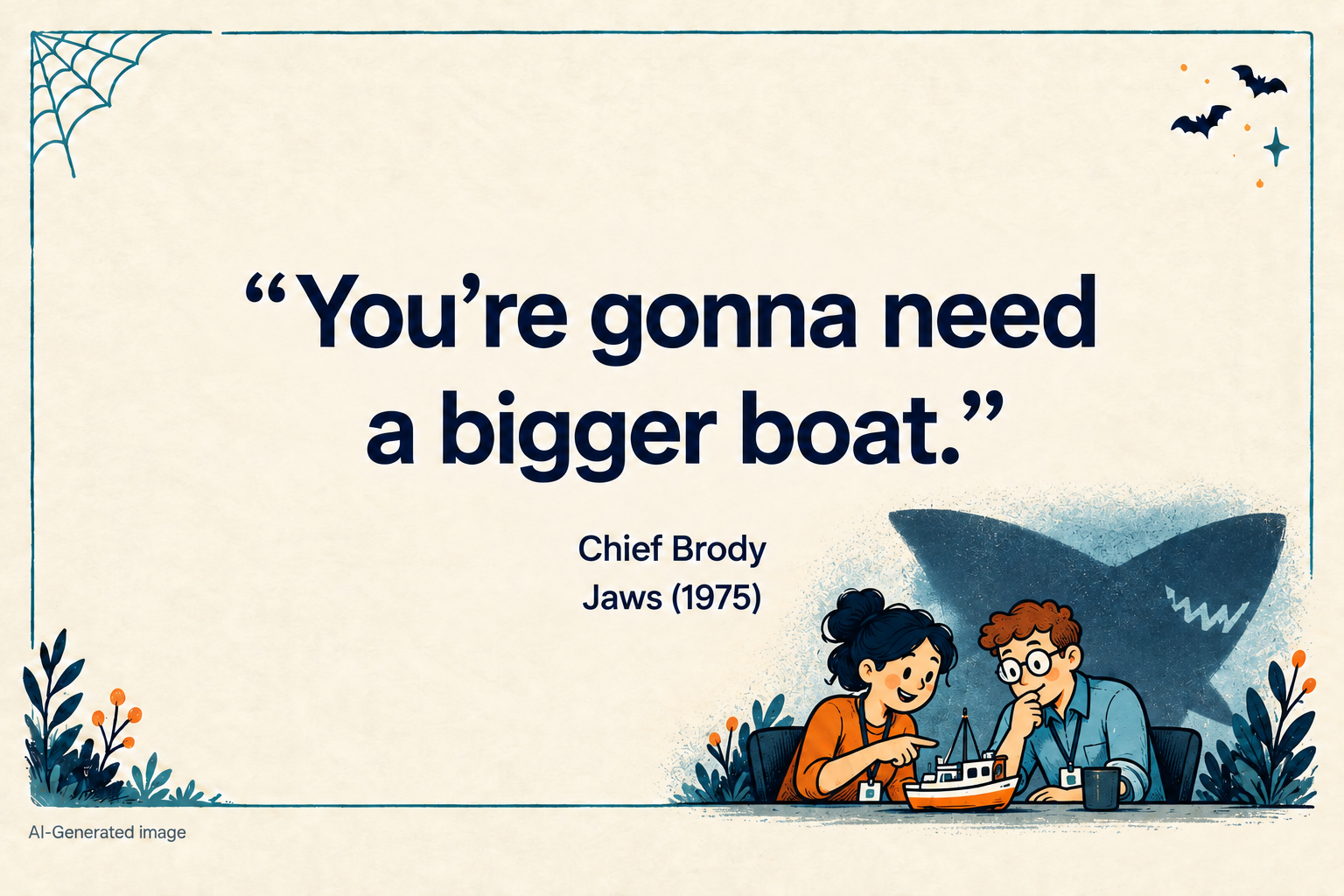
Recognizing that a situation exceeds your resources or authority is a workplace skill worth practicing.
An employee may know the standard approval process. Then a customer needs an exception, the approver is unavailable, and a colleague says, “We did this last time.” Suddenly, that tidy procedure has developed teeth.
A useful scenario asks employees to decide what happens next. Can they handle the request within their authority? Do they need additional expertise? Who can approve an exception?
Give them access to the job aids and contacts they would really use. Then discuss their reasoning. Continuing confidently with an inadequate plan should not earn bonus points for enthusiasm.
The scale of the training challenge is substantial. The World Economic Forum’s Future of Jobs Report 2025, based on more than 1,000 employers, projects that 59 out of every 100 workers will need training by 2030. That forecast does not measure the effectiveness of scenarios. It does give organizations a reason to examine what employees will practice, beyond what they will read.
In Alien (1979), Ripley refuses to admit an exposed crew member aboard the ship, citing the quarantine procedure. Her captain and colleagues pressure her to open the hatch; Ash ultimately lets them in.
Knowing a rule and applying it under pressure are different challenges.
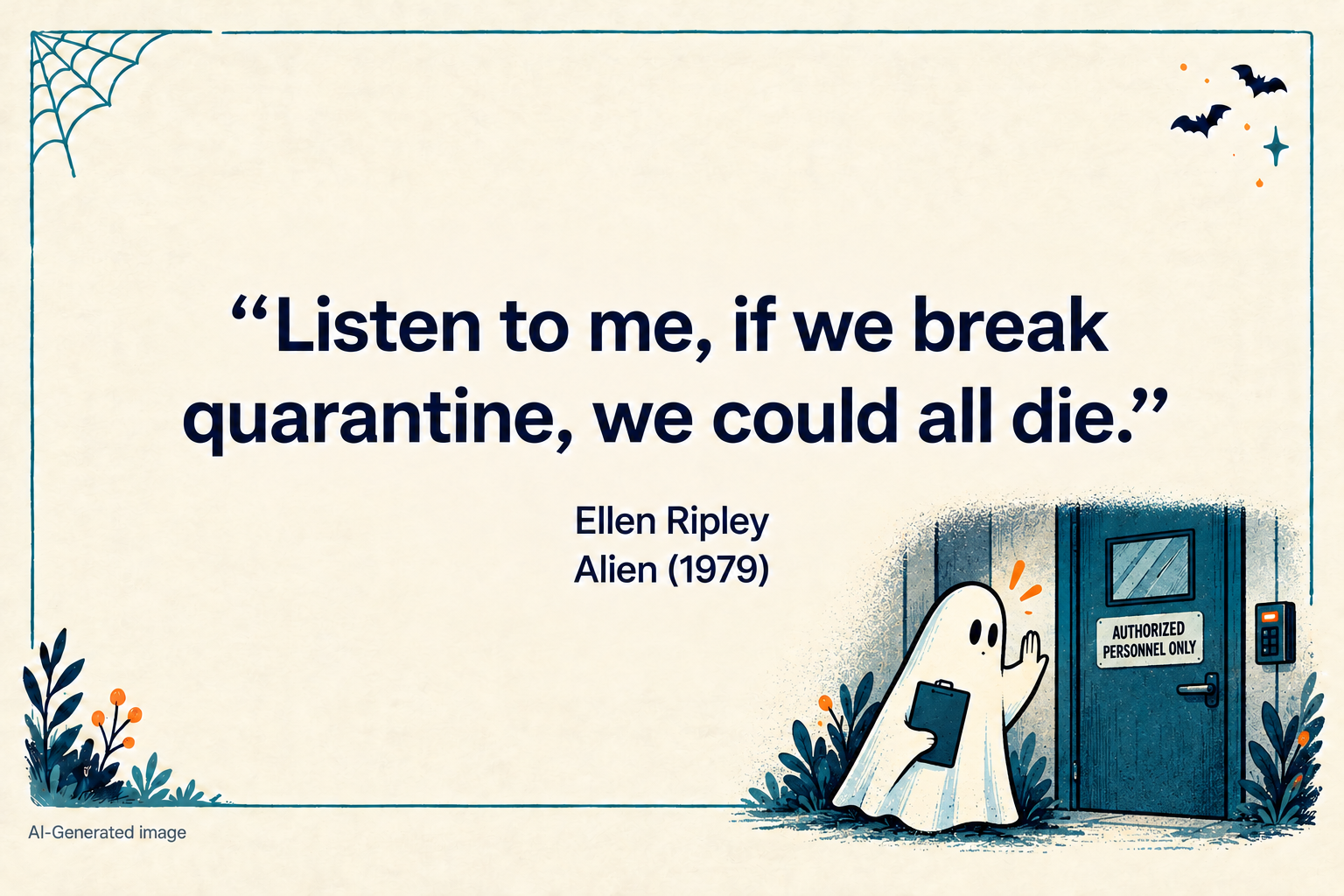
Workplace training often presents the correct procedure without the awkward conversation required to follow it. Real employees may face urgency, seniority, customer demands, or a teammate who promises that skipping one check will be fine.
Build those pressures into a supported practice exercise. Ask participants to explain the risk, identify an authorized escalation path, and choose a safe next step. Give the person playing the impatient colleague something believable to say. “We will miss the deadline” is more useful than “I enjoy violating procedures.”
Practice the handoffs, too. One person receives the request, another evaluates it, and a third communicates the decision. Who owns the next action? What information travels with it? What happens when the usual approver is unavailable?
The best time to discover a missing escalation path is before something starts growling in production.
In The Cabin in the Woods (2012), discovering an old diary in a creepy cellar apparently qualifies as a group reading activity. Marty objects to reading the Latin aloud. His concerns do not receive adequate consideration. Things deteriorate.
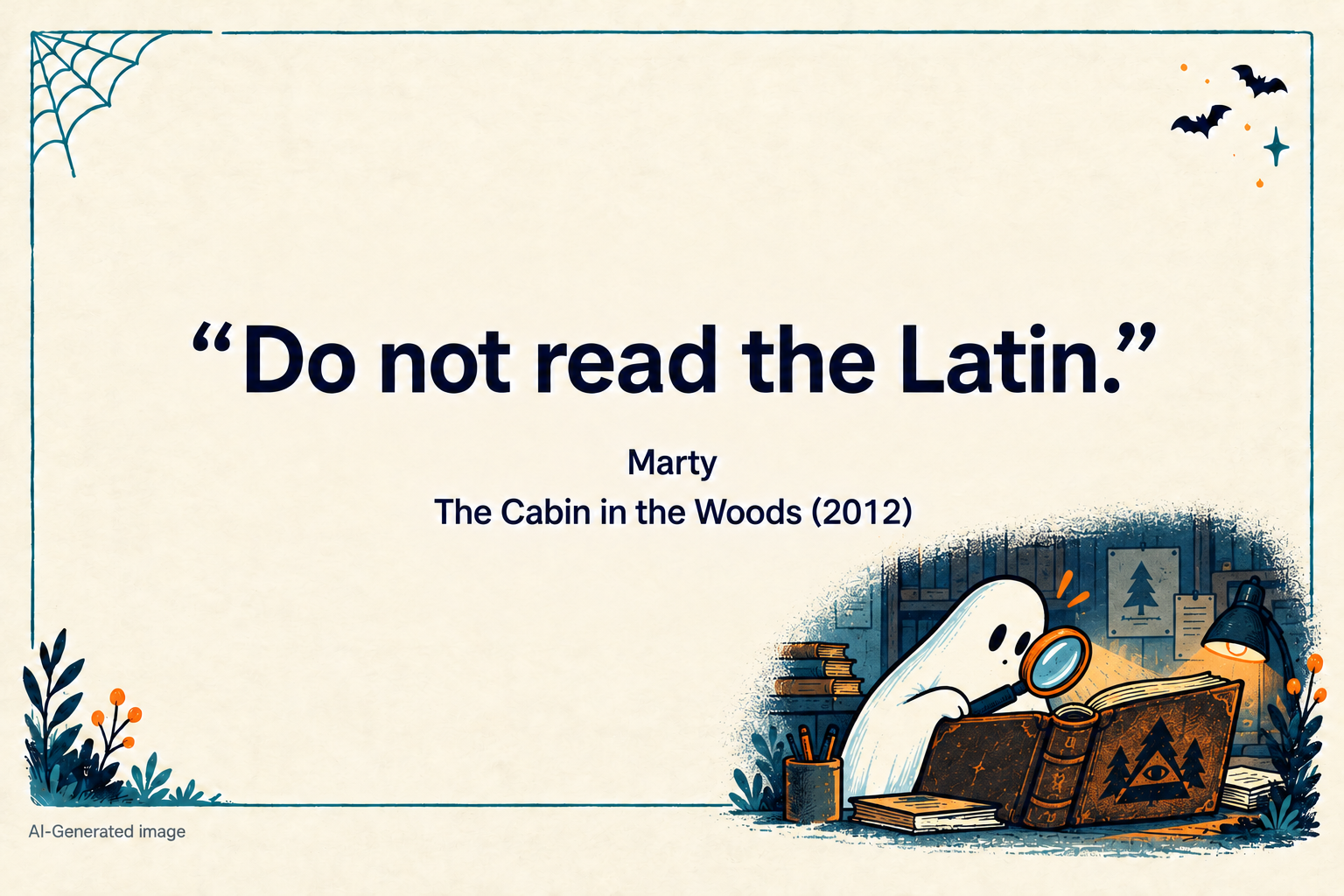
Workplace warnings usually involve fewer undead visitors, but they still need to influence the next decision. Can employees recognize when to pause, verify information, or ask for help? Does training let them practice doing that when someone else is eager to proceed?
“It was covered in training” has strong “Marty specifically told you not to” energy.
Use the exercise to test the support surrounding the decision. If employees must search six folders for the exception procedure, you have found something worth fixing. Conflicting instructions, missing contact details, and unclear ownership deserve attention, too.
Sometimes the most valuable result is a clearer job aid or a repaired handoff. A realistic exercise gives the organization something to learn alongside its employees.
Start small. A facilitated discussion, a role-play, or a few branching screens can give people a meaningful decision to practice. The production budget does not need its own executive producer.
A practical rehearsal needs five ingredients: one real decision, a plausible complication, believable choices, explained consequences, and a debrief with another attempt.
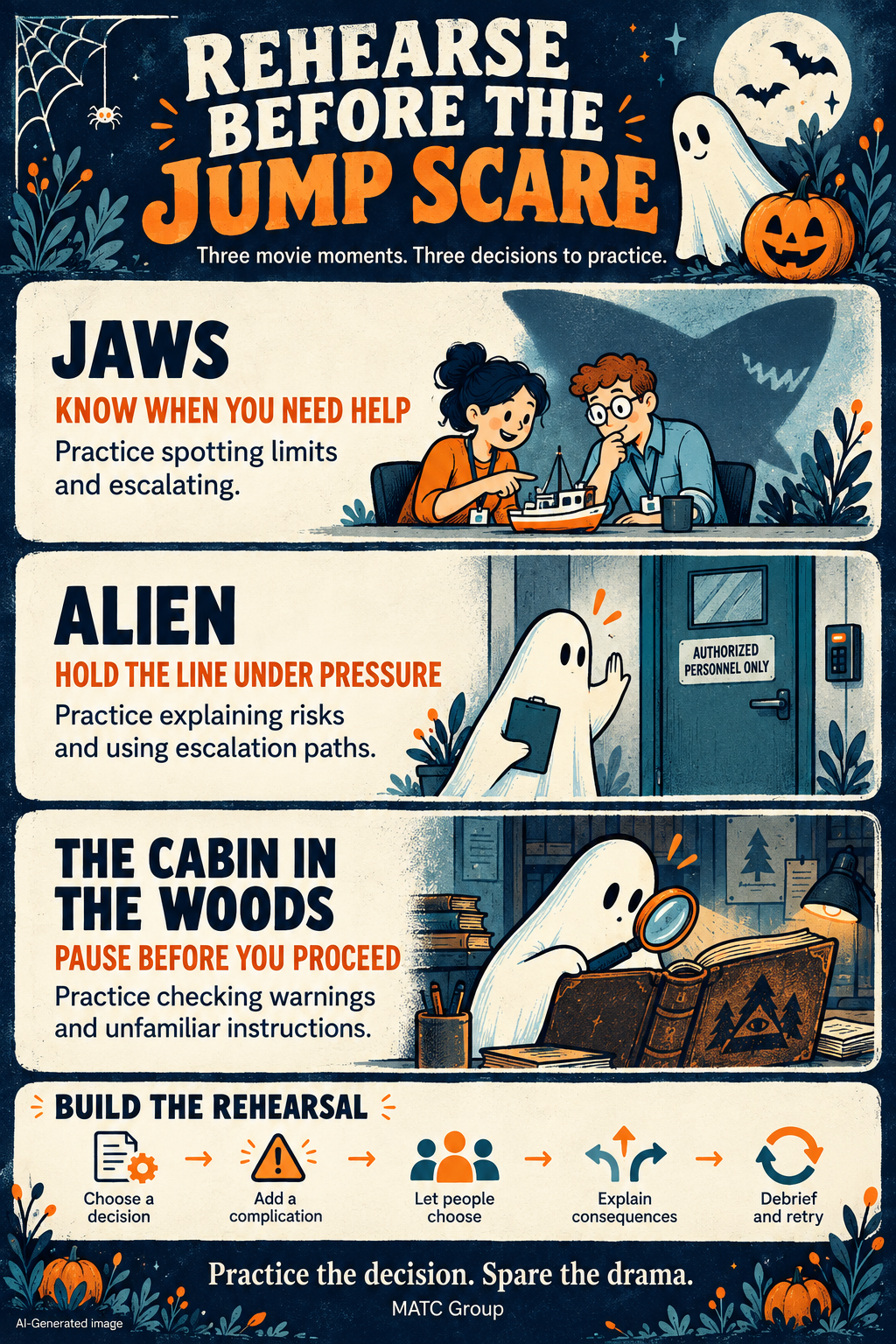
Keep the purpose clear. Participants should know they are practicing; surprise humiliation is a terrible instructional strategy, even with excellent fog effects. Provide the guidance and support they need, and make it acceptable to pause or ask questions.
Afterward, discuss what they noticed, which information helped, and what they would change. Try a slightly different version so they can apply the lesson rather than memorize the ending. Follow up during real work to see whether the practice helped.
MATC helps organizations design learning around the decisions employees actually face, with practice, feedback, and practical support. If your team can recite the policy but struggles with the plot twist, we can help you build a better rehearsal.
The basement can wait.
Disclaimer: The workplace lessons are editorial interpretations of the film scenes, not claims that the films constitute training research.
5 Haunting Mistakes Lurking in Your Courses (And How to Exorcise Them)
The Haunted Mansion of Knowledge Management: Five Mistakes That Will Send Chills Down Your Spine
5 Scary Mistakes Technical Writers Make and How to Vanquish Them
“AFI Catalog of Feature Films: The First 100 Years, 1893 – 1993. Alien (1979).” American Film Institute. Accessed 10/16/26. https://catalog.afi.com/Catalog/MovieDetails/53908
“AFI’s 100 Years…100 Movie Quotes.” American Film Institute. Accessed 10/16/26. https://www.afi.com/afis-100-years-100-movie-quotes
“Alien Quotes.” IMDB. Accessed 10/16/26. https://www.imdb.com/title/tt0078748/quotes
“The Cabin in the Woods – Fran Kranz: Marty.” IMDB. Accessed 10/26/26. https://www.imdb.com/title/tt1259521/characters/nm0469823
“The Future of Jobs Report 2025.” World Economic Forum. 1/7/25. Accessed 10/16/26. https://www.weforum.org/publications/the-future-of-jobs-report-2025
Vo, Alex. “200 Best Horror Movies of All Time.” Rotten Tomatoes. 10/15/26. Accessed 10/16/26. https://editorial.rottentomatoes.com/guide/best-horror-movies-of-all-time