This is the ninth post in The Human Side of Technology series.
An employee uses AI to draft a customer response. A manager uses it to summarize team feedback. A writer asks it to explain a process, while a reviewer checks that explanation before it reaches anyone else.
All four people are using AI. They are not doing the same job—or taking the same risks.
Yet organizations often approach AI literacy as if one introductory course and a few prompting tips will prepare everyone. That may help people get started. It leaves a much harder question unanswered: What does this person need to know to use AI responsibly in their workflow?
Workplace AI literacy means understanding what an AI tool can do, where it can fail, how to check its work, and when to involve another person. The details depend on the task, the employee’s authority, and the consequences of getting something wrong.
Skillsoft’s 2026 Workforce Readiness Report: AI Edition found that 86% of surveyed individual contributors and 93% of managers used generative AI tools at work. Yet only 16% of individual contributors and 23% of managers reported receiving training before new tools rolled out.
The gap matters, but filling it takes more than teaching people to write better prompts.
A polished prompt can still produce an unsupported claim. An approved tool can still be used for an inappropriate task. Someone who knows how to generate a recommendation may not know whether they have authority to act on it.
The distinction matters even more when AI can act on someone’s behalf. Training must cover the permissions an AI agent has, the approvals it needs, and how to interrupt an action that should not continue.
Everyone needs a few common basics. Employees should understand that AI can produce convincing errors, reflect biases, and miss important context. They also need practical answers to questions such as:
Those answers should be easy to find during work. A policy buried in a folder is unlikely to help someone deciding whether to upload a customer file.
As we explored in When AI Gives the Wrong Answer, Is the Model Really the Problem?, reliable use also depends on the knowledge and context surrounding AI. People who understand how AI works recognize when those foundations are missing.
Once the basics are in place, learning should reflect people’s workflow. McKinsey’s March 2026 guidance emphasizes explaining how AI changes responsibilities and investing in tailored learning. That makes role clarity part of AI readiness, alongside technical skills.
The following examples translate that principle into a practical framework. Organizations should assign the contacts and approval requirements for their own workflows.
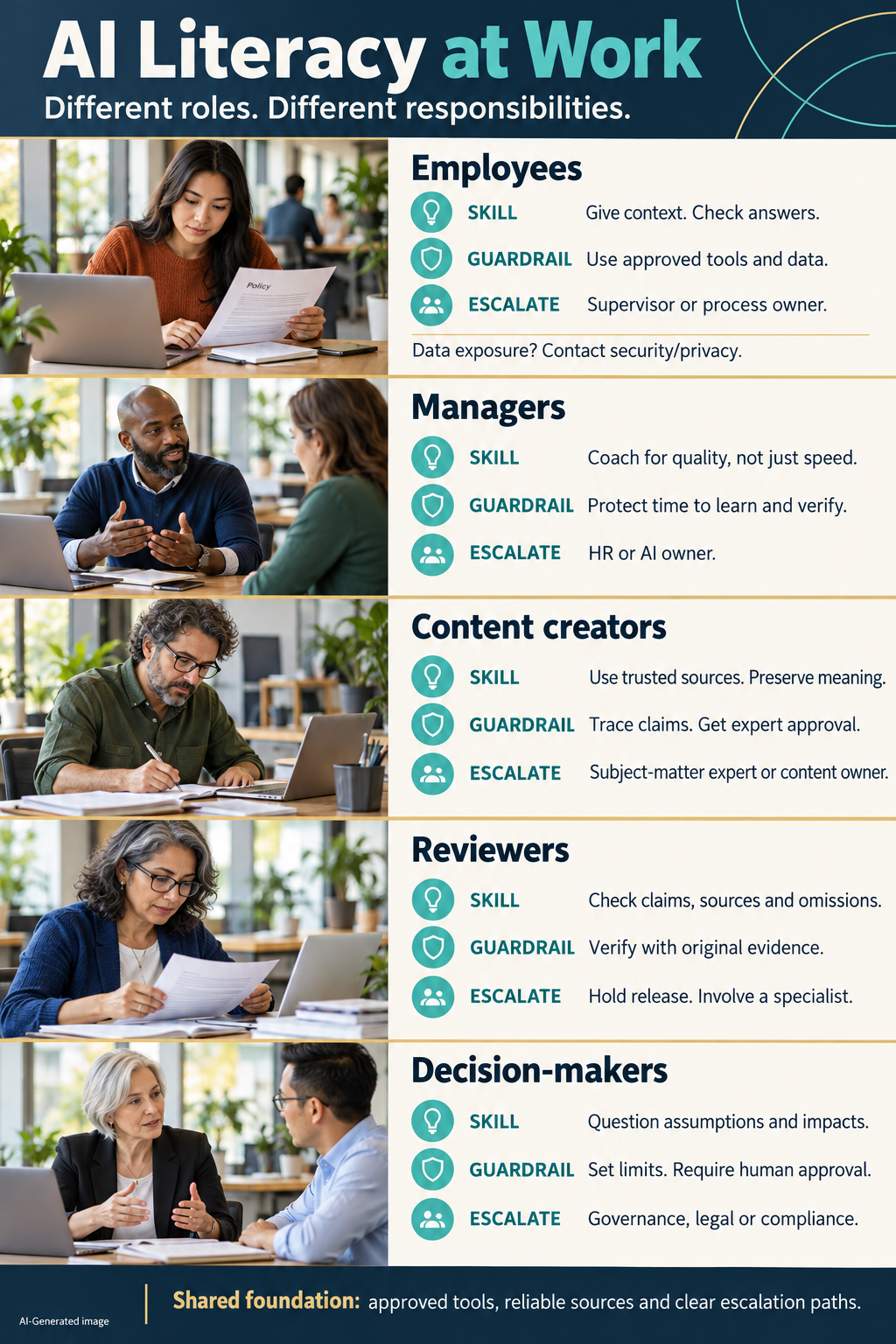
One person may occupy several of these roles. A manager who drafts, reviews, and approves a communication needs the skills for all three responsibilities.
The consequences also matter. Brainstorming newsletter headlines and recommending a change to a safety procedure require different levels of verification, even when the same person uses the same tool.
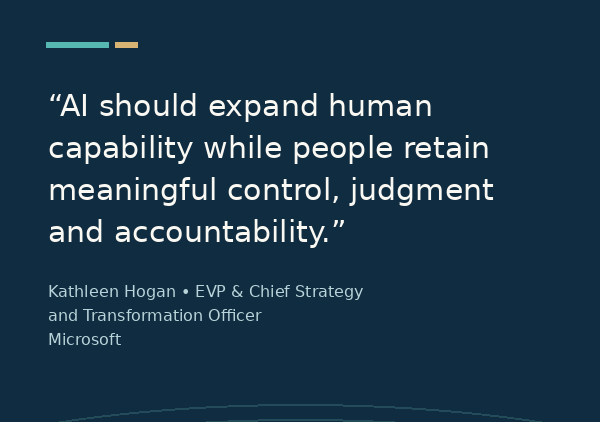
Kathleen Hogan, Microsoft’s Executive Vice President and Chief Strategy and Transformation Officer, describes the company’s AI transformation as a redesign of both workflows and responsibilities. Her account emphasizes defining what AI agents can access and do, how their actions are monitored, and when people must review, approve, or intervene. The lesson for AI literacy: teach the human responsibilities around the tool as clearly as the use of the tool itself.
“Ask your manager” is a weak escalation plan if the manager has no clearer guidance than the employee.
People need recognizable triggers: an answer conflicts with approved policy, a source cannot be verified, sensitive information may have been exposed, or a recommendation could materially affect someone’s employment, safety, or access to services.
For each trigger, identify who receives the concern, what information they need, whether the work should pause, and who can authorize it to resume. When agents can act, specify who can suspend them and review affected records. Provide a backup contact when the primary owner is unavailable.
An unsupported blog statistic might mean holding the draft and contacting the researcher. A suspected disclosure of employee information needs the organization’s security/privacy response process, without waiting for a routine editorial review.
Employees also need permission to raise concerns without being treated as obstacles to innovation. Otherwise, the escalation path may exist on paper while everyone quietly works around it.
Measure Judgment in the Workflow
A course completion record shows that someone finished a course. To understand readiness, ask them to handle a realistic situation.
Can the employee catch the incorrect customer promise? Does the reviewer identify the unsupported citation? Will the decision-maker pause when critical evidence is missing?
Support that practice with short job aids, approved examples, coaching, and refreshers when tools, permissions, or policies change. Managers should also check whether employees have access, time, and support to apply the learning. A missing permission or an overloaded schedule will not be fixed by another prompting tutorial.
Track whether errors and rework decline, concerns reach the right owner, and quality holds up as work becomes faster. An initial increase in reported concerns may reflect better recognition rather than worse performance.
AI literacy sits at the intersection of learning, documentation, knowledge management, and change. Employees need relevant practice and usable guidance. Managers and leaders need clear responsibilities and evidence that those capabilities transfer into work.
MATC helps organizations connect these foundations through learning design, technical documentation, performance support, and knowledge management. The goal is to prepare people for the responsibilities they carry when AI becomes part of the job.
AI literacy becomes useful when people can apply it where the next prompt, review, or decision actually happens.
When AI Gives the Wrong Answer, Is the Model Really the Problem?
AI Is Already at Work. Does Your Organization Actually Have a Plan for It?
Agentic AI for L&D: What It Is, and What to Govern First
“The Workforce Readiness Report: AI Edition.” Skillsoft. 6/10/26. Accessed 10/15/26. https://s3.us-east-1.amazonaws.com/skillsoft.com/prod/resources/Skillsoft-Workforce-Readiness-Report-AI-Edition-2026.pdf
“Only 1 in 4 Employees Feel Equipped for AI, Skillsoft Research Finds.” BusinessWire. 6/10/26. Accessed 10/15/26. https://www.businesswire.com/news/home/20260610613616/en/Only-1-in-4-Employees-Feel-Equipped-for-AI-Skillsoft-Research-Finds
Camp, Alex, Drew Goldstein, Laura Pineault, Holly Price, and Nicolette Rainone. “Are your people ready for AI at scale?” McKinsey & Company. 3/2/26. Accessed 10/15/26. https://www.mckinsey.com/capabilities/people-and-organization/our-insights/the-organization-blog/are-your-people-ready-for-ai-at-scale
Hogan, Kathleen. “What we’ve learned from Microsoft’s own AI transformation.” Microsoft. 9/17/26. https://blogs.microsoft.com/blog/2026/09/17/what-weve-learned-from-microsofts-own-ai-transformation