

Scientific and technical progress depends on the willingness to revise what we know. New evidence improves methods, testing reveals limitations, and experience exposes assumptions that once seemed reasonable. For organizations translating that knowledge into products, systems, and procedures, each revision creates a practical responsibility: ensuring that people understand what changed and can act on the updated information.
World Science Day for Peace and Development, observed on November 10, highlights science’s contribution to society and the importance of public engagement with scientific issues. For regulated and technical organizations, the occasion also offers an opportunity to examine how knowledge moves from expert understanding into everyday practice. Documentation governance helps preserve that connection as evidence, technology, and operational requirements evolve.
Consider a hypothetical laboratory introducing an approved software update that changes how analysts review results. The software is ready, but the standard operating procedure still shows the previous workflow, a training module uses outdated screenshots, and a locally-saved job aid describes an approval step that no longer exists. Each resource may have been accurate when created, yet together they now provide conflicting instructions.
The resulting uncertainty can spread beyond the immediate task. Analysts may follow different processes, supervisors may offer inconsistent explanations, and support teams may repeatedly resolve questions that a coordinated update could have prevented. A technical change is only as reliable as the instructions people use to carry it out. Managing that relationship requires ownership of the full information environment surrounding the change.
Documentation governance defines who owns information, who evaluates proposed changes, who authorizes release, and how updates reach affected audiences. Those responsibilities should be established before an urgent revision arrives. A content owner coordinates the lifecycle, appropriate specialists evaluate technical implications, designated approvers authorize release, and publishing or training teams prepare the resources people need.
The depth of review should reflect the consequences of error. Correcting punctuation and changing a safety-critical instruction warrant different treatment, although an apparently minor edit can still alter technical meaning. Organizations benefit from documented criteria for classifying changes, identifying reviewers, and escalating uncertainty. Review dates provide an additional safeguard, while events such as product releases, revised methods, and recurring support issues should trigger assessment when they occur.
Pharmaceutical guidance illustrates this approach. The FDA’s ICH Q10 guidance recommends evaluating proposed changes using quality risk management, drawing on relevant expert teams, and assessing results after implementation. It states that evaluation effort and formality should be “commensurate with the level of risk.” These recommendations address pharmaceutical quality systems; the broader governance lesson is to match scrutiny to potential impact.
A revision number helps distinguish documents, but users also need to understand a document’s status and applicability. An approved procedure may have a future effective date, while different equipment configurations or software releases may legitimately require different instructions. Useful version control makes those distinctions visible through clear identifiers, approval status, effective dates, revision summaries, and links to the relevant change record.
Historical information also needs deliberate treatment. Superseded versions may need to remain available for traceability, investigation, or retention purposes, with access and labeling that prevent accidental operational use. Stable links to authoritative content can reduce the circulation of detached copies, while printed materials and downloaded resources require their own distribution controls. Version history explains what changed; governance establishes who can approve it and when people should use it.
Subject matter experts provide the judgment needed to assess whether revised content is technically sound. Their contribution becomes more effective when review requests identify the proposed change, its rationale, affected passages, unresolved questions, and expected operational consequences. A focused request allows experts to examine the decisions that require their knowledge without reconstructing the entire project.
Technical accuracy may also require several perspectives. An engineer might confirm system behavior, an experienced operator might identify an impractical instruction, and a quality or regulatory specialist might recognize an additional approval dependency. Writers help reconcile those contributions and make the resulting instructions understandable. Explicit reviewer responsibilities, planned review time, and backup coverage help sustain this work, as discussed in Why Your Subject Matter Experts Are Burned Out (and How to Help).
A release announcement should explain what affected people need to do differently. Depending on the change, that explanation may include the reason for the revision, the roles or configurations affected, the effective date, required preparation, and the location of approved instructions. Communication should also address what happens to work already underway, especially when an activity may begin under one version and conclude after another becomes effective.
Different audiences will need different levels of detail. Administrators may require configuration instructions, frontline employees may need practice with a revised task, and managers may need guidance for handling exceptions. As explored in Communication Strategies for Change Management, communication becomes more useful when it addresses the audience’s actual responsibilities. Announcements, procedures, training, and support content should therefore be prepared as connected parts of the same release.
Publishing updated content establishes availability, but organizations still need evidence that the intended change took effect. Appropriate checks might include observing task performance, examining recurring questions, reviewing affected records, or confirming that obsolete instructions have been removed from active use. An acknowledgment can establish that a message was received; tasks involving significant judgment or risk may call for additional evidence of understanding and correct execution.
A related principle appears in NIST SP 800-171 Revision 3, published in 2024 for protecting controlled unclassified information in nonfederal systems and organizations. Its configuration management requirements address reviewing proposed changes, documenting approved changes, and verifying that security requirements remain satisfied after implementation. Within that specific scope, the publication reinforces the importance of evaluating both the proposed change and its implemented result.
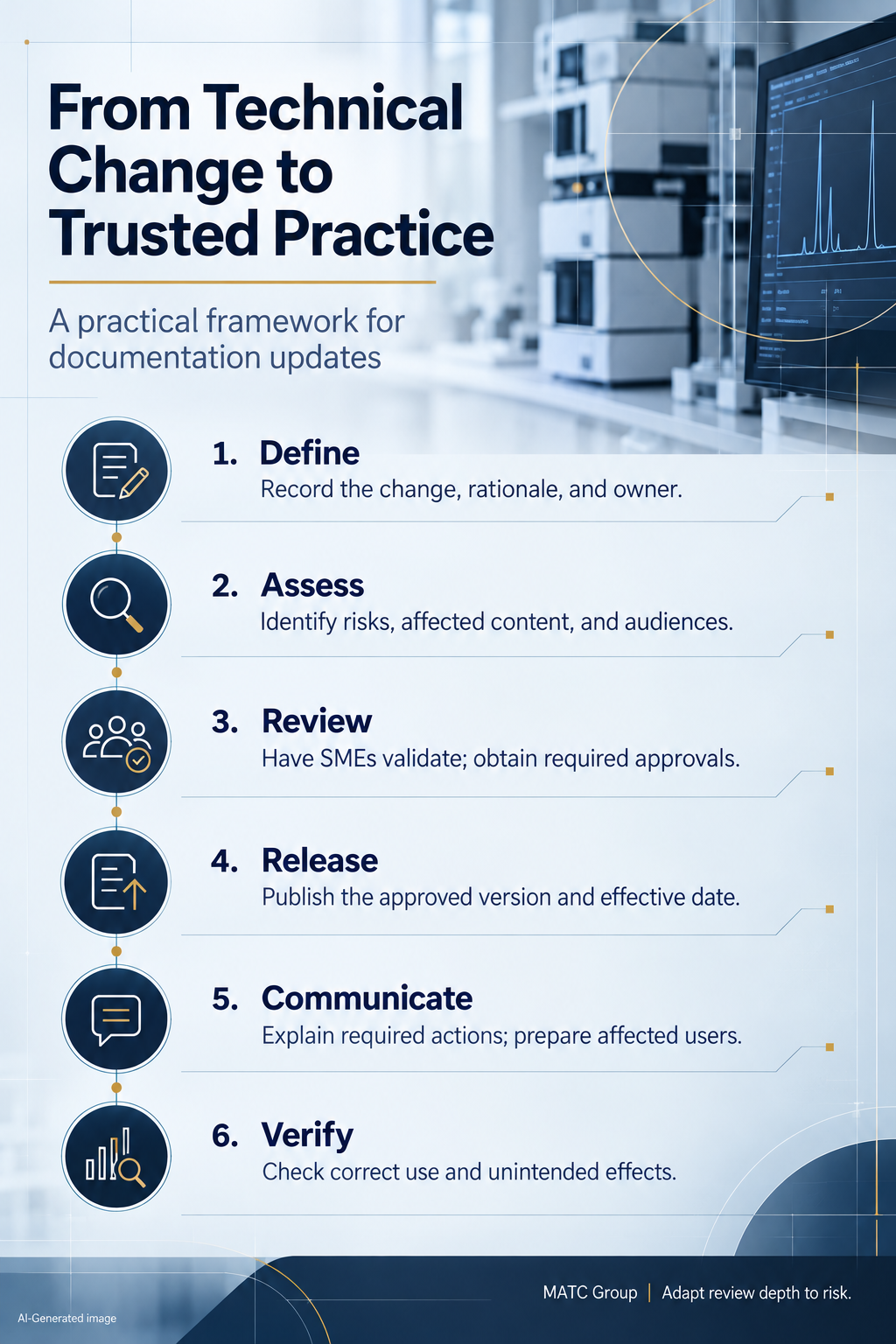
Preserve the Reasoning Behind the Revision
Future teams need to understand why a procedure changed as well as what the final wording says. Recording the evidence, assumptions, constraints, and decision rationale helps later reviewers distinguish a deliberate control from an inherited habit. It also supports continuity when experts change roles or leave, allowing their judgment to inform future decisions without depending entirely on personal recollection.
World Science Day provides a useful reminder that knowledge develops through examination and revision. Organizations honor that principle when they maintain a reliable path from new understanding to approved instructions, informed employees, and verified practice. MATC helps strengthen that path through technical writing, knowledge management, and learning resources that connect expertise with the work people perform.
How Technical Writing Drives Change Management Success
Communication Strategies for Change Management
Knowledge as a Product: How to Design Information People Will Actually Use
Why Your Subject Matter Experts Are Burned Out (and How to Help)
How Instructional Design Drives Successful Change
“Q10 Pharmaceutical Quality System.” FDA. April 2009. Accessed 10/21/26. https://www.fda.gov/regulatory-information/search-fda-guidance-documents/q10-pharmaceutical-quality-system
Ross, Ron and Victoria Pillitteri. “Protecting Controlled Unclassified Information in Nonfederal Systems and Organizations.” NIST. May 2024. Accessed 10/21/26. https://nvlpubs.nist.gov/nistpubs/SpecialPublications/800-171r3/NIST.SP.800-171r3.html
“World Science Day for Peace and Development.” UNESCO. Accessed 10/21/26. https://www.unesco.org/en/days/science-peace-development