
For many organizations, the question is no longer whether employees will use AI. They already are. A new Gartner survey offers a particularly striking example. Among internal audit leaders, 93% report some level of AI use. Yet 60% of audit functions do not have a formal AI strategy in place.
That is quite a gap.
And while Gartner’s research focuses specifically on internal audit, the underlying challenge should sound familiar to leaders across the organization: AI adoption can move much faster than the strategy, governance, learning, processes and measurement needed to support it.
Your organization may not be deciding whether to adopt AI anymore. It may be trying to catch up with the AI adoption that has already happened.
Gartner’s findings show just how uneven AI maturity can be. Only 38% of chief audit executives surveyed have an AI strategy in place, while another 39% are developing one. At the same time, about half report individualized, ad hoc use of one or more AI tools. Only 15% have implemented defined, organized AI use cases.
In other words, people are using AI. But in many cases, the organization has not yet established a consistent framework for how, where, or why it should be used. That creates a different challenge from the one that organizations faced even a few years ago.
The first phase of enterprise AI was largely about access and experimentation: Which tools should we try? What can they do? Where might they save time? The next phase requires harder questions:
Those aren’t technology questions alone. They’re strategy questions.
Experimentation is valuable. In fact, organizations need employees who are willing to test new tools and discover better ways to work. But individualized experimentation doesn’t automatically become organizational capability.
One employee may develop an excellent AI-assisted workflow while someone performing the same job uses an entirely different approach. Another may be entering information into a tool that shouldn’t receive it. Someone else may be relying on an AI-generated answer without knowing whether the underlying documentation is current. Valuable discoveries can disappear when the employee who made them changes roles or leaves.
We’ve talked before about the knowledge AI can’t see. The same principle applies to AI practices themselves: if useful approaches remain individual and undocumented, the organization can’t reliably learn from or scale them.
A strategy begins turning isolated experimentation into something the organization can actually use.
There’s another trap here.
Recognizing that AI needs a strategy does not mean organizations should spend the next year developing an enormous governance document while the technology—and employees—keep moving.
A useful AI plan can start with a few practical decisions:
That last point may be particularly important.
Gartner found that 54% of the audit leaders surveyed have not yet started measuring ROI from their use of AI. Not every AI benefit fits neatly into a financial calculation. Gartner acknowledges that some benefits are qualitative or non-financial. But organizations still need some way to distinguish useful AI adoption from AI activity.
That’s especially important as spending increases. In separate Gartner research released earlier this month, only 22% of organizations said they had successfully scaled AI across multiple business units or adopted an AI-first approach, even as 85% of functional leaders planned to increase AI spending in 2026.
The same study found that the most popular AI use cases frequently aren’t the ones producing the highest returns. That reinforces a point we’ve made before when discussing value versus feasibility: a compelling AI idea isn’t automatically the right AI investment. Strategy gives organizations a way to choose.
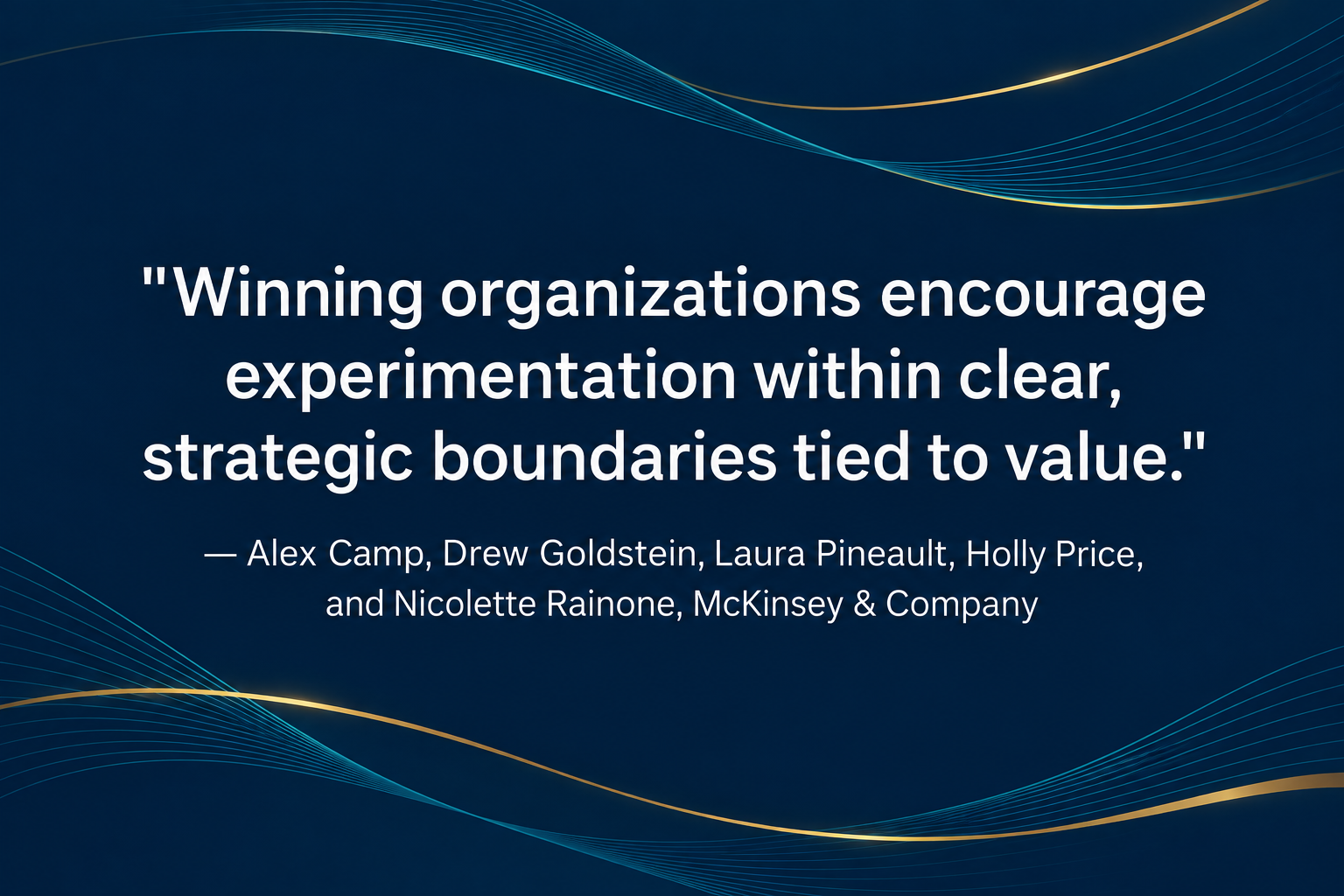
Alt text: Dark navy quote card with teal and gold flowing lines and white text: “Winning organizations encourage experimentation within clear, strategic boundaries tied to value.” — Alex Camp, Drew Goldstein, Laura Pineault, Holly Price, and Nicolette Rainone, McKinsey & Company
AI adoption is moving quickly enough that waiting for a perfect strategy isn’t realistic. But neither is allowing adoption to expand indefinitely without one.
Organizations need a middle ground: enough structure to establish priorities, protect information, support employees, capture what works and measure results—without creating so much bureaucracy that experimentation stops.
The goal isn’t to control every AI interaction, but to make sure individual experimentation can eventually become organizational capability. AI is already at work. The question now is whether your organization has a plan for turning all that activity into something useful.
An effective AI strategy isn’t only about selecting technology. It depends on the systems surrounding it: clear processes, reliable documentation, accessible organizational knowledge, effective learning, thoughtful governance and employees who understand both what AI can do and where human judgment still matters.
MATC helps organizations strengthen those foundations, identify gaps and turn emerging ways of working into repeatable, sustainable practices.
If AI adoption is already happening in your organization, you don’t have to start from scratch. You may simply need to turn what people are already learning into a strategy.
AI Adoption Is Growing. So Why Isn’t the Value?
Managing AI Isn’t Managing Software
The Knowledge AI Can’t See (But Your Organization Runs On)
Camp, Alex, Drew Goldstein, Laura Pineault, Holly Price, and Nicolette Rainone. “Are your people ready for AI at scale?” McKinsey. 3/2/26. Accessed 10/2/26. https://www.mckinsey.com/capabilities/people-and-organization/our-insights/the-organization-blog/are-your-people-ready-for-ai-at-scale
“Gartner Survey Finds 93% of Audit Functions Use AI, but 60% Lack a Formal Strategy.” 9/10/26. Accessed 9/14/26. https://www.gartner.com/en/newsroom/press-releases/2026-09-10-gartner-survey-finds-93-percent-of-audit-functions-use-ai-but-60-percent-lack
“Gartner Survey Finds Only 22% of Organizations Have Successfully Scaled AI Across Multiple Business Units.” Gartner. 9/1/26. Accessed 9/14/26. https://www.gartner.com/en/newsroom/press-releases/gartner-survey-finds-only-22-percent-of-organizations-have-successfully-scaled-ai-across-multiple-business-units