Artificial intelligence is getting better at showing its work.
Many of today’s AI tools can explain how they arrived at a recommendation, identify the information they used, or even walk users through their reasoning. Developers call this explainable AI, and it’s widely viewed as an important step toward building trust in AI-powered decisions.
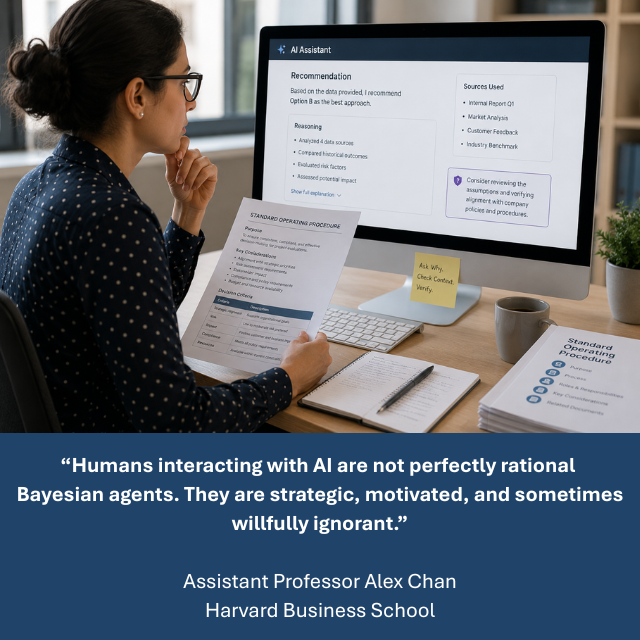
But recent research highlighted by Harvard Business Review suggests the bigger challenge isn’t whether AI can explain itself. It’s whether people will take the time to ask. The researchers found that people often avoid reviewing AI’s reasoning when doing so could make a decision more complicated or force them to think more critically.
On the surface, that seems like a technology problem. It’s actually a workplace culture problem. Organizations invest heavily in AI platforms, governance policies, and prompt libraries. Those investments matter. But if employees automatically accept AI recommendations without questioning them, the organization hasn’t improved decision-making. It has simply made it faster.
As AI becomes part of everyday work, one skill is becoming even more valuable than prompt engineering: Critical thinking. Employees shouldn’t be expected to distrust AI, but they should be encouraged to verify what it tells them. That means asking questions like:
Asking these questions them helps prevent mistakes before they happen, saving project time in the long run.
This is where documentation, learning, and knowledge management make the biggest difference.
Together, these disciplines create something every organization needs: Employees who know when to trust AI and when to ask another question.
One of the researchers behind the Harvard Business Review article observed that the greatest risk isn’t simply inaccurate AI recommendations. It’s that people stop asking why those recommendations were made. That’s an important distinction.
Technology alone won’t create better decisions. Organizations also need systems that encourage curiosity, reinforce critical thinking, and make institutional knowledge easy to access. The goal is to create employees who know how to work with AI and not blindly trust it. Because in the age of AI, the most valuable workplace question may still be the simplest one: “Why?”
AI can improve productivity, but only when it’s supported by strong documentation, effective learning experiences, and accessible organizational knowledge. MATC helps organizations build those foundations so employees can use AI thoughtfully, make informed decisions, and adapt confidently as technology continues to evolve.
How AI Got Us into Swordsmithing (and Other Tales of AI Mishaps)
From LMS to Learning Ecosystem
Soft Skills: The Secret Weapon for Career Success
Rand, Ben. “Employees Aren’t Questioning AI Advice Enough.” Harvard Business Review. 6/24/26. Accessed 7/7/26. https://hbr.org/2026/06/employees-arent-questioning-ai-advice-enough
“What is explainable AI?” IBM. 2/26/26. Accessed 7/7/26. https://www.ibm.com/think/topics/explainable-ai