
This is the 12th and final post in our Change Management Series.
Change management is often treated like a project plan with a start and end date. A rollout happens. Training is delivered. Documentation is published. Then everyone hopes things settle.
But high-performing organizations understand something different: change isn’t an event. It’s an environment.
That distinction matters because today’s workplace is saturated with transition. The average employee now experiences roughly ten planned change initiatives each year. That’s five times more than just a decade ago. Change will be part of everyday work for the foreseeable future.
Yet many organizations are not structurally prepared for that reality. Research from O.C. Tanner shows that only 27% of leaders believe they are strongly prepared to help their employees navigate change. At the same time, Chief Human Resources Officers (CHROs) list embedding change as a routine rather than a disruption as a top priority for 2026. The gap between intention and readiness is real.
The goal, then, isn’t to simply “get through” change. It’s to build a culture that expects it, understands it, and moves through it with confidence. That kind of culture does not happen by accident. It’s built deliberately through clear communication, continuous learning, and the systems that support people every day.
A change-ready organization does not panic every time a new tool, process, or strategy appears. People may not love every change, but they are not destabilized by it. That readiness comes from consistency in how change is handled.
In change-ready cultures:
When that structure exists, change accelerates instead of stalling. Organizations that use structured training for change management achieve 50% faster time-to-value compared to those that do not. Structure is not bureaucracy. It is momentum.
Over time, employees learn an important lesson: change is not chaos. It is a structured process supported by information, training, and leadership.
That expectation reduces resistance before it starts.

Cultures that handle change well share several traits:
When documentation, SOPs, and process guides are part of everyday operations, change does not introduce a completely new behavior. It builds on existing habits. People already know where to look for answers.
Clarity reduces friction. It shortens ramp-up time. It minimizes the informal workarounds that slow adoption and create inconsistency.
In reactive environments, training appears only when something goes wrong. In change-ready environments, learning is ongoing. Skill development, refreshers, and updates are normal parts of work.
This approach is not just supportive. It is measurable. Organizations see up to a 34% increase in employee performance when change is embedded as a routine rather than treated as a disruption. Continuous training makes adaptation part of the job, not an interruption to it.
Employees trust they will be supported as expectations evolve. That trust builds confidence.
When leaders encourage questions and feedback, uncertainty becomes part of improvement rather than a sign of failure.
This matters more than many leaders realize. When employees have a voice in organizational changes, they are three times more likely to thrive at work. Voice creates ownership and ownership reduces resistance.
Employees adapt more easily when they understand how change supports customers, efficiency, safety, or growth.
Purpose reduces emotional resistance because it answers the unspoken question: “Why should I invest energy in this?” When leaders consistently connect change to meaningful outcomes, adaptation feels aligned rather than imposed.
One of the biggest myths in change management is that stability means success. In reality, stability often means stagnation.
Organizations that thrive long-term build learning into their culture:
This ongoing adaptation prevents each new change from feeling like a shock. Instead, it becomes part of a familiar cycle: introduce, learn, refine, improve.
When learning is embedded, change stops feeling like disruption and starts functioning as capability. Capability compounds. Each well-managed change makes the next one easier.
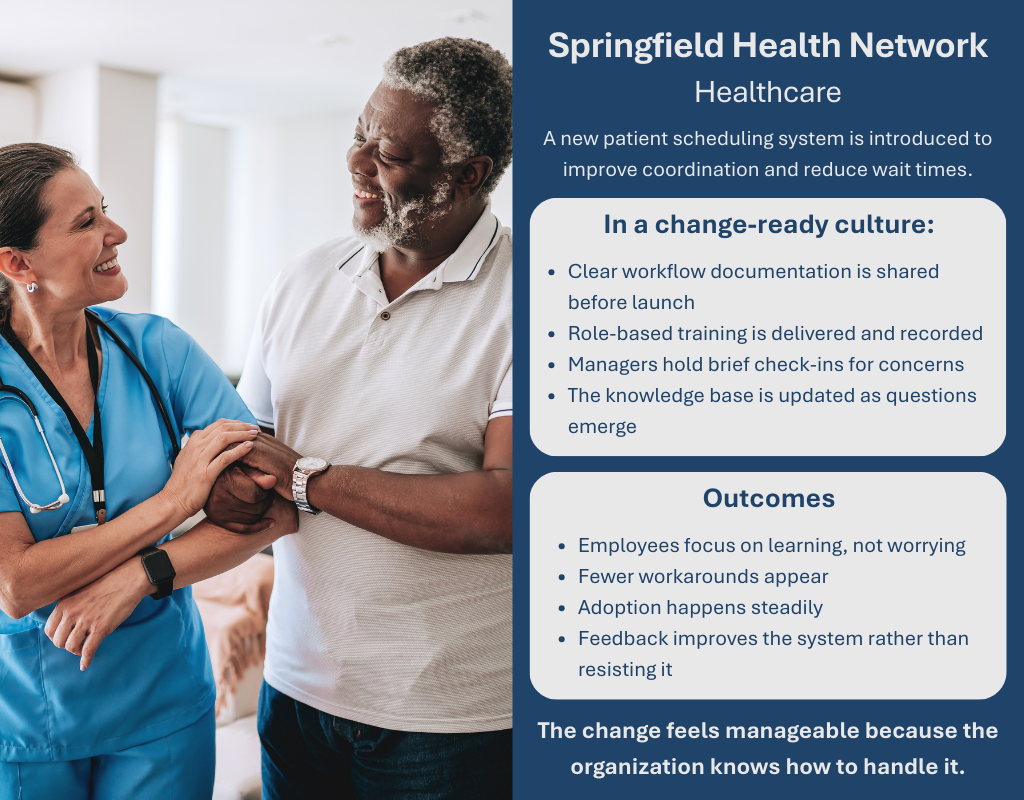
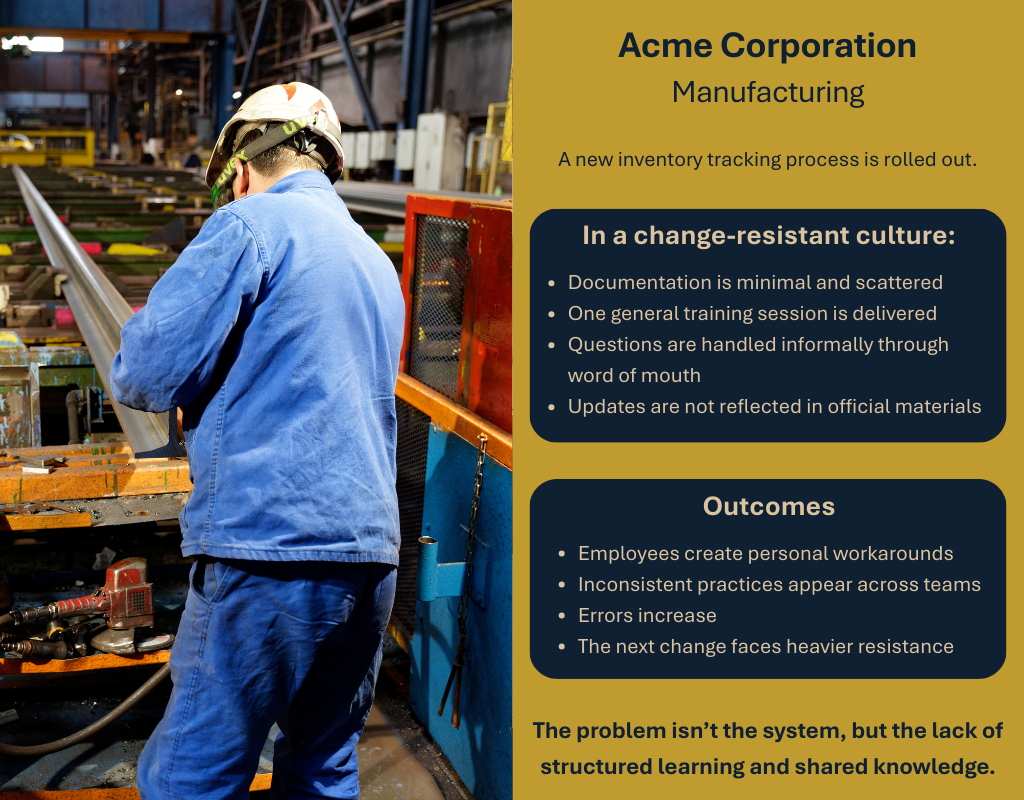
A change-ready culture prevents confusion from becoming the default response. Performance improves when clarity replaces guesswork and learning replaces anxiety. Resilient organizations build the systems and shared knowledge needed to navigate the changes in the modern business world. That is the difference between reacting to change and being ready for it.
Change Management: Why We Can’t Just Wing It (No. 1)
The Key Players in Change Management (No. 2)
From Chaos to Clarity: Which Change Plan Fits Your Business? (No. 3)
How Technical Writing Drives Change Management Success (No. 4)
How Instructional Design Drives Successful Change (No. 5)
The Importance of Training in Change Management (No. 6)
Knowledge Management’s Role in Change (No. 7)
Communication Strategies for Change Management (No. 8)
Measuring the Success of Change Management (No. 9)
Overcoming Common Challenges in Change Management (No. 10)
Scenarios in Change Management: What Success (And Failure) Teaches Us (No. 11)
References
“40 Change Management Quotes to Inspire the Entire Team.” Indeed. 11/19/25. Accessed 3/5/26. https://ca.indeed.com/career-advice/career-development/change-management-quotes