7 Ways to Build Engagement Without Relying on “Office Energy”

In traditional offices, engagement often happened naturally through “office energy”: You overheard conversations, recognized colleagues in the hallway, and gained context just by being present.

Remote and hybrid work remove those ambient clues. Employees can feel disconnected or unseen if organizations try to rely on the same in-office strategies. This is where a remote- or hybrid-first mindset comes in, one that prioritizes clarity, communication, and equitable access to information.

1. Build a Clear and Predictable Communication Framework

Remote teams depend on clarity to function well. Yet research indicates that 20% of remote workers identify communication and collaboration as their biggest challenges. One way to address this is by creating a predictable communication framework. When expectations around communication are clear and consistent, employees feel more confident navigating their roles and responsibilities. (See Communication Strategies for Change Management.)

Best practices:
  • Set expectations for response times, communication channels, and meeting cadence.
  • Use asynchronous tools like shared dashboards and status boards so no one feels “out of the loop.”
  • Keep one-on-one check-ins consistent, even if short.
  • Create communication guidelines that everyone can access.

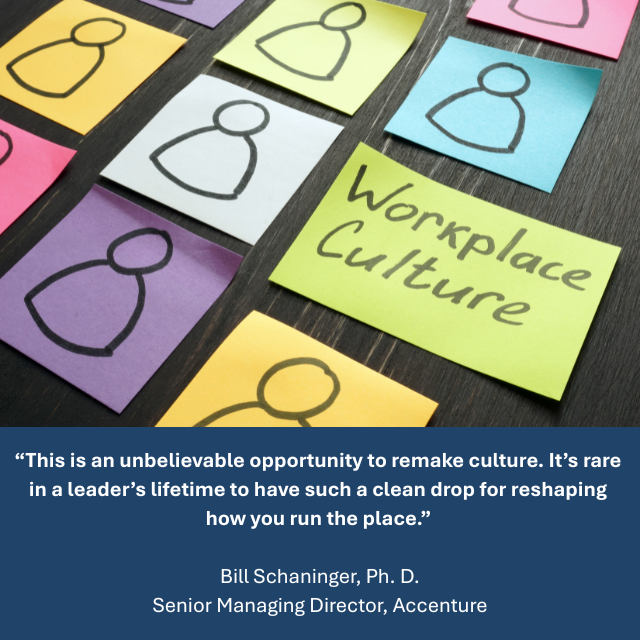
Several sticky notes of different colors with a person silhouette drawn on each, plus one that reads, “Workplace Culture.” Caption reads: “This is an unbelievable opportunity to remake culture. It’s rare in a leader’s lifetime to have such a clean drop for reshaping how you run the place.” -Bill Schaninger, Ph. D., Senior Managing Director, Accenture

2. Foster a Remote-First or Hybrid-First Culture

Trying to copy-and-paste office culture into Zoom land never works. Instead, build rituals and collaboration habits that make sense for distributed teams.  (See How Documentation Anchors Distributed Teams (And Keeps Us from Drifting into Chaos).)

Examples that work:

  • Virtual water-cooler channels for hobbies or casual conversation
  • Digital recognition boards
  • Scheduled social moments such as “five-minute coffee chats”
  • Team norms around cameras, meeting etiquette, and availability

3. Prioritize Well-Being and Work-Life Boundaries

When the home and office share the same walls, boundaries disappear fast. Burnout becomes invisible until it’s severe, especially for high performers or caregivers. Remote work wellbeing matters: Globally, 57% of fully remote workers are actively looking or passively watching for new job opportunities, but that drops to 38% for fully engaged and thriving remote workers.(See Leading Through Uncertainty: The New Core Competency.)

Ways to support well-being:
  • Encourage employees to set work hours and stick to them.
  • Avoid after-hours messages or weekend “quick asks.”
  • Normalize flexibility when life gets loud.
  • Offer mental health and well-being resources.
  • Use meeting-free blocks to reduce digital fatigue.

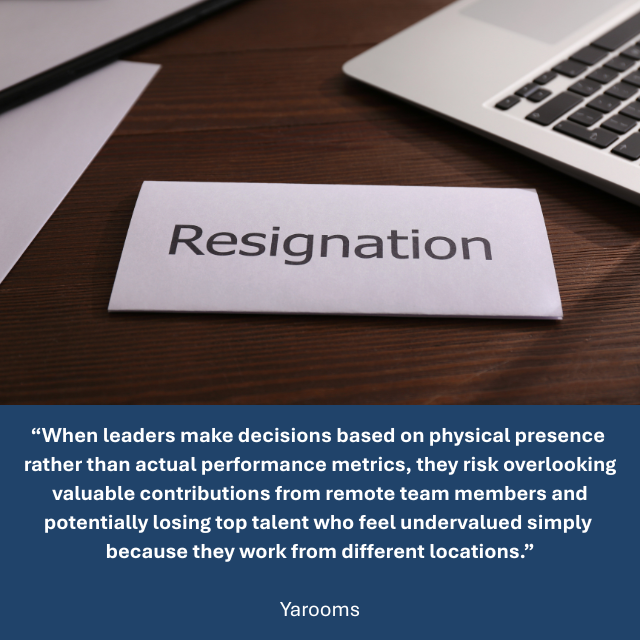
Folder letter with “Resignation” typed on it sitting on a desk. Caption reads: “When leaders make decisions based on physical presence rather than actual performance metrics, they risk overlooking valuable contributions from remote team members and potentially losing top talent who feel undervalued simply because they work from different locations.”

4. Make Development and Recognition Equitable

One of the biggest risks in hybrid environments is the creation of an “office advantage.” If recognition and opportunities skew toward the people who happen to be physically visible, remote employees disengage quickly. (See Reskilling & Upskilling for 2026: what Professionals Should be Ready For.)

To create equity:

  • Provide virtual-first learning and development options.
  • Make career paths and advancement criteria explicit.
  • Use structured recognition systems that reach the entire team.
  • Ensure performance conversations focus on output and outcomes, not visibility.

5. Redesign the Purpose of the Office

Hybrid work isn’t just “sometimes at home, sometimes at the office.” High-performing organizations intentionally design what office time is for. Think of in-office days as collaboration accelerators.

Examples include:

  • Project kickoffs.
  • Strategy sessions.
  • Innovation workshops.
  • Team-building or mentoring moments.
  • Cross-functional problem solving.

If employees are coming in only to sit on Zoom calls, the office becomes a friction point instead of an engagement tool. (See Redesigning the Purpose of the Office: Why Hybrid Work Requires Intentional In-Person Time.)
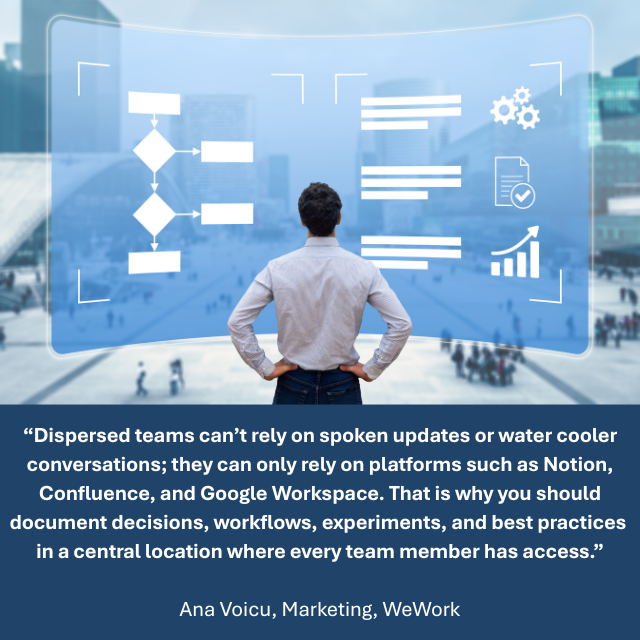
Person looking at large screen showing a workflow and documents. Caption reads: “Dispersed teams can’t rely on spoken updates or water cooler conversations; they can only rely on platforms such as Notion, Confluence, and Google Workspace. That is why you should document decisions, workflows, experiments, and best practices in a central location where every team member has access.” –Ana Voicu, Marketing, WeWork

6. Strengthen Knowledge Management and Documentation Practices

Engagement rises when employees know where to find answers.

Distributed workforces need:

  • A well-organized knowledge base.
  • Documented workflows and SOPs.
  • Searchable systems.
  • Consistent structure and naming conventions.
  • Clear ownership of content updates.

Knowledge should be available without asking a coworker, reducing frustration and preventing bottlenecks. (See The Science of Employee Motivation: Why Documentation Matters More than You Think.)

7. Modernize Your Tools and HR Systems

Remote and hybrid engagement depend heavily on having the right digital ecosystem.

Tools that support engagement:

  • Collaboration platforms.
  • Knowledge bases.
  • Project management systems.
  • Digital recognition apps.
  • Chat tools with dedicated social channels.
  • Self-service HR portals.

Don’t focus on more tools. Instead, ensure your tools work together so employees easily stay connected and supported. (See The Digital Ecosystem that Makes Remote and Hybrid Engagement Work.) 

How Engagement Has Shifted From the In-Office Era

A quick comparison helps highlight why the approach must evolve.
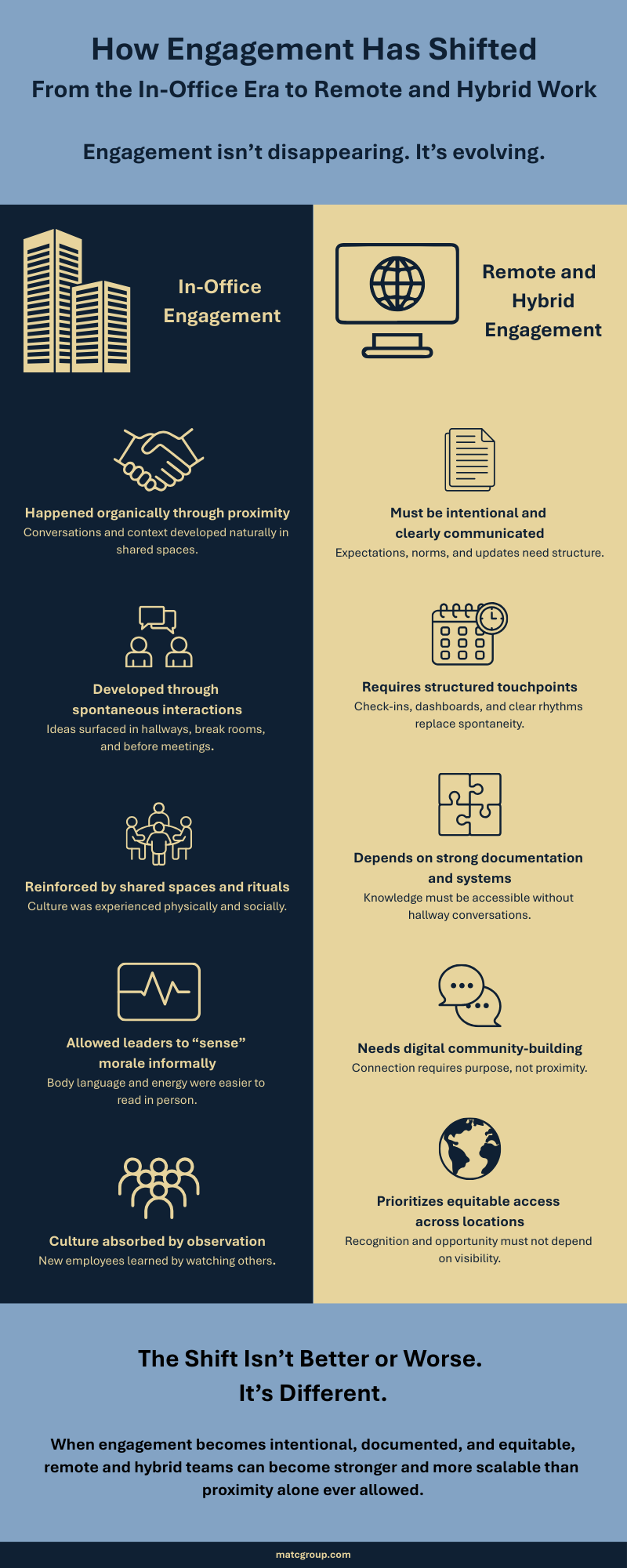
Infographic. How Engagement Has Shifted: From the In-Office Era to Remote and Hybrid Work. Engagement isn't disappearing. It's evolving. In-Office Engagement: Happened organically through proximity; conversations and context developed naturally in shared spaces. Developed through spontaneous interactions; ideas surfaced in hallways, break rooms, and before meetings. Reinforced by shared spaces and rituals; culture was experienced physically and socially. Allowed leaders to "sense" morale informally; body language and energy were easier to read in person. Culture absorbed by observation; new employees learned by watching others. Remote and Hybrid Engagement: Must be intentional and clearly communicated; expectations, norms, and updates need structure. Requires structured touchpoints; check-ins, dashboards, and clear rhythms replace spontaneity. Depends on strong documentation and systems; knowledge must be accessible without hallway conversations. Needs digital community-building; connection requires purpose, not proximity. Prioritizes equitable access across locations; Recognition and opportunity must not depend on visibility. The shift isn't better or worse. It's different. When engagement becomes intentional, documented, and equitable, remote and hybrid teams can become stronger and more scalable than proximity alone every allowed."

Where Leaders Should Start

If improving engagement feels overwhelming, begin with these steps:

  1. Audit your communication rhythms.
  2. Create a remote/hybrid culture guide.
  3. Document your processes.
  4. Modernize your tool ecosystem.
  5. Review your recognition and development systems for equity.
  6. Re-evaluate the purpose of your office space.
  7. Train managers in remote-first leadership.

Remote and hybrid work aren’t temporary states. They represent a long-term shift in how humans work, communicate, and create. Engagement in this environment needs strategy, consistency, and strong knowledge practices. When done well, organizations can build teams that feel connected, supported, and aligned no matter where they sit.

 
Related Blogs

How Technical Writing Drives Change Management Success

Modern Training: The Key to Employee Engagement and Company Growth

Overcoming Common Challenges in Change Management

 
References

Hancock, Brian, Bill Schaninger, and Brooke Weddle. “Culture in the hybrid workplace.” McKinsey & Company. 6/11/21. Accessed 3/2/26. https://www.mckinsey.com/capabilities/people-and-organizational-performance/our-insights/culture-in-the-hybrid-workplace

“Proximity Bias in the Workplace? 96% of Executives Notice.” YAROOMS. 1/14/25. Accessed 3/2/26. https://www.yarooms.com/blog/proximity-bias-in-the-workplace

Voicu, Ana. “All about distributed teams — and how to make them work.” WeWork. 1/19/26. Accessed 3/2/26. https://www.wework.com/ideas/research-insights/all-about-distributed-teams-and-how-to-make-them-work

Privacy Overview

This website uses cookies so that we can provide you with the best user experience possible. Cookie information is stored in your browser and performs functions such as recognising you when you return to our website and helping our team to understand which sections of the website you find most interesting and useful.