Knowledge management has always been about helping people find and use what an organization knows. In an AI-enabled workplace, that job becomes more urgent.
AI can summarize, retrieve, recommend, and generate. It cannot reliably determine whether a buried procedure is outdated, whether two policy versions conflict, or whether the person who knows how work actually gets done is about to retire. Those are knowledge-management problems—and they are still very human ones.
McKinsey’s 2026 global survey found that nearly nine in ten respondents use AI regularly in at least one business function, while 44% say AI is scaling across their enterprise. Yet only 37% report a positive effect on Earnings Before Interest and Taxes (EBIT). That gap matters.
The organizations that get more from AI are not simply adding tools to existing work. They are improving the knowledge, workflows, governance, and decision-making that surround those tools.
A modern knowledge-management approach can be organized around four connected practices.
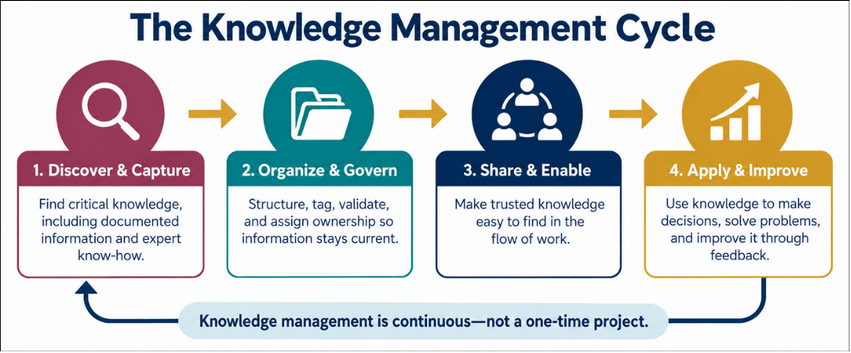
Start with the knowledge people need to do work well—not just the documents that already happen to exist.
That includes:
This is especially important when experienced employees change roles or leave. If a team’s answer to an important question is “Ask Pat,” the organization has identified a knowledge risk. Pat may be wonderful, but Pat should not be the entire system.
Capture knowledge in usable formats. A ten-page document may be appropriate for a complex process; a concise checklist, decision tree, short video, or searchable FAQ may be better for a routine task. The right format is the one that helps someone act correctly when they need it.
Information that cannot be found, understood, or trusted is not doing much work for anyone.
A strong knowledge-management program gives important content a home, a structure, and an owner. That means agreeing on practical standards for titles, metadata, naming conventions, version control, access, and review cycles. It also means identifying who is responsible for keeping high-value content current.
The goal is not bureaucracy for its own sake. It is confidence.
Employees should be able to tell:
Those details also matter for AI. An AI assistant connected to disorganized, duplicate, or outdated content may provide an answer quickly—but “quickly” is not the same as “correctly.”
Knowledge sharing is not a once-a-year cleanup project. It should be part of how people work.
Make critical knowledge easy to access where work happens: in a knowledge base, within a workflow tool, through embedded performance support, or through a well-designed AI search experience with clear links back to approved source material.
That does not mean publishing every file ever created. More content can make finding the right content harder. Focus on the information people repeatedly need to make decisions, complete work, solve problems, serve customers, and onboard others.
Encourage employees to contribute what they learn—but give them a clear process for doing so. A simple submission path, editorial review, and feedback loop are far more useful than asking everyone to “share more knowledge” and hoping for the best.
Knowledge management succeeds when it improves performance.
Use knowledge to make decisions, reduce rework, support change, improve customer experiences, and help people work independently. Then pay attention to where the system breaks down.
Useful questions include:
This step turns knowledge management into a continuous practice rather than a digital filing cabinet with a nice search bar.
That is particularly important as organizations expand AI use. McKinsey found that high-performing organizations are more likely to redesign workflows around AI, rather than simply insert AI into existing ways of working. The same principle applies to knowledge.
AI does not replace knowledge management. It raises the stakes.
When knowledge is current, structured, owned, and easy to find, people can work with more confidence—and AI tools have a stronger foundation to support them. When it is inconsistent or trapped in silos, AI can spread confusion at a much more efficient pace.
The most practical place to begin is also the least glamorous: identify the knowledge that matters most, make it trustworthy, and improve it continuously. That work supports employees today and creates a much better foundation for whatever technology comes next.
MATC helps organizations capture critical knowledge, improve documentation, strengthen information architecture, and create learning and performance-support resources people can actually use. We can also help identify the knowledge, workflow, and change-management work that should happen before—or alongside—an AI initiative.
Related Blogs
AI Adoption Is Growing. So Why Isn’t the Value?
Knowledge as a Product: How to Design Information People Will Actually Use
Every Organization Has a Dave (Until Dave Retires)
Reference
“The state of AI in 2026: On the road to ROI.” McKinsey. 8/25/26. Accessed 9/15/26. https://www.mckinsey.com/capabilities/quantumblack/our-insights/the-state-of-ai