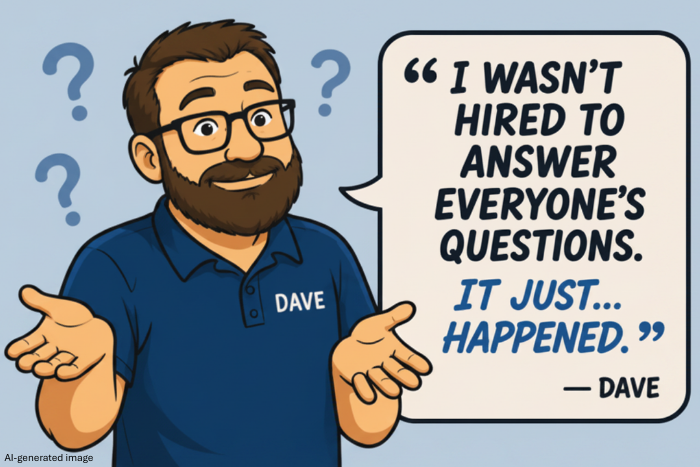
“Hey Dave, where’s the latest SOP for the packaging line?”
“Dave, why does the inventory report always look weird on the first Monday of the month?”
“Yo, Dave! Which customer insists we ship everything upside down?”
“Hi Dave. The system says this error should never happen. It happened.”
“How ya doin’ Dave…do you have a minute?”
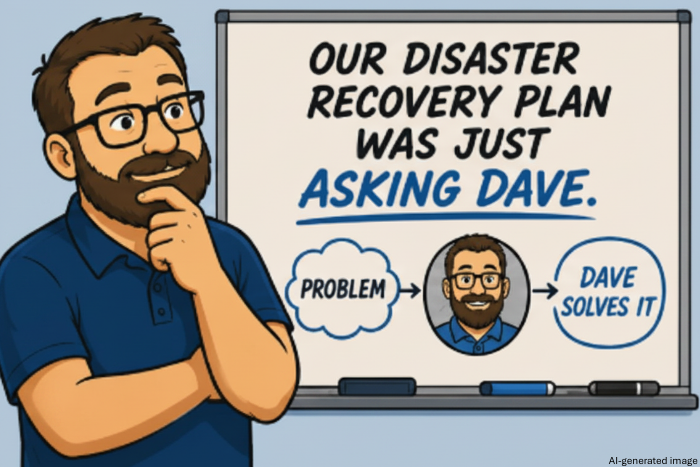
Of course Dave has a minute. Dave always has a minute.
In fact, if someone conducted a scientific study of office productivity, they’d probably discover that Dave answers somewhere between 73 and 4,000 questions every day. (The exact number depends on whether it’s Monday.)
Every organization has a Dave. Sometimes Dave is named Susan. Or Carlos. Or Priya. Or Seamus. The point is that every company has at least one person who somehow knows everything:
They’re also one retirement announcement, promotion, vacation, or unexpected departure away from taking decades of institutional knowledge with them. That’s why critical knowledge transfer has become one of the most important components of future-proofing an organization.
When people hear “knowledge transfer,” they often picture someone handing over a binder, recording a few training videos, or sharing a folder full of documents. That’s certainly part of it. But the real challenge isn’t transferring documents, it’s transferring the judgment and experience behind the decisions. Maybe it’s knowing that the standard procedure works…except when Mr. Smith places an order on Thursdays. Or remembering why a process changed three years ago, even though nobody updated the documentation. That’s the kind of information Dave somehow just…knows.
This type of expertise, often called tacit knowledge, can’t simply be downloaded like a software update. It needs to be intentionally captured before it disappears.
Organizations spend enormous amounts of money preparing for the future – investing in AI, modernizing technology, strengthening cybersecurity, and automating workflows. These are all worthwhile investments.
But none of those initiatives succeed if the organization’s knowledge exists only inside Dave’s head. AI can’t retrieve information that was never documented, automation can’t replicate expertise that no one has explained, and new employees can’t learn processes that have never been written down.
Adopting new technology is just one part of future-proofing. One of the most critical components of future-proofing is ensuring your organization’s knowledge survives long enough to use it.
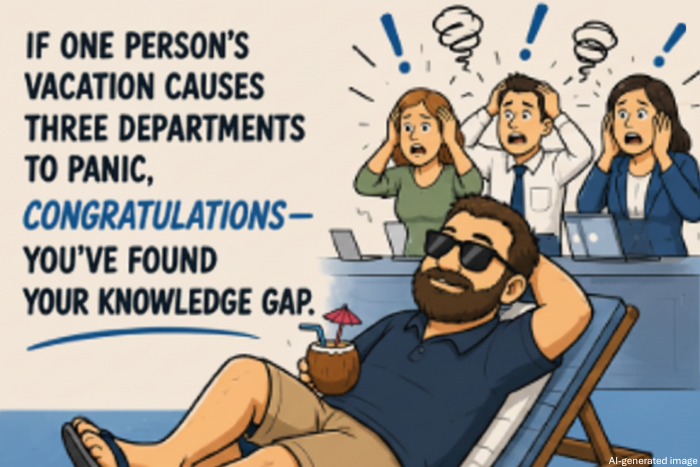
Let’s be honest: “We’ll ask Dave” is not actually a knowledge management strategy, it just feels like one. Organizations can operate successfully for years because Dave always has the answer. Then one day Dave announces he’s retiring. Suddenly everyone realizes they have approximately three weeks to download thirty years of experience.
Spoiler alert: that rarely goes well. Knowledge transfer shouldn’t begin during someone’s farewell lunch. It should be part of everyday work.
Unfortunately, Dave isn’t unusual. According to a 2026 Deloitte Insights report, 92% of organizations fail to consistently capture knowledge from retiring employees. In other words, most companies don’t realize how much they depend on Dave until Dave starts cleaning out his desk.
Not every piece of information needs the same level of documentation. Instead of trying to document everything, identify the knowledge that would cause the biggest disruption if it disappeared tomorrow. That’s more important than it may sound. A 2024 analysis found that 42% of institutional knowledge is unique to individual employees, meaning nearly half of an organization’s expertise may exist nowhere else. Identifying those knowledge holders is one of the first steps toward reducing organizational risk. Ask questions like:
If your immediate answer to several of those questions is “Dave,” you’ve found your highest-priority knowledge transfer opportunity.
One of the biggest mistakes organizations make is treating documentation as something that happens after the work is finished. In reality, the best documentation happens while the work is happening:
Every “Hey Dave…” conversation is probably documentation waiting to happen.
Today’s AI-powered search tools and intelligent knowledge bases make finding information easier than ever. That’s fantastic, provided the information actually exists. If documentation is outdated, incomplete, or scattered across twenty-three shared folders named “Final_Final_v7_REAL,” AI simply helps people find bad information faster. Technology works best when organizations first establish consistent documentation practices, clear governance, and reliable knowledge management.
Think of AI as an incredibly fast librarian. It still needs books on the shelves.
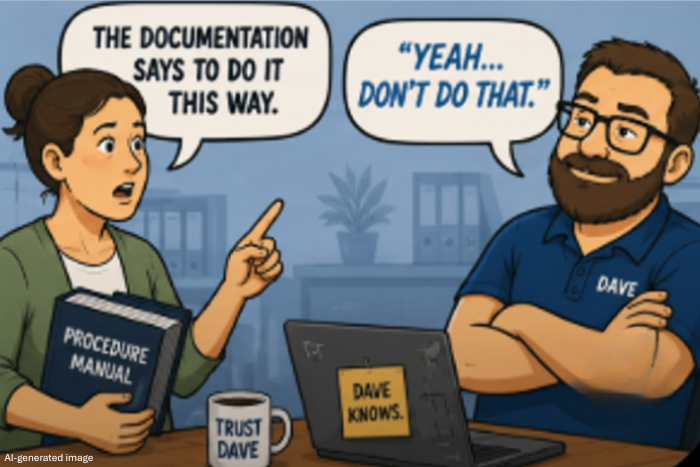
Dave is wonderful. He deserves recognition, respect, and the first choice of donuts in the break room every Friday. What he doesn’t deserve is being the company’s unofficial backup server for institutional knowledge.
Healthy organizations encourage mentoring, cross-training, collaborative documentation, after-action reviews, and continuous knowledge sharing. Instead of rewarding people for being the only person who knows something, they reward people for making sure others know it too. That’s how organizations become resilient instead of dependent.
Many experienced employees take pride in being indispensable. A better legacy is leaving behind an organization that continues to thrive because of everything you shared. The strongest organizations don’t lose knowledge every time someone changes roles. They gain knowledge after every project, improve documentation after every lesson learned, and continuously strengthen their organizational memory.
While you can’t predict every challenge ahead, future-proofing ensures that when the next challenge arrives no one has to begin the meeting by saying, “Does anyone have Dave’s phone number?”
At MATC, we help organizations capture, organize, and preserve critical knowledge through technical documentation, knowledge management, learning strategy, and AI-ready content that keeps expertise available long after the experts have moved on.
How to Capture Institutional Knowledge Before It Walks Out the Door
The Knowledge AI Can’t See (But Your Organization Runs On)
What Happens When Knowledge Isn’t Documented? Lessons From Aviation for Knowledge Management
Cahana, Eyal and Evan Siegel. “The $9 trillion knowledge exodus: How organizations can turn baby boomer retirements into a competitive advantage.” Deloitte. 6/18/26. Accessed 7/7/26. https://www.deloitte.com/us/en/insights/topics/talent/knowledge-management-plan.html
“Employee Turnover Knowledge Loss: Costs & Prevention 2026.” KS-Agents. 2026. Accessed 7/7/26. https://ks-agents.com/blog/strategic-analysis-knowledge-loss-employee-turnover