Q: We’re moving to a new LMS. Can we migrate the courses now and clean up the tags and categories later?
A: You can. You can also move house without labeling the boxes. Just don’t expect to find the coffee maker on Monday morning.
An LMS migration moves content. Good organization helps people use it. If employees can’t find the right course—or tell whether it’s current—a shiny new platform won’t solve the problem.
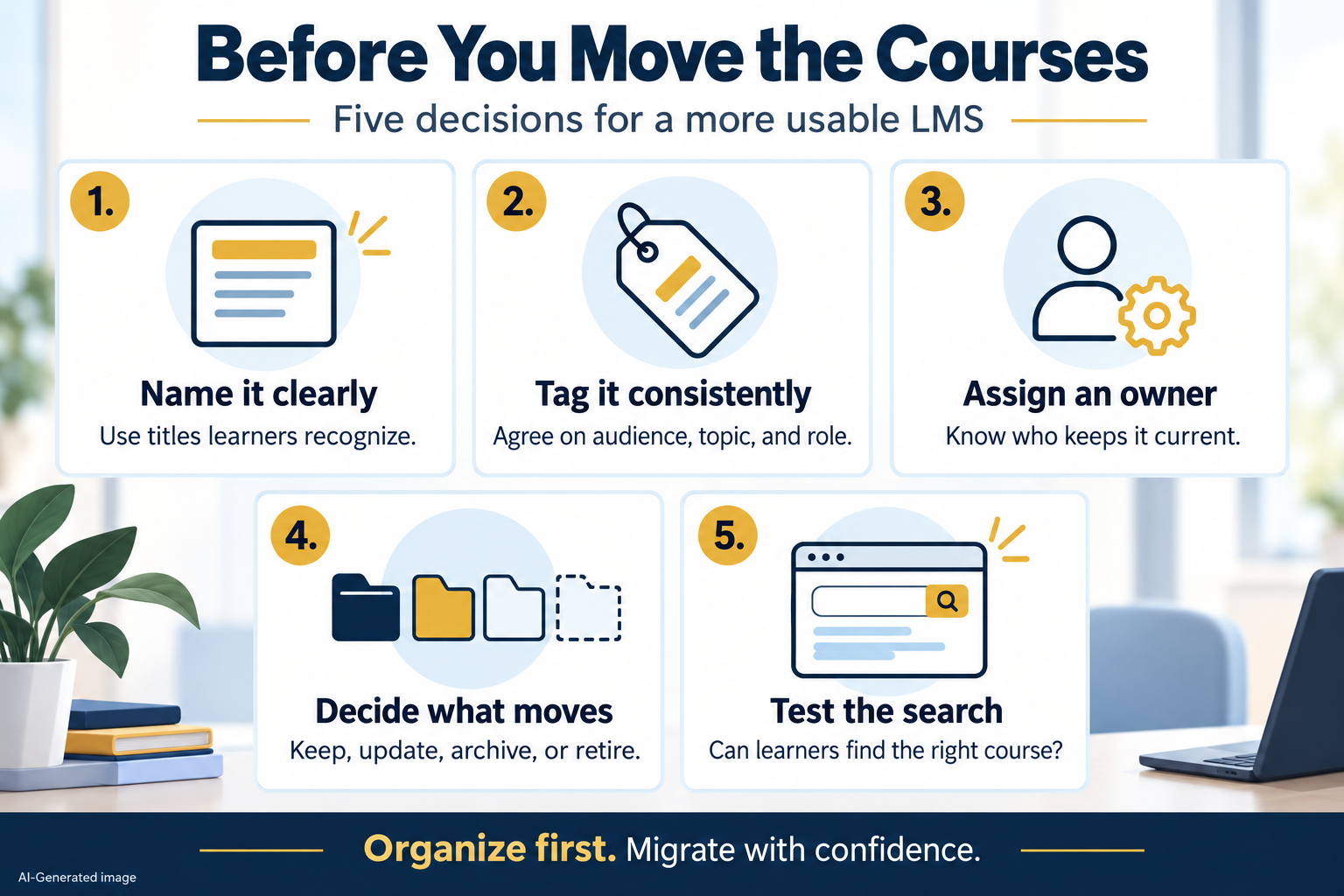
Metadata describes a learning asset: its title, audience, topic, owner, version, or review date.
Taxonomy establishes consistent categories and terms for organizing those assets.
Think of metadata as the label on the box and taxonomy as the system that determines which room it belongs in. Both matter when you’re unpacking thousands of courses.
Imagine searching for supervisor training and finding “Manager Basics,” “Leadership 101,” and “New Supervisor Training_FINAL2.” Are they different courses? Different versions? Is one required?
That uncertainty creates extra work. Microsoft’s 2025 Work Trend Index found that 48% of employees say their work feels chaotic and fragmented. Learning catalogs should help reduce the friction.
Consistent titles, useful filters, and clear ownership help learners identify relevant content and administrators maintain it.
Metadata can also support assignments, recommendations, and reporting when the LMS is configured to use those fields. Missing or inconsistent information gives those features less to work with.
Our article A Learning Culture Isn’t Just About Training Anymore explores the broader goal: making useful knowledge available where people need it. Your LMS catalog should support that same goal.
A successful LMS migration gives employees confidence that they can find relevant, current learning without a scavenger hunt.
Treat metadata and taxonomy as part of migration planning, with ownership and review built in from the start.
The coffee maker can wait. Required training probably can’t.
Planning an LMS transition? MATC can help align your learning strategy, knowledge structures, and organizational readiness before the move.
5 Signs Your Training Materials Need a Refresh
The Hidden Cost of Tribal Knowledge Isn’t What You Think
Unleashing the Power of Templates for Microlearning Modules
“2025: The year the Frontier Firm is born.” Microsoft. 4/23/25. Accessed 10/15/26. https://www.microsoft.com/en-us/worklab/work-trend-index/2025-the-year-the-frontier-firm-is-born