Generative AI can help an L&D team draft a course outline, summarize a source document, or suggest quiz questions. An agentic AI system can take the next steps, too.
Given a goal, an AI agent may break the work into tasks, search connected sources, make decisions within defined limits, use software tools, and return with a completed—or nearly completed—result. In an L&D setting, that might mean reviewing a new policy, identifying affected roles, proposing learning assets, drafting communications, assigning follow-up tasks, and flagging gaps for a human reviewer.
That potential is exciting. It also changes the governance conversation.
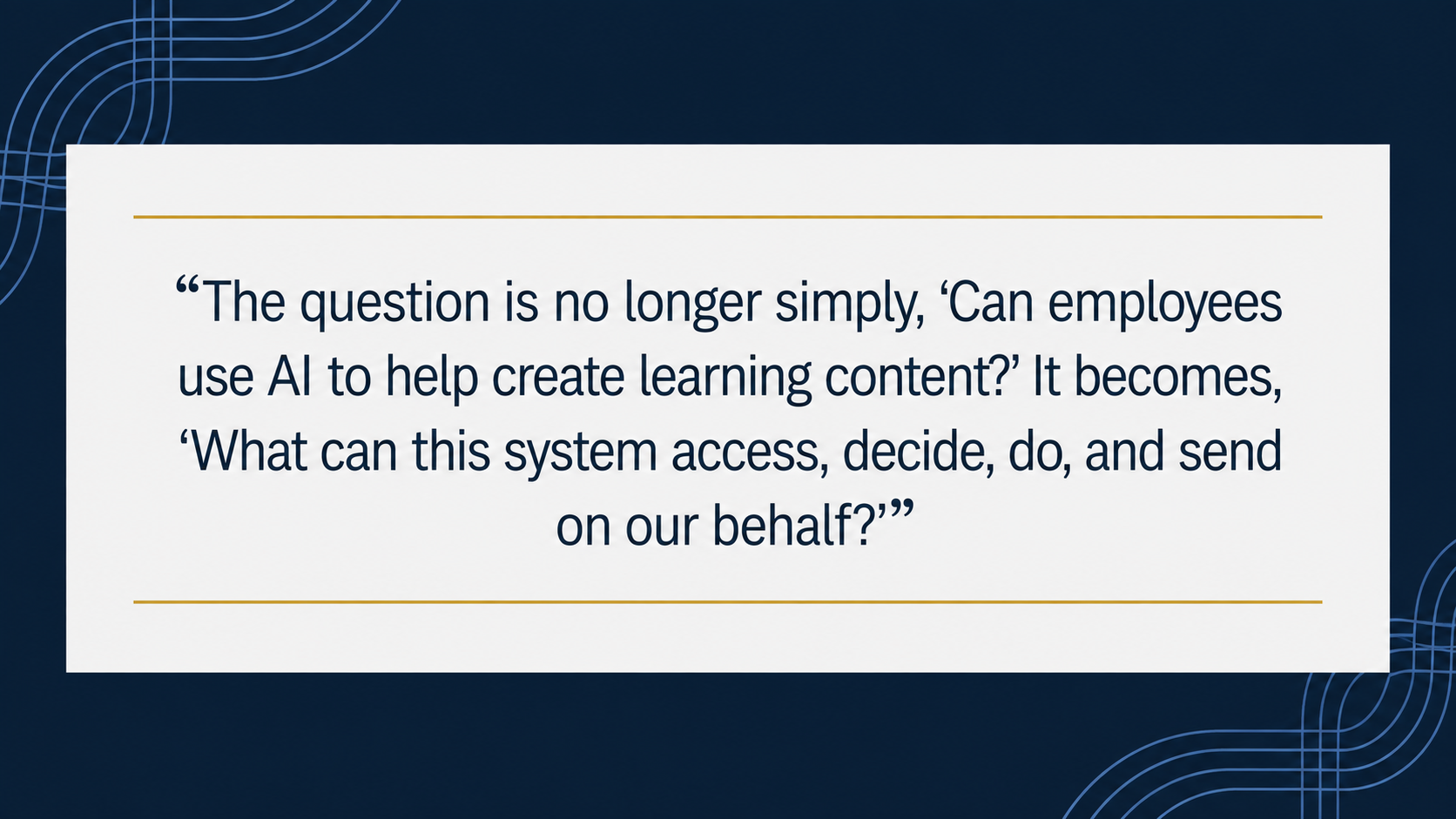
The question is no longer simply, “Can employees use AI to help create learning content?” It becomes, “What can this system access, decide, do, and send on our behalf?”
A chatbot responds to a prompt. An agent can work toward an objective across multiple steps.
For example, an L&D professional might ask an agent to support a software rollout. The agent could pull information from product documentation, compare it with job-role data, draft learning paths, create first-pass job aids, and populate a project workspace. With the right connections, it could potentially interact with the LMS, calendar, knowledge base, or collaboration tools.
That does not mean it should have unlimited access to any of them.
The need for responsive learning is real. The World Economic Forum reports that employers expect 39% of workers’ core skills to change by 2030, while 77% of employers plan to upskill their workforce in response to changing needs. Agentic AI could help learning teams respond more quickly—but speed without guardrails can create new problems.
The value of agentic AI comes from its ability to act—not merely generate. That is also where risk grows. A polished but incorrect course is a problem. An agent that uses outdated source material, exposes employee information, assigns the wrong training, or publishes an unreviewed communication is a different kind of problem.
Organizations do not need a 60-page policy before experimenting. They do need clear guardrails before agents begin taking action in learning workflows.
Start with these four questions.
Define the difference between assistance and action.
An agent may be allowed to summarize approved materials, identify duplicate content, or prepare a draft learning plan. Publishing a course, changing an employee’s required training, sending a manager communication, or creating an official record should usually require human approval.
This is not about slowing every workflow down. It is about putting review at the points where an error has real consequences.
L&D work often touches more than course content. It can involve employee profiles, performance information, compliance records, customer details, and internal strategy.
Create an approved-source list for each use case. Specify whether the agent may access only curated learning content, or whether it can draw from policy libraries, knowledge bases, HR systems, or other platforms. Just as important, establish data that may never be entered into or retrieved by the system.
Good outputs depend on trustworthy context. A fast answer built from outdated policies or unrestricted internal search is not a reliable answer.
Someone must be accountable for the agent’s work—not just for turning it on.
For each use case, name a business owner, a content owner, and a reviewer with the authority to stop or correct the process. The European Union’s AI Act emphasizes appropriate human oversight and adequate AI literacy for people who operate or use AI systems. Even for organizations outside its scope, those are sensible operating principles.
L&D teams should also make it clear when learners or managers are interacting with AI-generated guidance rather than a human expert.
Agents need a way to be monitored, tested, and improved.
Keep records of what the agent was asked to do, which sources it used, what actions it took, and who approved the result. Review a sample of outputs regularly. Watch for recurring errors, missing context, biased recommendations, or tasks that exceed the intended scope.
Most importantly, provide an easy way for people to report a questionable output and pause the workflow when needed.
The first agentic AI use case in L&D should be helpful but reversible. Think content inventory, first-draft learning plans, knowledge-base maintenance suggestions, or identification of training materials affected by a policy update.
Those uses can reveal where the real opportunities—and the real governance gaps—are before an agent has access to sensitive data or authority to make meaningful changes.
Agentic AI may become an important part of how learning teams work. But the organizations that gain the most from it will not be the ones that automate the fastest. They will be the ones that decide, in advance, where human judgment must remain firmly in the loop.
MATC Quick Take: Managing AI Isn’t Managing Software
AI Adoption Is Growing. So Why Isn’t the Value?
A Learning Culture Isn’t Just About Training Anymore
“The AI Act Explorer.” EU Artificial Intelligence Act. 2024. Accessed 9/4/26. https://artificialintelligenceact.eu/ai-act-explorer/#doc-overview
“The Future of Jobs Report 2025.” 1/7/25. Accessed 9/4/26. https://www.weforum.org/publications/the-future-of-jobs-report-2025/in-full
“Future of Jobs Report 2025: 78 Million New Job Opportunities by 2030 but Urgent Upskilling Needed to Prepare Workforces.” World Economic Forum. 1/7/25. https://www.weforum.org/press/2025/01/future-of-jobs-report-2025-78-million-new-job-opportunities-by-2030-but-urgent-upskilling-needed-to-prepare-workforces