

This is the fourth post in The Human Side of Technology series.
AI-powered learning platforms can recommend content, track progress, generate practice questions, and personalize pathways in ways that weren’t possible a few years ago. A recent survey from Synthesia found nearly 50% of instructional designers now use AI daily to reduce development time, improve efficiency, and lower costs. The tools are here, and adoption is accelerating.
But here’s the uncomfortable truth: Learning doesn’t fail because the technology isn’t advanced enough. It fails when the experience forgets the human on the other side of the screen. Flashy features can’t compensate for cognitive overload, unclear expectations, or training that ignores real-world context. Instructional design is what turns powerful tools into meaningful learning.
AI systems can analyze behavior and suggest:
That’s valuable data. And when used well, it works. Personalized learning has been shown to increase employee engagement by up to 60%. But personalization in learning goes beyond content sequencing. Instructional designers humanize AI-enhanced tools by considering:
Technology can adapt pathways. Designers adapt the experience.
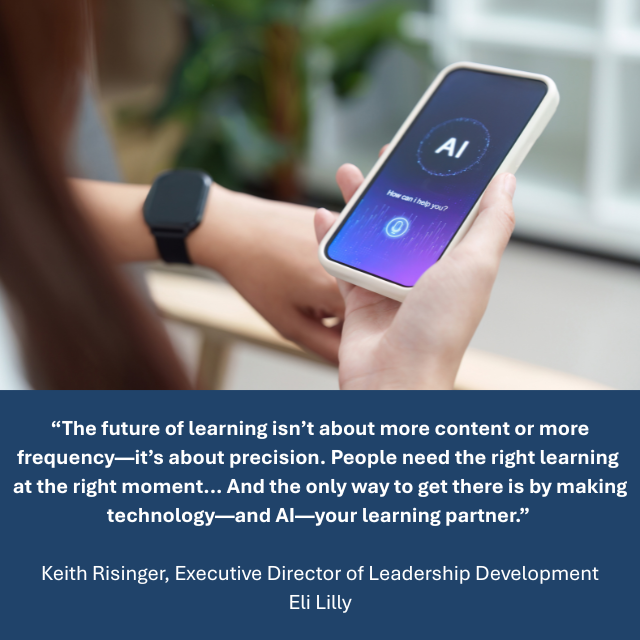
Organizations often adopt AI learning tools with high expectations and little redesign. The assumption is that smarter technology automatically produces better learning. Common outcomes when design lags behind tools:
Learners don’t say, “This algorithm isn’t optimized.” They say, “This is confusing,” or “I don’t have time for this.” That reaction is a design signal, not a user failure.
1. They design for cognitive load, not just capability
AI can deliver endless content. Designers decide what not to include. Clear structure, short modules, and focused objectives protect attention and retention.
2. They connect learning to real work
AI might recommend a course. Designers ensure the content answers, “How does this help me today?” Scenarios, job-based examples, and application tasks bridge that gap.
3. They shape tone and communication
Automated reminders and feedback can feel mechanical. Designers influence language so interactions feel supportive, not transactional.
4. They build in reflection, not just completion
AI tracks progress. Designers create pauses for learners to think, apply, and connect ideas, turning activity into learning.
When AI and instructional design work together, the experience feels intuitive, relevant, and supportive. The technology fades into the background, and the learner stays focused on doing the job better.
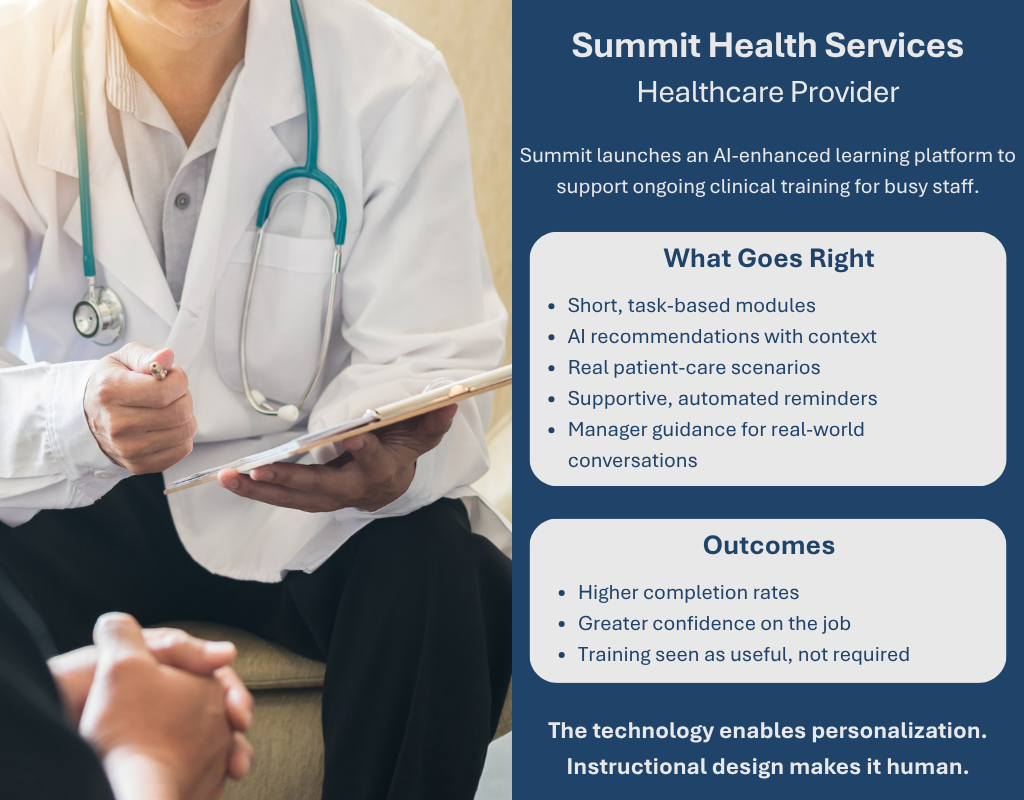
When design is treated as an afterthought, even advanced platforms create friction. The result is often disengagement, confusion, and a perception that learning is just another task to get through.
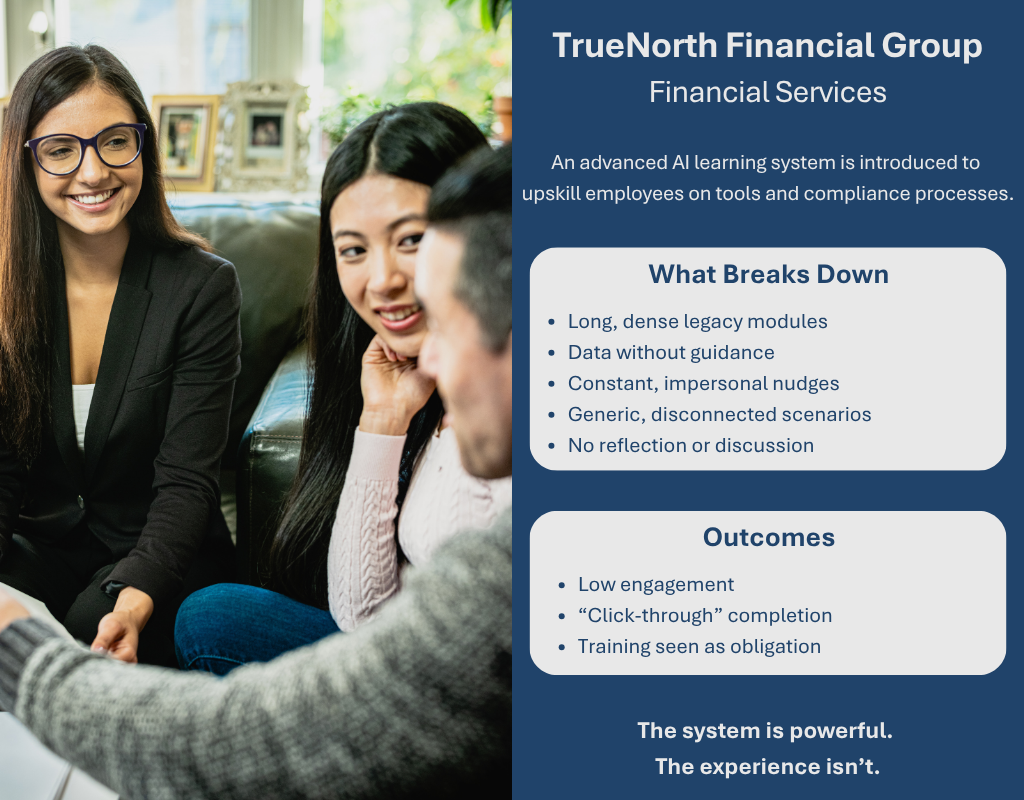
AI can personalize what learners see. Instructional design ensures that what they see actually works for them. Personalization and engagement gains are real, but only when they are paired with thoughtful design. Without that layer, even the most advanced tools create noise instead of clarity.
Training must adapt to the learner’s context, capacity, and needs, not expect the learner to adapt to the tool. The most advanced learning strategy is still human-centered design.
Many organizations have access to technology, but struggle with how to use it effectively. AI platforms are implemented quickly, but:
This is where the gap forms between capability and impact.
MATC helps close that gap by aligning technology with human-centered design. That includes:
The goal is not just smarter tools. It’s better learning that people can use immediately. Because when learning works, performance follows.
Can’t make it to CLO Exchange Boston? Contact us today, or talk with us at upcoming events:
Documentation in the Age of AI: Why Clarity Is a Competitive Advantage
Transform Your Training Programs with an AI-Enhanced LMS
“How AI Got Us Into Swordsmithing” and Other Tales of AI Mishaps
Alster, Kevin. “Instructional Design Trends: 2024 Survey Insights.” Synthesia. 11/18/24. Accessed 4/23/26. https://www.synthesia.io/post/state-of-instructional-design-survey
Bodell, Lisa. “How AI Is Powering The Future Of Learning — At Work and Beyond.” Forbes. 4/29/25. Accessed 4/32/26. https://www.forbes.com/sites/lisabodell/2025/04/29/ai-just-ripped-up-your-training-manual-the-future-of-learning-is-here/
“The Skills Revolution and the Future of Learning and Earning.” McKinsey. 2023. Accessed 4/23/26. https://tinyurl.com/4un6awrh