
This is the 11th post in our Change Management series.
The average employee now lives through about ten planned change initiatives every year—five times more than a decade ago. Change management frameworks are critical for structure during uncertain times. Models offer guidance. Best practices outline what should happen.
Today we offer scenarios that show what often happens, highlighting how training, documentation, and communication shape outcomes.
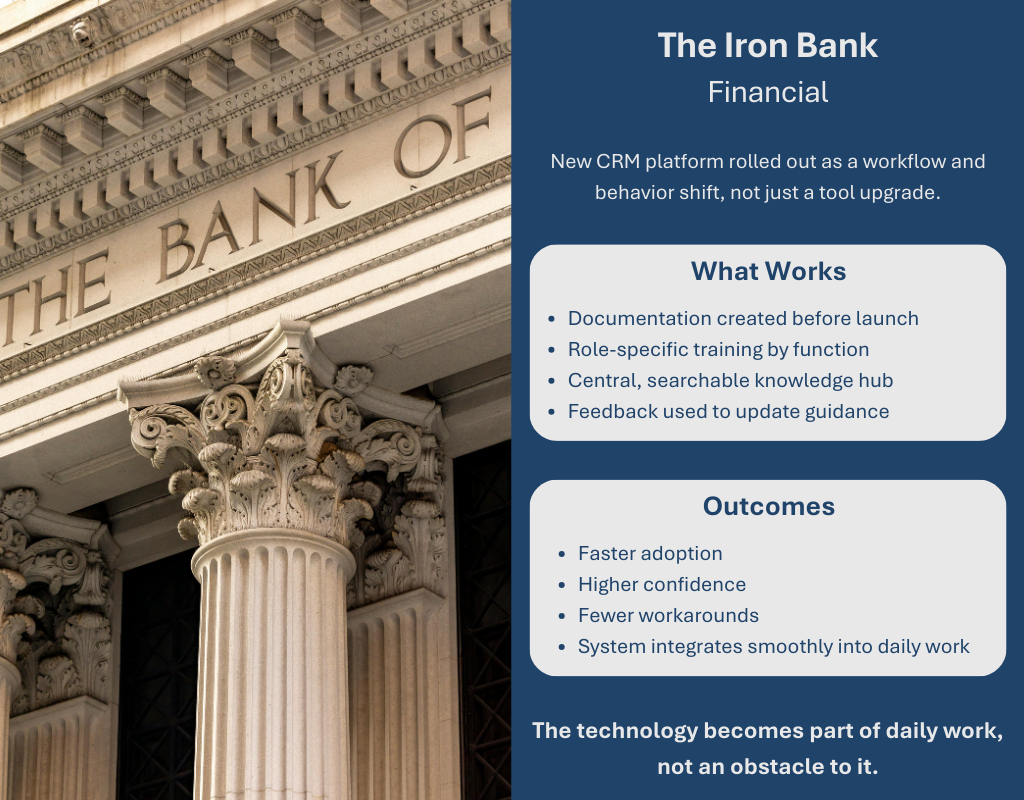
Company: The Iron Bank
Industry: Financial Services
The situation:
The Iron Bank introduces a new customer relationship management (CRM) platform to improve data visibility and standardize workflows across teams. Rather than treating the rollout as a software upgrade, leadership approaches it as a behavioral and operational shift.
What goes right:
Likely outcome:
Employees adopt the system faster, confidence increases, and reliance on informal workarounds declines. The change feels intentional rather than disruptive.
The technology becomes part of daily work, not an obstacle to it.
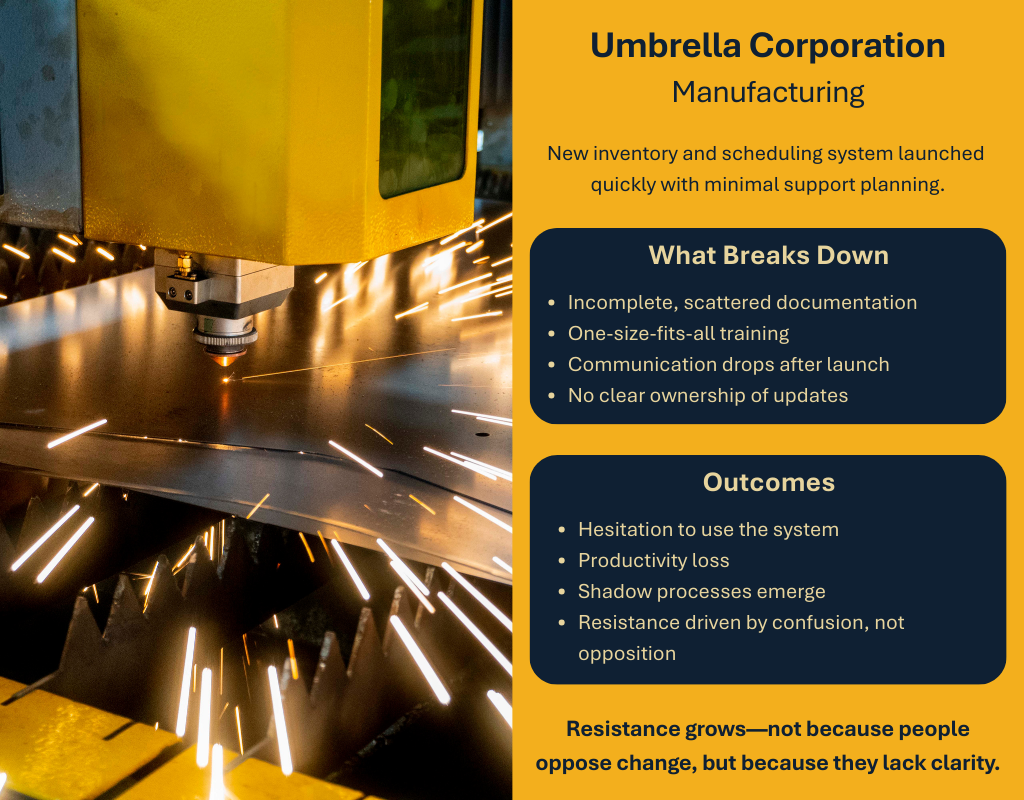
Company: Umbrella Corporation
Industry: Manufacturing
The situation:
Umbrella Corporation rolls out a new inventory and scheduling system to modernize operations and improve efficiency. Leadership announces the change quickly, assuming the system’s design will minimize the need for extensive support.
What breaks down:
Likely outcome:
Employees hesitate to use the system, productivity dips, and unofficial processes emerge to compensate for uncertainty.
Resistance grows—not because people oppose change, but because they lack clarity.
While the details differ, the underlying patterns are consistent.
Key takeaways include:
Organizations that plan for these factors early spend less time repairing change later.
Scenarios allow organizations to explore outcomes without paying the cost of failure.
They make abstract risks tangible and highlight the often-invisible role documentation and training play during transitions.
Most importantly, they reinforce a critical truth: Change management succeeds when people feel supported, informed, and capable.
When documentation and learning are treated as strategic assets, change becomes navigable rather than disruptive.
Knowledge Management’s Role in Change