
From Content Creators to Learning Architects - How Instructional Design Is Evolving

For years, instructional designers (IDs) were often seen as the people who “made the training.” They built courses, designed slides, wrote scripts, and turned subject matter expertise into structured learning materials.

That work still matters. But it’s no longer enough.

Today, (ID) is evolving from a production-focused role into a strategic one. The profession is moving from content creation to learning architecture — and the difference is reshaping how organizations view learning and development.
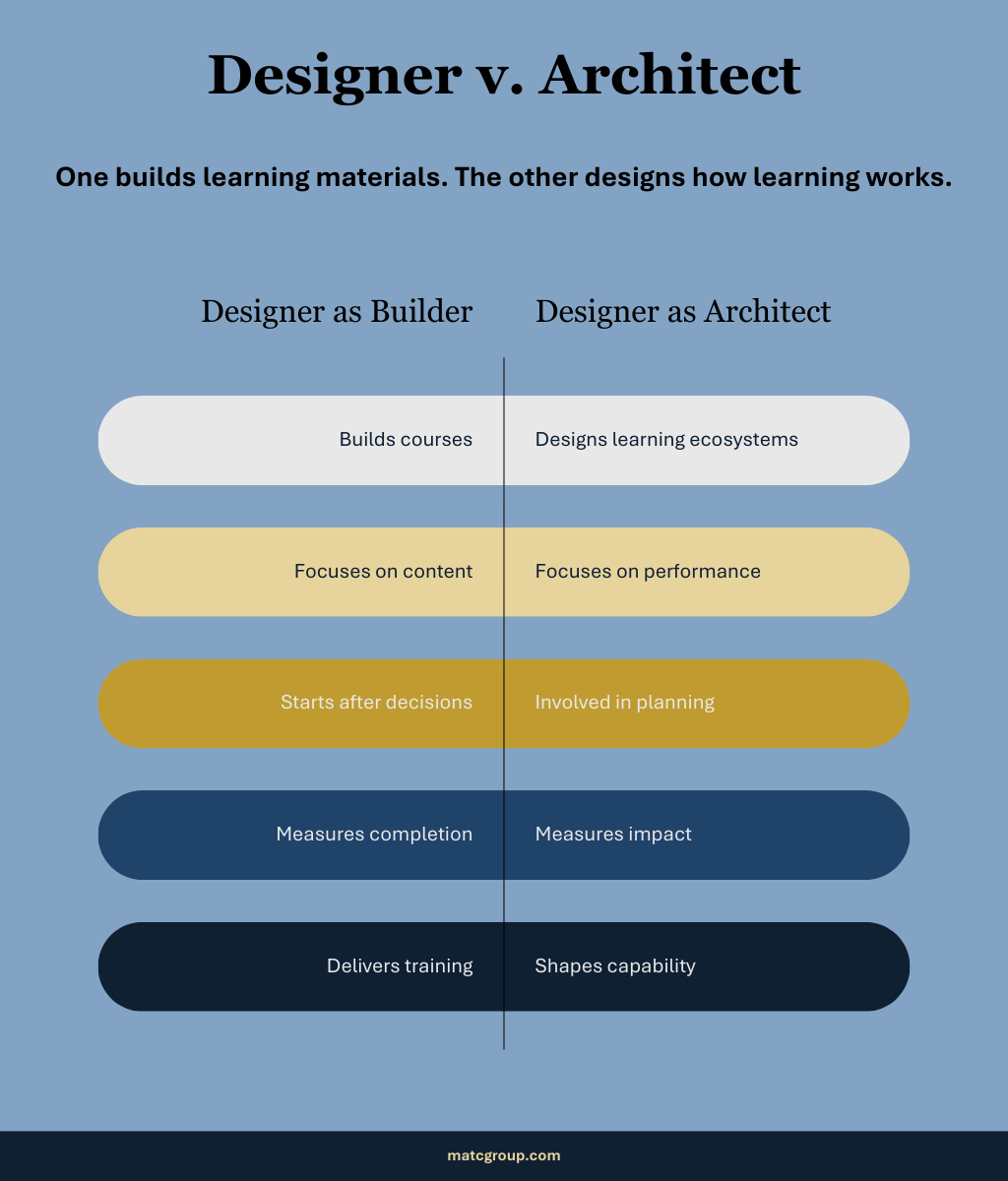
 

Infographic showing the differences between a designer and architect. Text reads: Designer v. Architect. One builds learning materials. The other designs how learning works. Designer as Builder: Builds courses; Focuses on content; Starts after decisions; Measures completion; Delivers training. Designer as Architect: Designs learning ecosystems; Focuses on performance; Involved in planning; Measures impact; Shapes capability.


Content Creators vs. Learning Architects

Both roles care about learning. The difference lies in scope, influence, and impact.

 
Instructional Designers as Content Creators

Traditionally, IDs have been responsible for:

  • Developing courses, modules, and job aids
  • Writing learning objectives and assessments
  • Working with Subject Matter Experts (SMEs) to turn information into instruction
  • Choosing formats such as eLearning, instructor-led training, or video-based training
  • Ensuring content is accurate, clear, and instructionally sound


This role focuses on what gets built and how it’s delivered.

 
Instructional Designers as Learning Architects

Learning architects operate at a higher level. They still understand content design, but their focus expands to:

  • Aligning learning to business goals and performance outcomes
  • Identifying root causes of performance gaps before proposing training
  • Designing learning ecosystems, not just courses
  • Integrating learning into workflows, systems, and tools
  • Using data to evaluate impact and continuously improve
  • Advising leaders on change, adoption, and capability development


This role focuses on why learning exists, where it fits, and what it changes.

One creates learning assets. The other designs learning strategy.

 

Silhouette of person wearing hard hat against a cityscape, with connected gears overlayed on the silhouette. Caption reads: "The shift is global: across all regions, companies seek more autonomous, tech-enabled, and learner-driven approaches to workforce development. By understanding these drivers of change – from AI automation to cultural shifts – stakeholders can better prepare for the future of workplace learning." -Matt Mason, SVP, Director of Talent Operations Office, Truist

Why This Shift Is Happening

Several forces are pushing ID in this direction.

 
Business pressure for measurable impact

Organizations are no longer satisfied with completion rates and smile sheets. Leaders want to see how learning affects performance, productivity, quality, and risk. IDs who can connect learning to outcomes become strategic partners, not order takers.

 
Technology has changed access to information

Employees can Google almost anything. The value of ID is no longer just packaging information — it’s structuring experiences, systems, and support that help people apply knowledge on the job.

 
Work is changing faster than courses can keep up

Static training alone cannot support continuous change. Organizations need learning ecosystems that include performance support, knowledge management, coaching, and embedded guidance. That requires architectural thinking.

 
Learning is central to change management

New systems, processes, and strategies fail without adoption. IDs are uniquely positioned to bridge communication, training, and workflow support, making them critical players in organizational change.


Why It’s Imperative for Instructional Designers to Keep Up

This evolution is not optional. It directly affects career relevance and influence.

Designers who stay focused only on content production may find themselves:

  • Brought in late, after decisions are already made
  • Limited to execution rather than strategy
  • Competing with rapid authoring tools and AI for production tasks


Designers who grow into learning architects are more likely to:

  • Be involved in early planning and decision-making
  • Influence how work, systems, and learning intersect
  • Demonstrate business value, not just learning output
  • Future-proof their roles as automation handles more basic production


The profession is not disappearing. It is expanding.
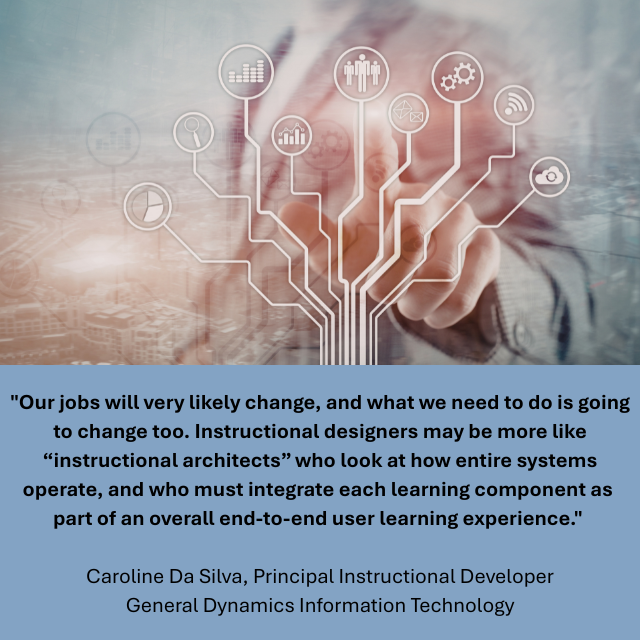
 

Person pointing at touchscreen with various icons connected with lines. Caption reads: "Our jobs will very likely change, and what we need to do is going to change too. Instructional designers may be more like “instructional architects” who look at how entire systems operate, and who must integrate each learning component as part of an overall end-to-end user learning experience." -Caroline Da Silva, Principal Instructional Developer, General Dynamics Information Technology


How Companies Can Help Instructional Designers Evolve

Organizations play a major role in enabling this shift.

 
Give IDs a seat at the table
  • Include IDs in project scoping, not just development
  • Involve them in performance discussions, not only training requests
  • Encourage them to ask “Is training the right solution?”
 
Invest in broader skill development

Support training in areas such as:

  • Data literacy and learning analytics
  • Change management principles
  • Business acumen and industry knowledge
  • Knowledge management and performance support design
 
Redefine success metrics

Instead of measuring only outputs (courses built, hours delivered), also measure:

  • Performance improvements
  • Adoption rates of new systems or processes
  • Reduction in errors, rework, or support tickets
  • Employee confidence and capability in new roles
Encourage cross-functional collaboration

IDs should regularly work with:

  • Operations and process owners
  • IT and systems teams
  • HR and talent management
  • Knowledge management and documentation teams


This exposure builds architectural thinking.
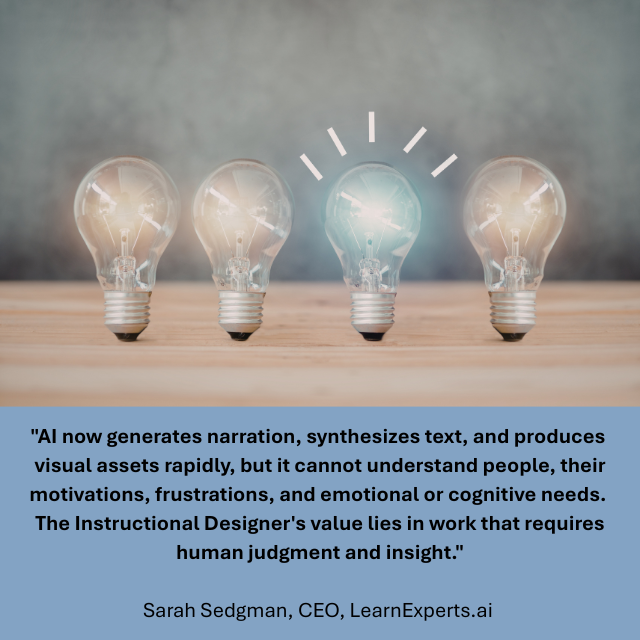
 

Four lit lightbulbs in a row, with one having a blue tint. Caption reads: "AI now generates narration, synthesizes text, and produces visual assets rapidly, but it cannot understand people, their motivations, frustrations, and emotional or cognitive needs. The Instructional Designer's value lies in work that requires human judgment and insight."-Sarah Sedgman, CEO, LearnExperts.ai


What Instructional Designers Can Do on Their Own

IDs don’t have to wait for permission to grow.

 
Learn the business
  • Understand how your organization makes money or delivers value
  • Study key metrics leaders care about
  • Ask stakeholders about performance challenges, not just training needs
 
Strengthen performance consulting skills
  • Practice conducting needs analyses that go beyond content gaps
  • Explore root causes such as process, tools, incentives, and clarity
  • Recommend blended solutions, not just courses
 
Build data confidence
  • Learn to design measurable objectives tied to performance
  • Get comfortable with dashboards, surveys, and usage data
  • Use data to tell a story about impact
 
Expand into adjacent disciplines
  • Knowledge management
  • Documentation strategy
  • Change communication
  • Performance support tools


These areas naturally connect to learning architecture.

 
Shift your mindset

Move from “What course should we build?” to:

  • What should people do differently?
  • What gets in their way today?
  • Where can learning be embedded into work?


That mindset shift is the foundation of architectural thinking.


Keeping the Learner at the Center

As ID becomes more strategic, there is a risk of focusing so heavily on systems, metrics, and business outcomes that the learner’s experience fades into the background. Learning architecture does not replace learner-centered design — it depends on it.

Even at the ecosystem level, designers still need to ask:

  • What does this change look like from the learner’s perspective?
  • What pressures, constraints, or cognitive load are they already managing?
  • How easily can they access support in the flow of work?
  • What might make adoption feel difficult or risky to them?


Business alignment determines why learning exists, but learner focus determines whether it works. The most effective learning architects balance organizational goals with a clear understanding of the people expected to change their behavior.
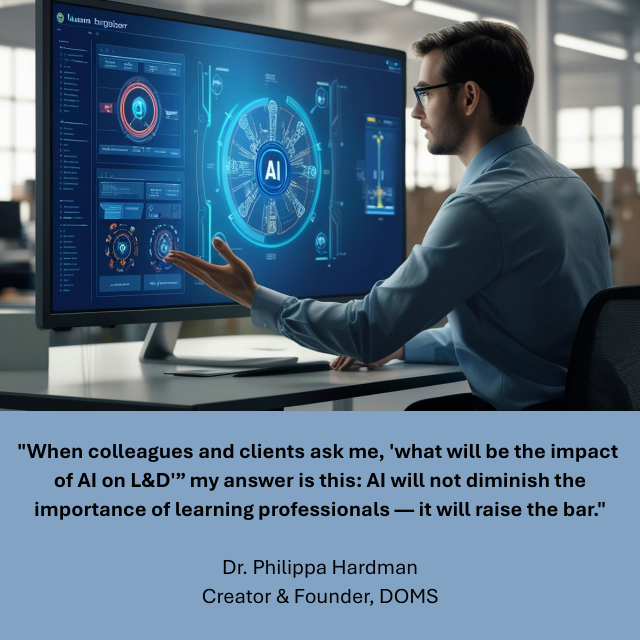
 

Person looking at large monitor with AI data on it. Caption reads: "When colleagues and clients ask me, 'what will be the impact of AI on L&D'” my answer is this: AI will not diminish the importance of learning professionals — it will raise the bar." -Dr. Philippa Hardman, Creator & Founder, DOMS


The Future of Instructional Design

ID is no longer just about crafting learning experiences. It is about designing how people gain capability in complex, fast-changing environments. That capability still develops one person at a time, which means even the most strategic learning architecture must remain grounded in the learner’s real experience, constraints, and needs.

The most effective designers will be those who:

  • Think in systems, not just modules
  • Speak the language of business as well as learning
  • Use data, not just intuition
  • See themselves as partners in performance, not producers of content


The profession is evolving from builders of training to designers of learning ecosystems. For IDs and organizations alike, embracing that shift is what turns learning from a support function into a strategic advantage.

 
Related Blogs

Reskilling & Upskilling for 2026: What Professionals Should be Ready For

Evaluating Training ROI with Data: Why Instructional Design Must be Measurable

Data Privacy Day: Protecting Privacy in the Age of AI

 
References

Da Silva, Caroline. “Transforming From Instructional Design To Learning Experience Design.” eLearning Industry. 4/28/25. Accessed 2/3/26. https://elearningindustry.com/instructional-design-learning-experience-design 

Hardman, Dr. Philippa. “Instructional Design Isn’t Dying — It’s Specialising.” Dr. Phil’s Newsletter. 4/17/25. Accessed 2/3/26. https://drphilippahardman.substack.com/p/instructional-design-isnt-dying-its 

Mason, Matt. “(Opinion) The Future of Instructional Design Roles: Top 10 Reasons They May Become Obsolete AND Three Winning Strategies to ‘Weather the Storm.'” LinkedIn. 7/8/25. Accessed 2/3/26. https://www.linkedin.com/pulse/opinion-future-instructional-design-roles-top-10-reasons-matt-mason-db5le 

Sedgman, Sarah. “How Instructional Designers Can Stay Relevant In The Age Of AI.” eLearning Industry. 1/2/26. Accessed 2/3/26. https://elearningindustry.com/how-instructional-designers-can-stay-relevant-in-the-age-of-ai 

 
Privacy Overview

This website uses cookies so that we can provide you with the best user experience possible. Cookie information is stored in your browser and performs functions such as recognising you when you return to our website and helping our team to understand which sections of the website you find most interesting and useful.