Data Privacy Day: Protecting Privacy in the Age of AI

Today is Data Privacy Day, a reminder that protecting personal information isn’t just a legal obligation—it’s a responsibility shaped by organizational culture.

As artificial intelligence becomes part of nearly every workflow, from HR analytics to customer service chatbots, the line between “helpful data” and “sensitive data” can get blurry. AI makes it easier than ever to collect, analyze, and apply information. But without strong governance and human oversight, it also makes it easier to misuse.

The challenge for organizations isn’t whether to use AI, it’s how to use it responsibly.
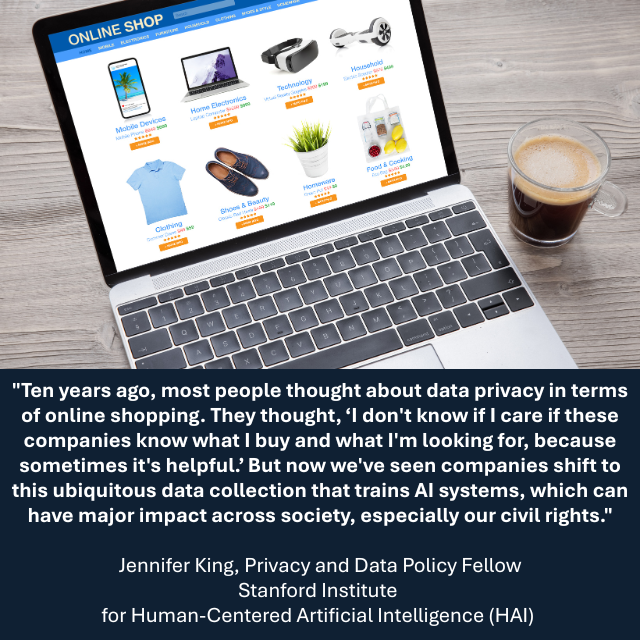
: Open laptop, showing several items for sale on the screen. Caption reads: "Ten years ago, most people thought about data privacy in terms of online shopping. They thought, “I don't know if I care if these companies know what I buy and what I'm looking for, because sometimes it's helpful.” But now we've seen companies shift to this ubiquitous data collection that trains AI systems, which can have major impact across society, especially our civil rights." -Jennifer King, Privacy and Data Policy Fellow, Stanford Institute for Human-Centered Artificial Intelligence (HAI)

AI and the Privacy Paradox

AI systems thrive on data. The more they process, the smarter they get. But that same data can expose individuals if it’s not managed correctly.

This is the privacy paradox: the tension between innovation and protection. Examples are everywhere:

  • A chatbot that accidentally stores customer messages containing personal details.
  • A predictive model that pulls from unfiltered HR data to forecast turnover risk.
  • A generative AI that “learns” from internal documents containing confidential client information.

Each scenario shows why transparency, consent, and control matter. When data privacy is an afterthought, trust disappears fast.

The Foundation: Responsible Data Practices

Privacy can’t be bolted on after the fact. No, it must be built in from the start. To ensure data privacy while using AI, organizations should adopt these foundational practices:

  • Minimize data collection. Only collect what’s necessary for the task at hand. If the AI doesn’t need it, don’t feed it.
  • Anonymize sensitive information. Remove or mask personal identifiers before data is used for analysis or model training.
  • Understand your data sources. Know where information comes from, who owns it, and whether you have the right to use it.
  • Maintain transparency. Clearly communicate when and how AI systems use personal or behavioral data.
  • Implement consent controls. Give users the ability to opt out or modify how their data is used.

Data privacy is a leadership responsibility, not just an IT issue.

Leadership’s Role: Setting the Standard

Strong privacy governance starts at the top. Leaders set the tone for how data is valued, protected, and discussed across the organization. Effective leaders:

  • Create cross-functional privacy teams that include legal, IT, HR, and learning professionals.
  • Require training on data ethics for anyone using or designing AI systems.
  • Model transparency by explaining how the organization uses AI internally and externally.
  • Encourage employees to question data sources and purpose, rather than assuming all AI tools are safe.

Leaders build trust when they make privacy part of everyday decision-making.
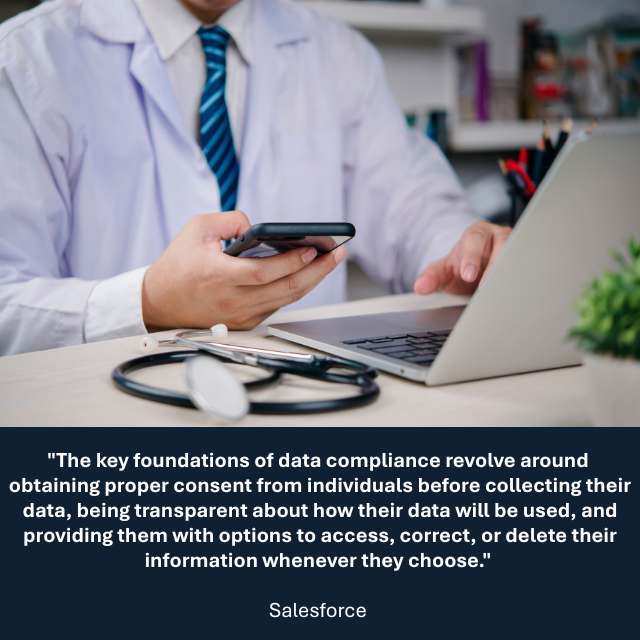
Person wearing a tie and lab coat looking at a laptop and a mobile phone, with a stethoscope nearby. Caption reads: "The key foundations of data compliance revolve around obtaining proper consent from individuals before collecting their data, being transparent about how their data will be used, and providing them with options to access, correct, or delete their information whenever they choose." -Salesforce

Training and Documentation: The Unsung Heroes of Privacy

Training and documentation often sit quietly in the background, but they’re the backbone of privacy compliance and awareness.

Training teams should:

  • Embed data privacy modules into onboarding and AI literacy programs.
  • Use real examples of privacy risks (and recoveries) to make lessons stick.
  • Reinforce that privacy is everyone’s job, not just IT’s.

Technical writers and knowledge managers also play a crucial role:

  • Document what data AI systems collect, store, and share.
  • Maintain version control on privacy policies and user-facing disclaimers.
  • Create plain-language guides that explain privacy settings for end users.

In short: transparency only works if it’s documented and understandable.

AI-Specific Privacy Safeguards

AI introduces new challenges that traditional data policies may not cover. To protect privacy in AI environments, add these layers:

  1. Model-level monitoring. Regularly review outputs for sensitive or identifiable information.
  2. Access controls. Limit who can train or fine-tune models and who can view the data.
  3. Data retention policies. Set expiration dates for training data.
  4. Vendor oversight. Audit third-party AI tools to ensure their privacy standards match yours.
  5. Bias checks. Privacy isn’t just about protection—it’s also about fairness. Ensure data isn’t being used to unintentionally discriminate.

AI moves fast, but responsible governance keeps it grounded.

Building a Privacy-First Culture

True data privacy needs the right company culture to succeed, and it’s more than just compliance checklists. That culture starts when everyone understands the “why” behind privacy.

  • Employees feel empowered to ask: Should we collect this?
  • Designers think about ethical implications, not just features.
  • Leaders measure success by both innovation and integrity.

Privacy-focused organizations trust themselves to use AI responsibly, rather than fear it.

Final Thoughts

AI will continue to shape how we work, learn, and communicate. However, by learning to guide technology instead of resisting it, we can better protect privacy.

This Data Privacy Day, take a moment to ensure your systems, training, and documentation reflect not just what your organization can do with AI, but what it should do.

 
Related Blogs

Reskilling & Upskilling for 2026: What Professionals Should be Ready For

Why Training Employees in AI is Critical for Future-Proofing Your Business

Who Will Host Your LMS? Cloud Convenience V. Self-Hosted Control 

 
References

Miller, Katharine. “Privacy in an AI Era: How Do We Protect Our Personal Information?” Stanford. 3/18/24. Accessed 1/6/26. https://hai.stanford.edu/news/privacy-ai-era-how-do-we-protect-our-personal-information

“Understanding Data Privacy Compliance.” Salesforce. Accessed 1/6/26. https://www.salesforce.com/platform/data-privacy-compliance/what-is-data-privacy-compliance 
Privacy Overview

This website uses cookies so that we can provide you with the best user experience possible. Cookie information is stored in your browser and performs functions such as recognising you when you return to our website and helping our team to understand which sections of the website you find most interesting and useful.