
Scenarios in Change Management: What Success (and Failure) Teaches Us

This is the 11th post in our Change Management series.


The average employee now lives through about ten planned change initiatives every year—five times more than a decade ago. Change management frameworks are critical for structure during uncertain times. Models offer guidance. Best practices outline what should happen.

Today we offer scenarios that show what often happens, highlighting how training, documentation, and communication shape outcomes.
 

Scenario 1: A Well-Supported Change That Gains Traction

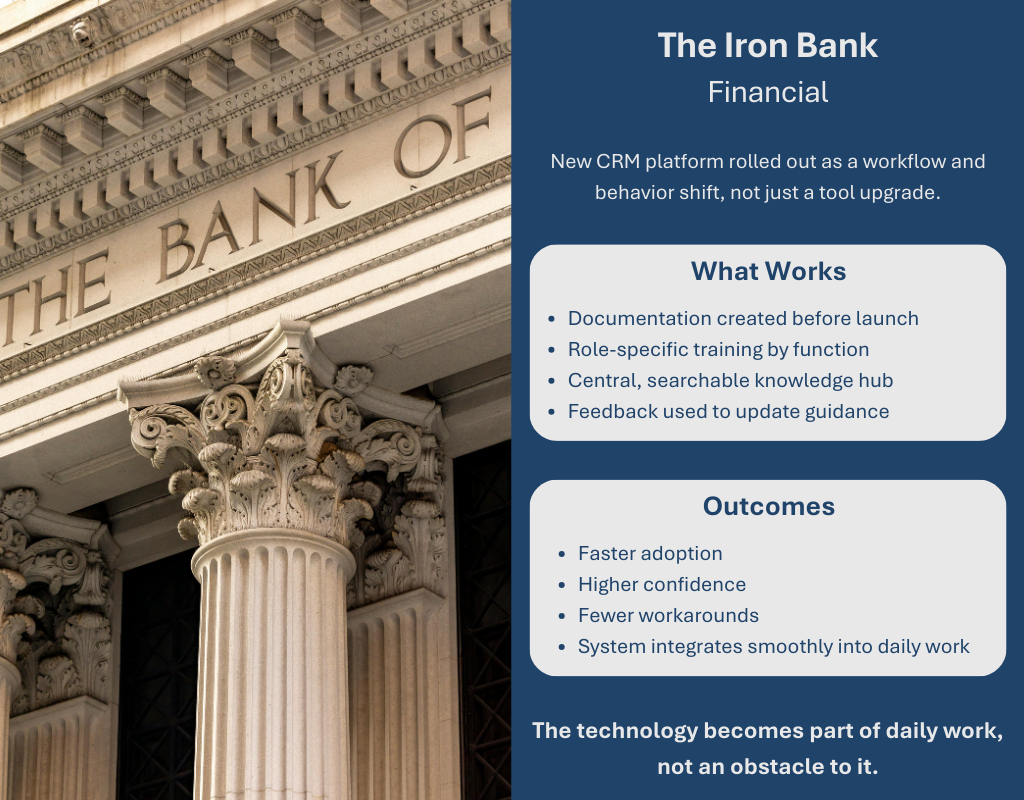
An infographic showing an ornate bank building and shortened version of the text below.


Company: The Iron Bank
Industry: Financial Services

The situation:

The Iron Bank introduces a new customer relationship management (CRM) platform to improve data visibility and standardize workflows across teams. Rather than treating the rollout as a software upgrade, leadership approaches it as a behavioral and operational shift.

What goes right:

  • Documentation is created early. New workflows are documented before launch, giving employees a clear picture of what will change and how their roles will be affected.
  • Training is role-specific. Sales, customer support, and managers receive training aligned to their daily responsibilities instead of a generic overview.
  • Knowledge is centralized. Job aids, FAQs, and quick-reference guides live in a searchable repository that is easy to maintain and update.
  • Feedback informs improvements. Early user questions reveal gaps in understanding, which are addressed through documentation updates and short refresher sessions.

Likely outcome:

Employees adopt the system faster, confidence increases, and reliance on informal workarounds declines. The change feels intentional rather than disruptive.

The technology becomes part of daily work, not an obstacle to it.
 

Scenario 2: A Rushed Change That Struggles to Stick

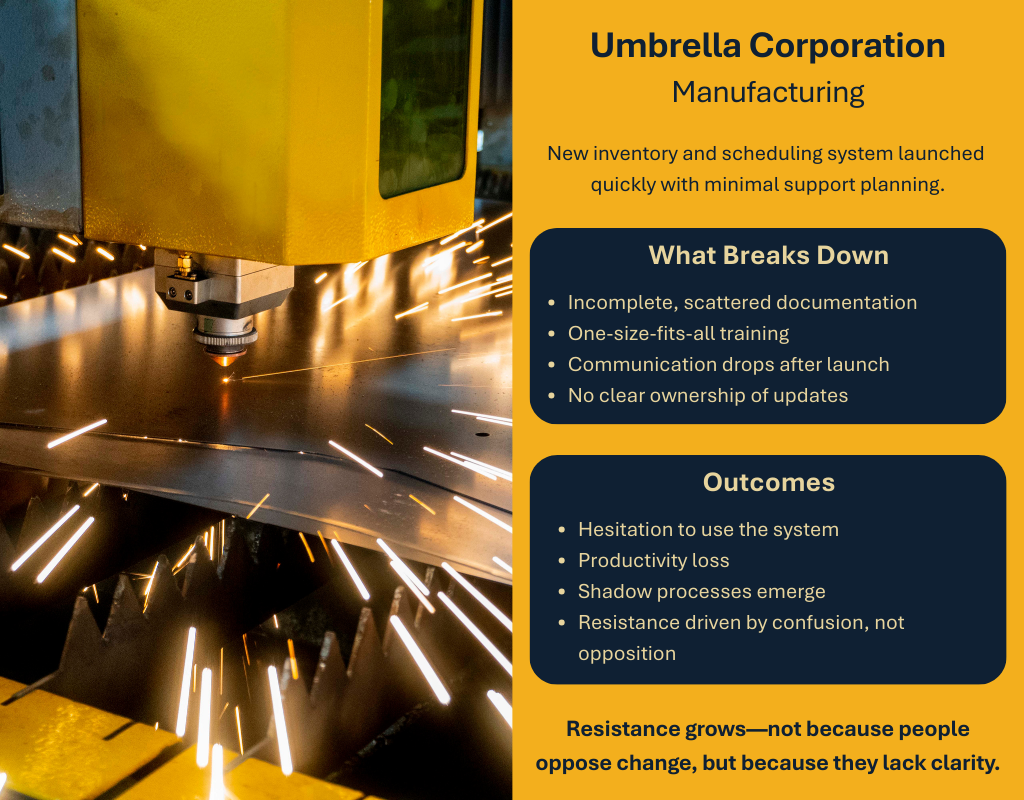
Infographic showing a factory machine and shorter version of the text below.

Company: Umbrella Corporation
Industry: Manufacturing

The situation:

Umbrella Corporation rolls out a new inventory and scheduling system to modernize operations and improve efficiency. Leadership announces the change quickly, assuming the system’s design will minimize the need for extensive support.

What breaks down:

  • Documentation is incomplete or scattered. Instructions live in multiple locations, are outdated, or assume prior knowledge that many employees do not have.
  • Training is broad and shallow. A single training session attempts to cover all roles, leaving employees unsure how the system applies to their specific tasks.
  • Communication is front-loaded. After the initial announcement, guidance tapers off even as questions increase.
  • Knowledge ownership is unclear. No one is responsible for keeping documentation current as workflows evolve.

Likely outcome:

Employees hesitate to use the system, productivity dips, and unofficial processes emerge to compensate for uncertainty.

Resistance grows—not because people oppose change, but because they lack clarity.


Lessons These Scenarios Reveal

While the details differ, the underlying patterns are consistent.

Key takeaways include:

  • Documentation reduces uncertainty. When people understand expectations, they engage more confidently with change.
  • Training must match reality. Role-based learning is far more effective than one-size-fits-all sessions.
  • Knowledge management sustains momentum. Change continues after launch. Documentation must evolve with it.
  • Resistance often signals confusion. Lack of clarity is one of the most common causes of stalled adoption.
  • Communication is ongoing, not event-based. Successful change depends on repeated, reinforced messaging.

Organizations that plan for these factors early spend less time repairing change later.


Why Scenario-Based Learning Matters in Change Management

Scenarios allow organizations to explore outcomes without paying the cost of failure.

They make abstract risks tangible and highlight the often-invisible role documentation and training play during transitions.

Most importantly, they reinforce a critical truth: Change management succeeds when people feel supported, informed, and capable.

When documentation and learning are treated as strategic assets, change becomes navigable rather than disruptive.

 
Related Blogs

Knowledge Management’s Role in Change

Communication Strategies for Change Management

Change Management: Why We Can’t Just Wing It

Privacy Overview

This website uses cookies so that we can provide you with the best user experience possible. Cookie information is stored in your browser and performs functions such as recognising you when you return to our website and helping our team to understand which sections of the website you find most interesting and useful.