For decades, the office served as the default workplace. People showed up because that’s where the work happened. Meetings were in conference rooms, collaboration meant pulling chairs together, and culture was absorbed by being physically present with coworkers.
Hybrid work changed the equation. Today, the office is no longer the automatic center of gravity. High-performing organizations have learned that in-person time carries more weight when it’s carefully designed. The question isn’t “How often should people come in?” It’s “What should the office be for?”
That shift in mindset separates organizations that thrive in hybrid environments from those that struggle. An office without a purpose becomes an inconvenience. An office with a purpose becomes a strategic engagement tool.
Before hybrid work, the office served many functions simultaneously:
This happened without much planning. Proximity took care of culture and communication. When people were co-located, collaboration was easy to stumble into.
Hybrid work removed that automatic benefit. Without deliberate design, office time loses meaning. And when office visits feel pointless, employees disengage from the entire hybrid model.
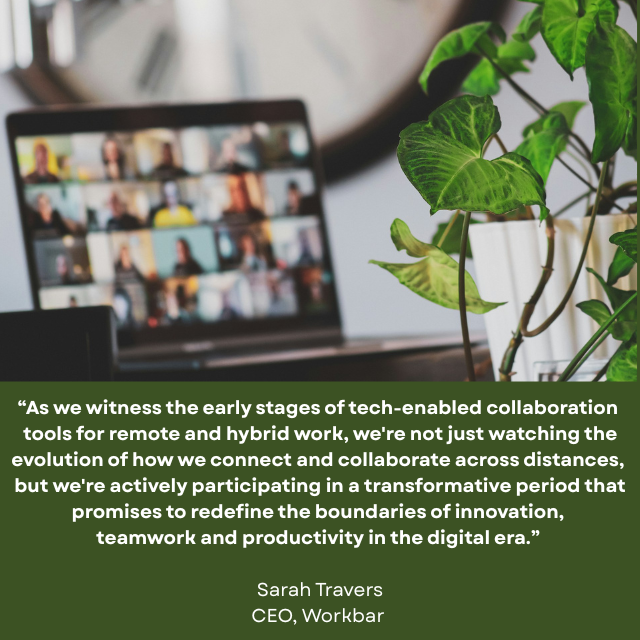
In a hybrid world, employees can do focused, individual work from anywhere. Home. Coffee shops. Coworking spaces. None of that requires a commute.
So, when employees do commute, the experience needs to be worth it.
That means rethinking office time as a strategic resource rather than a default location.
In-person days should enable work that is:
When organizations do this intentionally, the office becomes a multiplier. When they don’t, it becomes a friction point.
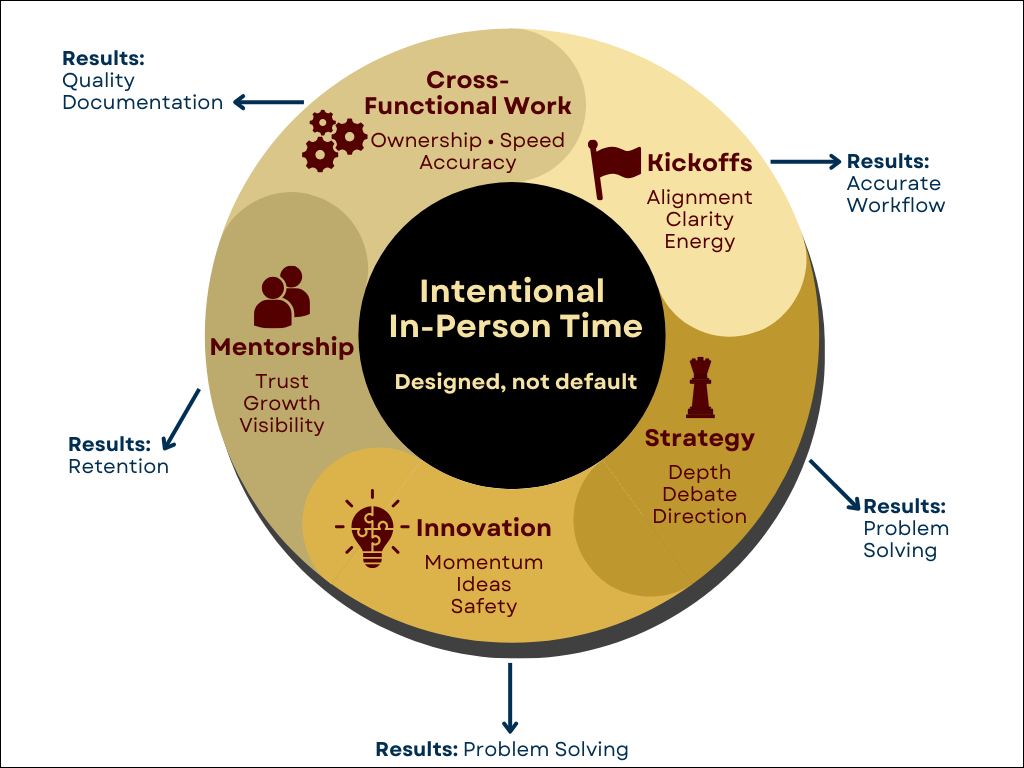
Here are the activities that benefit most from in-person time, and why they matter:
A strong kickoff sets the tone for the entire project. In person, teams can align faster, clarify roles, ask questions, and spot potential risks early.
What improves in person:
Kickoffs also feed documentation. When people talk through expectations together, it becomes easier to capture accurate processes for the workflow ahead.
Deep-thinking work is often easier when people can see body language, sketch ideas on a whiteboard, and debate ideas without lag or screen fatigue.
In-person strategy sessions support:
Hybrid teams need periodic strategic alignment to stay cohesive, and the office can be the best place for that.
Innovation rarely emerges from a string of isolated emails. It comes from bouncing ideas around and following sparks of creativity in real time.
In-person innovation sessions encourage:
Remote tools can support brainstorming, but they rarely match the energy of being physically together when generating big ideas.
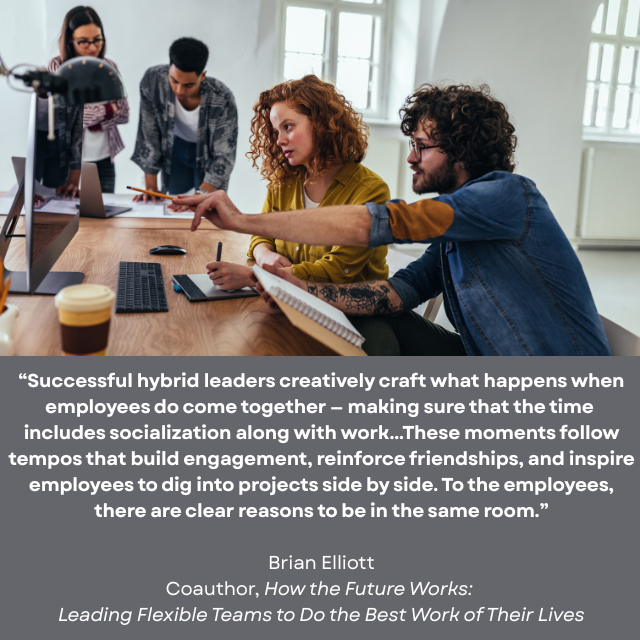
Human connection still matters. People build trust more naturally in person, and mentorship becomes stronger when new employees can observe how others interact.
In-person relationship building enables:
These soft elements influence performance, engagement, and retention as much as formal training does.
When multiple departments need to work through a complex issue, the office becomes a neutral ground where barriers drop.
In-person multi-team collaboration enables:
Cross-functional work often produces new processes or knowledge assets. Doing it together leads to more accurate documentation and fewer rework cycles.
Let’s be direct: If employees are coming in only to sit on Zoom calls, answer emails, or work quietly with headphones on, the office becomes a burden instead of an asset.
This is the most common reason hybrid engagement fails. Employees don’t resist coming in. They resist wasting time.
Avoid using the office for:
Hybrid policies fall apart when employees feel they are commuting only to do work they can do better at home.
Once organizations accept that the office must have a purpose, they can design it for that purpose.
Space and layout considerations:
The design should send a clear message: “This space is built for working together.”

This shift requires strong documentation habits.
When teams meet in person for kickoffs, workshops, or strategy sessions, someone should capture:
Hybrid work thrives when documentation ensures continuity. The office is where alignment happens. Documentation is how alignment is preserved.
To maximize the value of the office, leaders should:
Employees should leave the office feeling energized, connected, and clear on next steps. That’s the mark of in-person time well spent.
Hybrid work isn’t “home sometimes, office sometimes.” It’s a fundamental redesign of how, when, and why people come together.
The office still matters — but for different reasons than before. When organizations treat the office as a collaboration accelerator rather than a default location, engagement improves, turnover drops, and teams build stronger connections.
How Documentation Anchors Distributed Teams (And Keeps Us from Chaos)
The Resurgence of Business Etiquette Training in a Post-Pandemic World
Engagement Matters: Turning the Tide on Workforce Discontent
Digi, Corey. “Hybrid Work: The New Normal Redefining Productivity.” Forbes. 12/30/24. Accessed 12/10/25. https://www.forbes.com/councils/forbesfinancecouncil/2024/12/30/hybrid-work-the-new-normal-redefining-productivity/
Elliott, Brian. “Hybrid Work: How Leaders Build In-Person Moments That Matter.” MIT Sloan. 8/1/2024. Accessed 12/15/25. https://sloanreview.mit.edu/article/hybrid-work-how-leaders-build-in-person-moments-that-matter
Travers, Sarah. “Succeeding In The New Normal: Strategies For Creating An Effective Hybrid Work Model.” Forbes. 4/23/24. Accessed 12/10/25. https://www.forbes.com/councils/forbesbusinesscouncil/2024/04/23/succeeding-in-the-new-normal-strategies-for-creating-an-effective-hybrid-work-model/