

March 20 is World Agriculture Day, a reminder that one of the world’s most essential industries operates under constant uncertainty. Farmers do not plan for perfect conditions. They plan for droughts, floods, equipment failure, labor shortages, pests, and supply chain disruptions because those challenges are not hypothetical. They are expected.
That mindset offers a powerful lesson for organizations struggling with crisis management and resilience. Disruption is not an anomaly. It is the operating environment.
Agriculture also operates at enormous scale. According to the USDA’s 2022 Census of Agriculture, the United States has roughly 1.9 million farms, and 95% of them are family-operated. Together, U.S. farms and ranches produced $543 billion in agricultural products in 2023, up from $389 billion in 2017. Behind those numbers is an industry that must constantly adapt while sustaining one of the most critical sectors of the global economy.
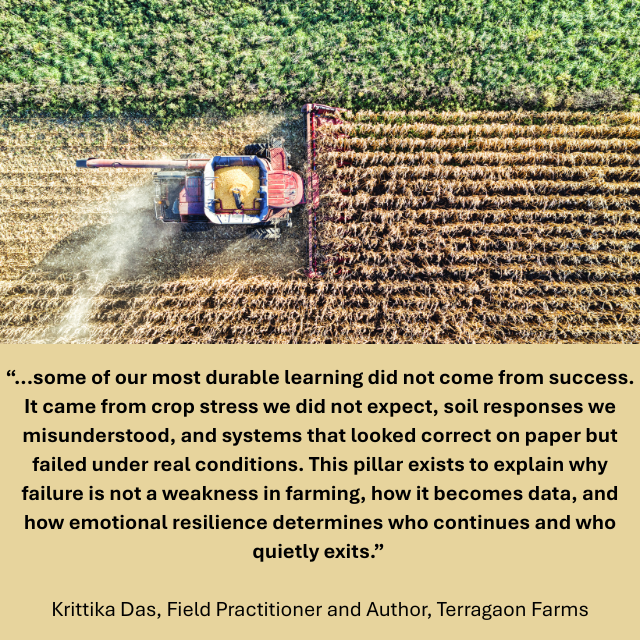
In agriculture, risk is built into every decision. Crops may fail. Weather forecasts may be wrong. Markets may shift overnight. Planning happens anyway.
What makes farming resilient is not optimism but realism:
Crisis management in organizations often fails because stability is assumed until proven otherwise. Agriculture assumes instability and prepares for it.
Many organizations confuse reacting quickly with being prepared. When a crisis hits, leaders scramble to locate procedures, clarify authority, and determine next steps. By then, the damage has already begun.
Agriculture separates readiness from response:
Resilient systems do not rely on heroics. They rely on preparation.
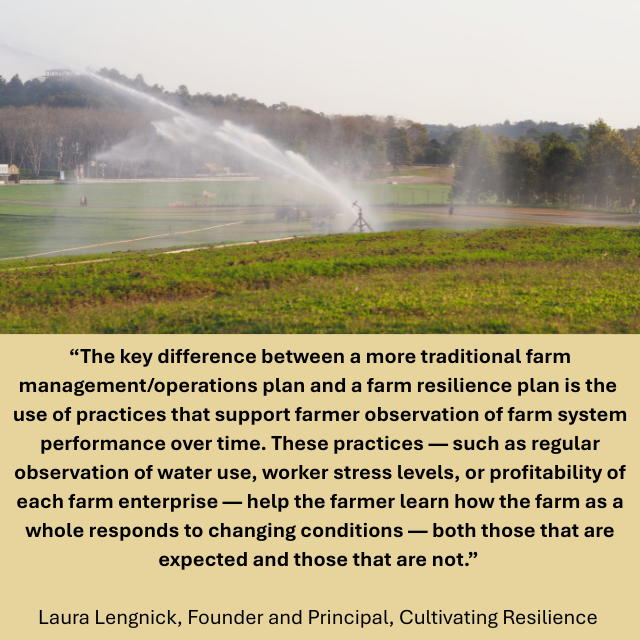
Farmers rarely bet everything on a single crop, tool, or technique. Diversification is a risk strategy, not a luxury.
That same principle applies to organizations:
Resilience is designed into the system long before it is tested.
The agricultural sector also demonstrates how resilience evolves over time. The USDA reports that 153,101 farms used renewable energy systems in 2022, a 15% increase since 2017. These systems include solar panels, windmills, hydro systems, geothermal systems, and methane digesters. For farmers, adopting renewable energy is not only about sustainability. It also improves operational stability and reduces vulnerability to outside disruptions.
When something goes wrong in agriculture, there is no time to interpret vague guidance. Instructions must be clear, current, and usable in real conditions.
The same is true during organizational crises:
Documentation that only works in calm conditions is not crisis documentation. Clear, accessible knowledge allows teams to act decisively when pressure is high.
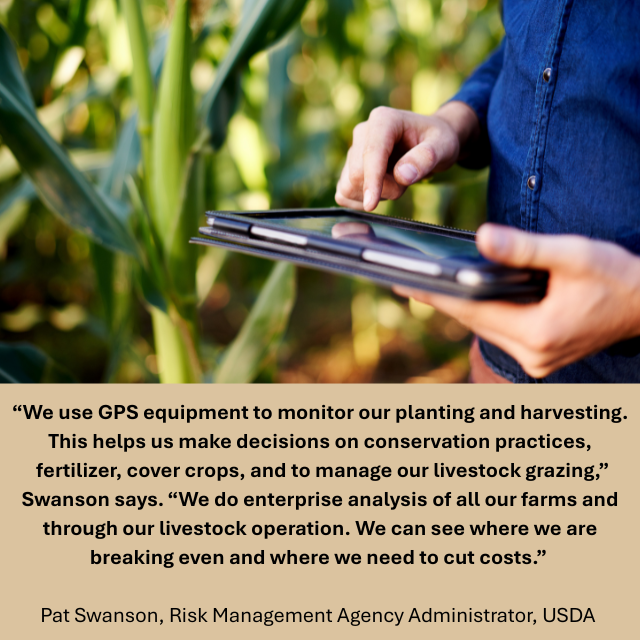
Agriculture teaches us that crisis management and resilience are not separate initiatives. They are the same discipline viewed from different moments in time.
Resilient organizations:
Crisis does not create chaos. Unprepared systems do.
World Agriculture Day highlights an industry that survives because it respects uncertainty rather than denying it. From millions of family-run farms to billions of dollars in annual production, agriculture operates in an environment where uncertainty is normal and preparation is essential.
Organizations that adopt the same mindset stop asking how to avoid crisis and start asking how to withstand it. That shift is where true resilience begins.
Documentation: The Unsung Hero of Crisis Prevention and Recovery
Leading Through the Storm: Emotional Intelligence in Crisis Leadership
What Happens When Knowledge Isn’t Documented? Lessons from Aviation for Knowledge Management
Baratta, Bethany. “Why recordkeeping is ‘one of the most essential pieces of farming today.'” Environmental Defense Fund. 6/18/20. Accessed 3/9/26. https://blogs.edf.org/growingreturns/2020/06/18/recordkeeping-farm-success-sustainability
Das, Krittika. “Learning From Failure: What Farming Teaches When Things Go Wrong.” Tarragaon. 1/11/26. Accessed 3/9/26. terragaon.com/learning-from-failure-farming
Ostane-Baucom, Hope. “Cultivating Resilience: Expert Advice for Climate-Ready Agriculture.” RAFIusa.org. 4/15/25. Accessed 3/9/26. https://www.rafiusa.org/expert-advice-for-climate-ready-agriculture