

The Synonym Survival Guide for Technical Writers

We writers love words. We collect them, admire them, and occasionally hoard them like dragons with dictionaries. But when it comes to technical writing, variety isn’t always the spice of life; it’s sometimes the recipe for confusion.

That’s where this Synonym Survival Guide comes in. It’s your friendly reminder that in documentation, clarity always wins the word contest.


When Synonyms Attack

In creative writing, swapping one word for another adds flavor. In technical writing, it can cause chaos.

Picture this:

  • Page 1 calls it a “card reader.”
  • Page 2 says “payment device.”
  • Page 3 refers to it as the “terminal.”

Same thing, three names. Now your reader isn’t learning, they’re decoding. And instead of clarity, you’ve created a choose-your-own-adventure manual.

Consistency builds trust. When terms shift, users stop trusting the content and start second-guessing themselves.
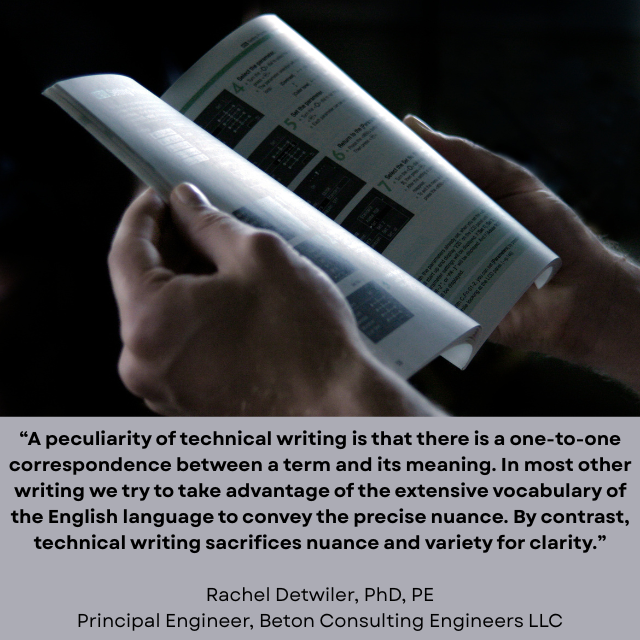
Person holding an open user guide in their hands. Caption reads: “A peculiarity of technical writing is that there is a one-to-one correspondence between a term and its meaning. In most other writing we try to take advantage of the extensive vocabulary of the English language to convey the precise nuance. By contrast, technical writing sacrifices nuance and variety for clarity.” - Rachel Detwiler, PhD, PE, Principal Engineer, Beton Consulting Engineers LLC


How to Spot Rogue Synonyms

Think of rogue synonyms like mischievous squirrels sneaking into your content: cute at first, but they’ll scatter your consistency faster than you can say “find and replace.”

Common culprits include:

  • Refund/Return/Reversal: Three words, three possible meanings. Pick one and define it.
  • Submit/Send/Save: Not interchangeable if they trigger different system actions.
  • Customer/Client/User/Guest: Decide which fits your brand or product, and stick with it.
  • Order/Transaction/Sale: Close cousins, but not identical twins.
  • Menu/Tab/Option: Use the same term users see on screen—no creative interpretation needed.

The goal isn’t to eliminate variety everywhere, but to keep language aligned with intent, interface, and reader expectation.


Why It Matters

It’s not just about word choice. Inconsistent terminology can lead to:

  • Errors: Users follow the wrong steps because terms don’t match.
  • Inefficiency: Support teams spend time clarifying what the document meant.
  • Frustration: Readers lose confidence in your documentation and your brand.
  • Localization nightmares: Translators struggle when synonyms blur meanings.

Like a good map, good documentation should get everyone to the same destination without detours or guessing.


Your Synonym Survival Toolkit 

To keep your terminology tamed and your users sane, try these practical steps:
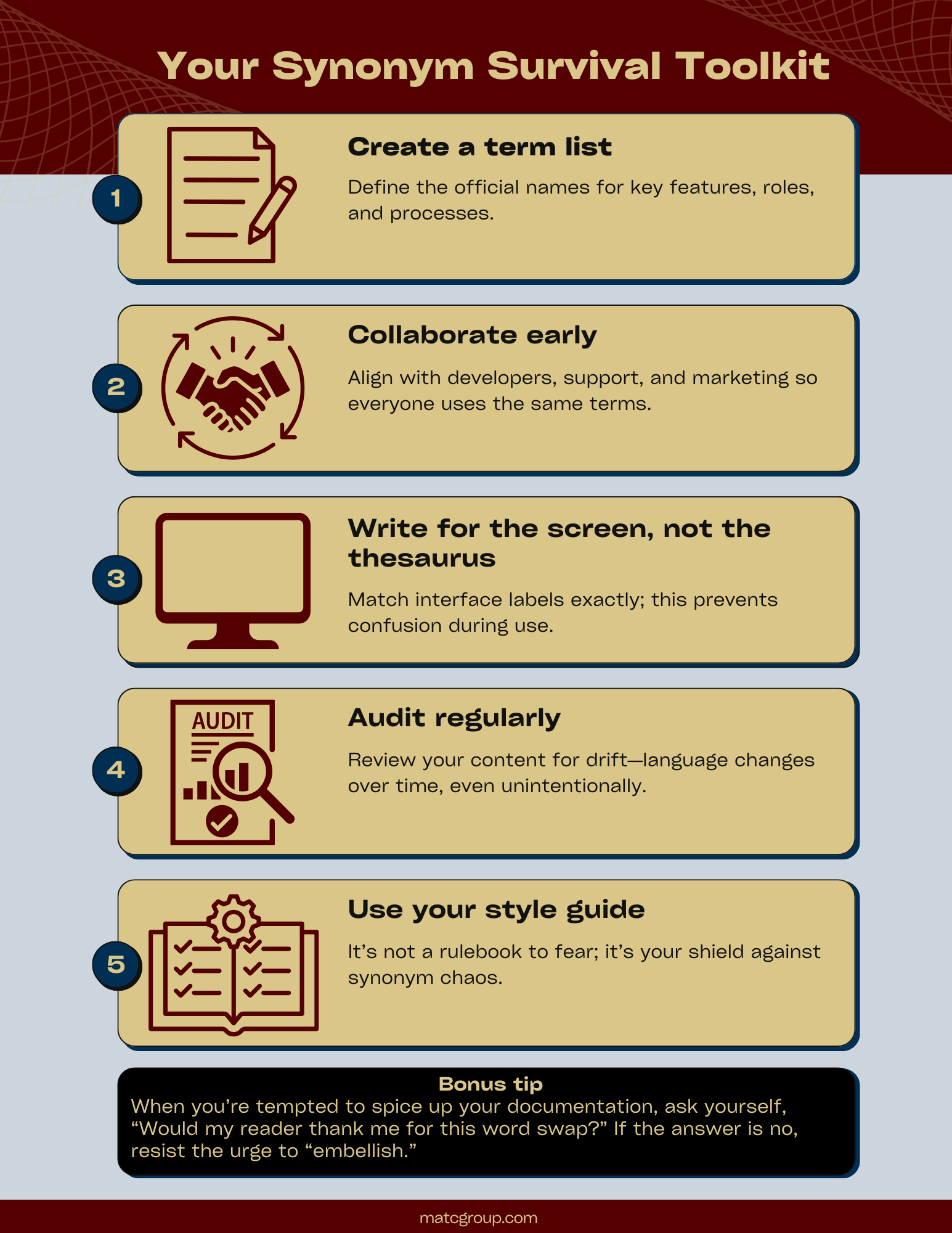
Infographic showing the following information: Your Synonym Survival Toolkit: 1. Create a term list. Define the official names for key features, roles, and processes. 2. Collaborate early. Align with developers, support, and marketing so everyone uses the same terms. 3. Write for the screen, not the thesaurus. Match interface labels exactly; this prevents confusion during use. 4. Audit regularly. Review your content for drift—language changes over time, even unintentionally. 5. Use your style guide. It’s not a rulebook to fear; it’s your shield against synonym chaos. Bonus tip: When you’re tempted to spice up your documentation, ask yourself, “Would my reader thank me for this word swap?” If the answer is no, resist the urge to “embellish.”


Final Thoughts

Technical writing doesn’t need to sound robotic, but it must always be reliable. Readers depend on you to be their linguistic compass, not their creative writing coach.

So, this Thesaurus Day (January 18), celebrate responsibly. Raise a mug to Roget, then get back to doing what great writers do best: making complex information clear, consistent, and human.

After all, precision isn’t boring. It’s brilliant.


Related Blogs

A Short Primer on the Origin, Birth, or Genesis of the Modern Thesaurus

Using Simplified Technical English (STE) to Create Clear, Consistent Documentation

AI-Generated Content: A Love-Hate Relationship


References

Detwiler, Rachel. “You don’t say: editing technical writing.” Beton Consulting Engineers. 5/28/19. Accessed 12/18/25. https://www.betonconsultingeng.com/editing-technical-writing  

Privacy Overview

This website uses cookies so that we can provide you with the best user experience possible. Cookie information is stored in your browser and performs functions such as recognising you when you return to our website and helping our team to understand which sections of the website you find most interesting and useful.