
This is the second post in our Risk & Resilience series.
When a crisis hits, people don’t rise to the occasion. They fall back on what they’ve practiced.
In high-pressure moments—cyber incidents, system outages, safety events, operational failures—employees don’t have time to search for guidance or interpret dense manuals. Decisions happen fast, often with incomplete information and heightened emotion.
This is where learning and development becomes a resilience strategy. Crisis-ready learning prepares people to act decisively, communicate clearly, and stay calm when systems don’t cooperate.
Most organizational training is designed for ideal conditions:
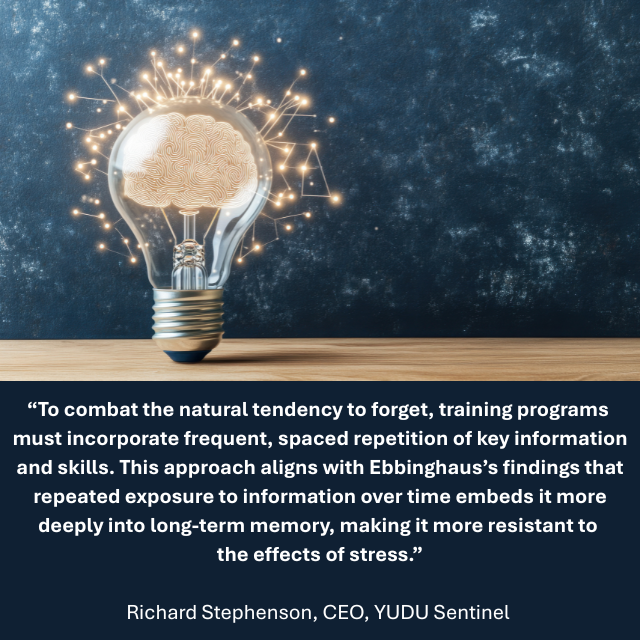
Crisis conditions remove all of those assumptions. Under stress, cognitive load spikes. Fine motor skills drop. Memory narrows. People revert to habit.
Many organizations believe they are prepared because documentation exists. And to be fair, most have taken that step. A 2024 Fusion Risk Management survey found:
That foundation matters. But documentation alone does not create readiness. When the same survey looked at training and practice, the numbers told a different story.
Employees reporting drills or simulations:
Even more concerning:
This gap between plans and practice leaves employees at greater risk and organizations more vulnerable when a crisis hits. If training only exists as static documentation or long-form courses, it fails when it matters most. Resilience also requires training that is embodied, practiced, and familiar.
Through repetition, teams develop practiced responses that hold up under pressure. It conditions people to recognize signals, follow patterns, and make decisions without stopping to deliberate every step. This frees cognitive space for what truly requires human thinking and judgment.
Effective crisis training emphasizes:
The goal is not perfect recall. The goal is reliable action.
![Work desk with a sign reading “Worst Case Scenario” on it. Caption reads: “One of the most famous and influential uses of scenario planning in the business context occurred at Royal Dutch Shell... Faced with the uncertainty of the global oil market, [Pierre] Wack and his team developed a series of scenarios that anticipated the 1973 oil crisis...By considering a range of possible futures, Shell was better prepared than many of its competitors to navigate the crisis, allowing it to maintain its competitive edge and emerge stronger in the aftermath."-Roger Chao, MBA, FAICD, FGIA, Chair, Audit and Risk Committee, Rural Workforce Agency, Victoria](https://www.matcgroup.com/wp-content/uploads/2026/02/One-of-the-most-famous-and-influential-uses-of-scenario-planning-in-the-business-context-occurred-at-Royal-Dutch-Shell-where.png)
Scenario-based instructional design mirrors the reality of crisis conditions. Instead of teaching people about emergencies, it places them inside controlled versions of those moments.
Well-designed scenarios include:
These scenarios help learners practice not just procedures, but judgment, communication, and coordination. They also surface gaps in processes long before a real crisis does.
Crisis response is not built in the moment of disruption. It’s shaped by the kinds of learning experiences people have long before anything goes wrong. Some approaches strengthen recall, decision-making, and coordination under pressure better than others, especially when conditions are fast-moving and uncertain.
Short, focused learning units reinforce critical actions without overwhelming learners. In crisis contexts, microlearning works best when it is:
Microlearning keeps essential responses fresh and accessible, even months after formal training ends.
Simulations allow teams to experience pressure without real-world consequences. The most effective simulations are not polished or predictable.
They are messy.
They force participants to:
Discomfort is not a flaw. It is the learning mechanism.
Crisis response is rarely a solo activity. War-room exercises bring cross-functional teams together to practice coordination and leadership under pressure.
These exercises help teams:
They also expose assumptions that documentation alone cannot.
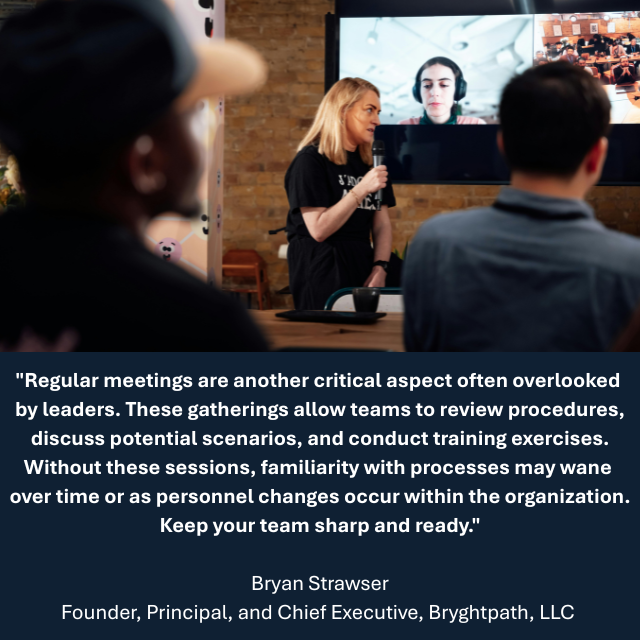
Many organizations believe they are prepared because they have crisis documentation. Documentation is critical, but not sufficient on its own.
In a crisis, people do not read. They react. Training that mirrors reality ensures that documentation becomes reinforcement, not a lifeline.
When learning reflects real conditions, employees do not panic when systems fail. They recognize the situation and act.
Learning and development teams play a critical role in resilience, not by delivering more content, but by designing better experiences.
Crisis-ready learning requires L&D to:
Resilience is built long before a crisis begins.
Calm under pressure is not a personality trait. It is a practiced response. Organizations that invest in realistic, scenario-based learning not only survive crises, they recover faster and adapt better afterward.
Real resilience comes from training that reflects reality, reinforcing what is already in company documentation.
Training, Protocols, Leadership: What Separates Catastrophe from Control
How Mental Health Can Make or Break Your Business in a Crisis
Documentation: The Unsung Hero of Crisis Prevention and Recovery
Chao, Roger, MBA, FAICD, FGIA. “Scenario Planning for Crisis Preparedness.” BoardRoom Magazine. LinkedIn. 11/8/25. Accessed. 1/26/26. https://www.linkedin.com/pulse/scenario-planning-crisis-preparedness-boardroom-magazine-0uoac
Stephenson, Richard. “How Crisis Conditions Impact Training Recall: Insights from Ebbinghaus’s Forgetting Curve.” YUDU Sentinel. 5/8/24. Accessed 1/26/26. https://www.sentinelresilience.com/blog/how-crisis-impact-training-recall
Strawser, Bryan. “Crisis Management Mistakes: Identifying and Avoiding Them.” Bryghtpath. 6/30/23. Accessed 1/26/26. https://bryghtpath.com/crisis-management-mistakes