
Every February, Punxsutawney Phil pops out, and people around the U.S. learn if he sees his shadow or not. More often than not, he sees it and condemns us to six more weeks of winter.
In the world of documentation, it’s not much different – except instead of snow, we get another six weeks of revisions.

Somewhere, a writer sighs, an SME opens “Final_FINAL_V9.docx,” and a manager swears this version will be the last. (It won’t.)
Welcome to Documentation Groundhog Day, where review cycles never end, feedback appears out of nowhere, and approval meetings feel suspiciously familiar.
Alt text Person sitting at desk with head down on an open laptop. Caption reads: “When there is a clear limit defined from the outset, clients are more inclined to prioritize their potential revisions instead of drip-feeding their feedback. In short, they stop treating you like an on-demand editing machine and begin organizing their ideas when they realize they only have two rounds.” -Sheena McGinley, Founder of PROOFIT.IE https://www.memtime.com/blog/client-keeps-asking-for-revisions
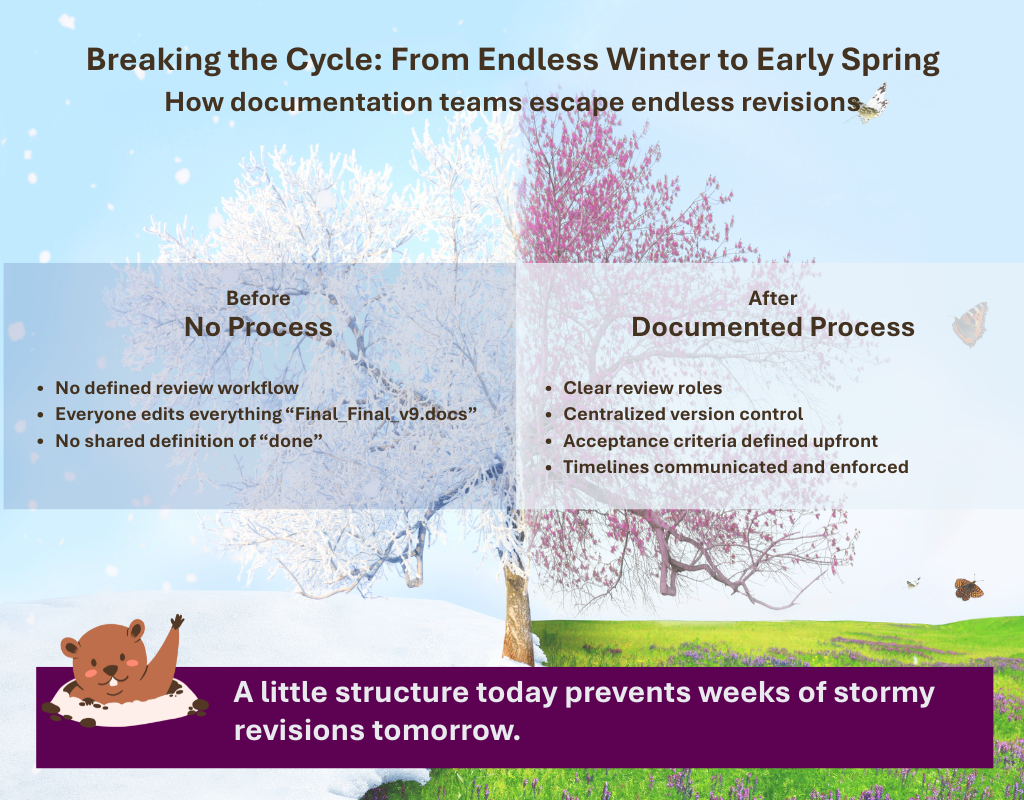
Just like meteorologists, documentation teams rely on pattern recognition. Unfortunately, the pattern often looks like this:
It’s not that people want to drag out the process, but few organizations have a clear workflow for what “done” actually means.
Without documented standards, every stakeholder becomes their own personal weather system, blowing through with comments like, “Can we make this sound friendlier?” or “Let’s reword the entire intro.”
Result: Six more weeks of revisions.
There are a few warning signs you might be stuck in the revision loop:
It’s not the groundhog’s fault, it’s your process.
If you want to end the endless winter of revisions, start by documenting how documentation gets done. Yes, it seems meta, but documenting the documentation process is vital to efficient revising.
A little structure today prevents six weeks of stormy revisions tomorrow.
Remember: Documentation is part of your organization’s entire climate system and doesn’t live in isolation.
When your KM tools, templates, and training materials are aligned, you create predictability. People know where to find information, how to use it, and when it updates. That’s the professional equivalent of early spring.
But when knowledge is scattered, outdated, or dependent on memory, your organization becomes Punxsutawney—all shadows and guesswork.
Leaders can stop the storm by setting the tone:
Because sometimes the bravest thing a leader can say is, “We’re done. Let’s publish.”
The groundhog may not control the weather, but your team can control the forecast for documentation chaos. By setting expectations, documenting your review process, and trusting your own expertise, you can escape the endless loop of Groundhog Day edits.
So, if Phil saw his shadow this year, take it as a sign: it’s time to audit your workflows before another season of revision begins.
5 Ways Technical Writers improve Cross-Functional Communication and Workflow
Creating a Culture of Knowledge Sharing: Best Practices for Organizations
Your Go-To Guide to the Top Technical Writing Authoring Tools
McGinley, Sheena. “Client Keeps Asking for Revisions? Here’s How to Handle It Like a Pro.” Memtime. Accessed 1/15/26. https://www.memtime.com/blog/client-keeps-asking-for-revisions