Dear 2025 Me,
You did your best. Really, you did. You wrangled templates, trained teams, and explained—again—that documentation isn’t “just for onboarding.” You survived last-minute change requests, surprise software rollouts, and at least one project where the phrase “we’ll fix it in training” was uttered unironically.
But as we kick off 2026, I think we both know: we can do better.
Let’s stop waiting until a process breaks (or someone panics) to write the procedure. 2025 was full of “we’ll document that later” moments that turned into “no one remembers how this works.” This year, let’s build documentation into the workflow—like oxygen, not aspirin. (See what can happen when no one remembers: Training, Protocols, and Leadership: What Separates Catastrophe from Control)
Pro Tip: Create a “documentation touchpoint” in every project plan. If something’s new, changed, or confusing, it gets logged and assigned before go-live.

Remember that time you found five versions of the same SOP named “FINAL” in different folders? Let’s not repeat that scavenger hunt. In 2026, we’re tagging, indexing, and archiving like librarians with a purpose.
Pro Tip: Treat your knowledge base like a living ecosystem. Every piece of content should have a clear home, owner, and review date, because even good knowledge can go stale.
You already ditched the jargon last year—well done! Now let’s make it even simpler. Documentation isn’t about impressing auditors; it’s about helping humans. That means short sentences, active voice, visuals, and tone that doesn’t make people cry into their keyboards. (See Why Poor Documentation Hurts Morale, and What to Do About It.)
Pro Tip: If you wouldn’t say it in a conversation, don’t write it in a manual.
In 2025, we got better at aligning training with real-world needs, but we can still bridge the gap between learning and doing. This year, let’s create “just in time” learning moments (quick reference cards, micro-videos, searchable guides) that meet people where they are, not where we wish they were.
Pro Tip: Pair every training module with a linked job aid. If learners can’t use it at work tomorrow, it’s not “training,” it’s trivia.
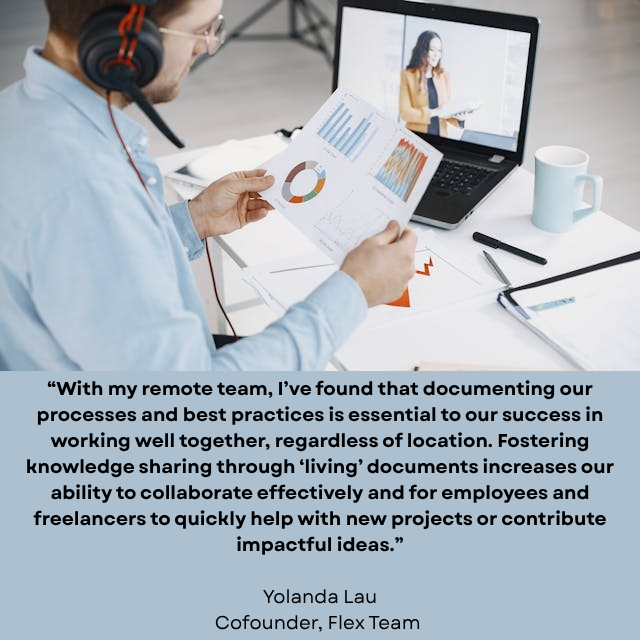
Remember: Knowledge management is about people, not just systems. 2026 Me will encourage questions, feedback, and shared ownership of information. Because when everyone contributes, the organization learns faster, adapts better, and forgets less.
Pro Tip: Celebrate contributions to the knowledge base like other teams celebrate sales goals. After all, shared knowledge is growth.
So here’s to us, 2025 Me.
You laid the groundwork.
2026 Me is just making it a little more… documented.
Sincerely,
Your Future Self (Now With Version Control)
The Science of Employee Motivation: Why Documentation Matters More Than You Think
What Happens When Knowledge Isn’t Documented? Lessons from Aviation for Knowledge Management
Why Poor Documentation Hurts Morale, and What to Do About It
Lau, Yolanda. “Remote Work: Creating A Documentation-First Culture.” Forbes. 6/23/21. Accessed 11/17/25. https://www.forbes.com/councils/forbeshumanresourcescouncil/2021/06/23/remote-work-creating-a-documentation-first-culture
Wakuthii, Sarah. “Organizing Information with Knowledge Management.” LinkedIn. 3/2/24. Accessed 11/17/24. https://www.linkedin.com/pulse/organizing-information-knowledge-management-sarah-wakuthii-ektuf