

Each March, Women’s History Month offers an opportunity to reflect on the women whose leadership changed how our institutions function. Some broke barriers quietly. Others reshaped the rules of entire systems. Few did both as powerfully as Frances Perkins.
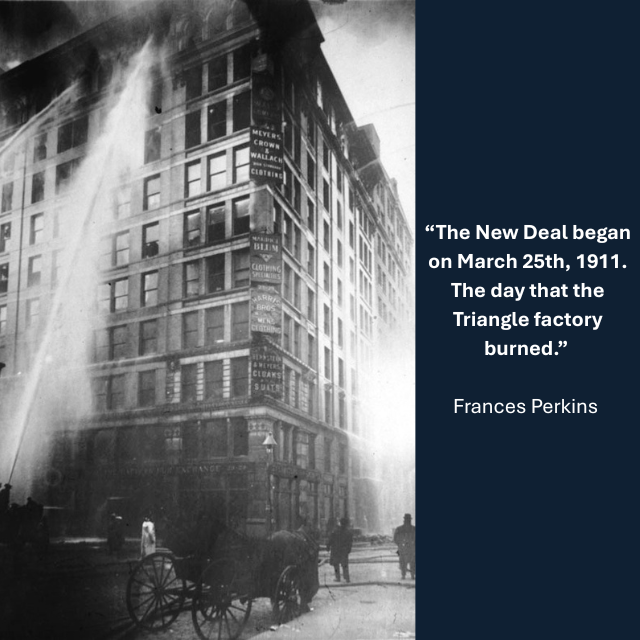
March 25 also marks the anniversary of the Triangle Shirtwaist Factory fire, one of the deadliest industrial disasters in American history. In 1911, the fire killed 146 of the approximately 500 people employed by the factory, most of them young immigrant women. Locked doors, overcrowded floors, and inadequate safety measures turned a workplace into a death trap.
Perkins witnessed the aftermath firsthand. That moment would shape the rest of her career. What followed was a decades-long effort to transform tragedy into policy, and outrage into lasting protections for workers. More than a century later, her leadership still offers lessons about resilience, crisis response, and the long, often difficult work of institutional change.
In 1911, Frances Perkins was working as a social worker and labor advocate in New York.
The Triangle Shirtwaist Factory spread across the top three floors of the 10-story Asch Building. When the fire broke out near the end of the workday, workers were trapped on those floors. Fire ladders could not reach them, and several jumped from windows to escape the flames. Crowds helplessly watched in horror as the disaster unfolded.
Frances Perkins was nearby in Washington Square, having tea with friends when the alarm spread through the neighborhood. She rushed toward the factory and witnessed the aftermath of the fire. The experience left a permanent impression on her. She later described the tragedy as the moment that set the course for her life’s work in labor reform.
The fire exposed something that many reformers had already suspected but could no longer ignore: workplace safety could not depend on the goodwill of employers alone. Real protection required law, enforcement, and political will. Perkins would spend the rest of her career helping build those systems. What that fire brought to light in 1911 still appears in modern organizations, just in different forms. Today, the risks are not always locked doors or blocked exits. They are unclear processes, inconsistent training, and knowledge that lives in silos instead of shared systems.
When critical information is not documented, standardized, and accessible, organizations rely on informal workarounds. In routine operations, that creates inefficiency. In high-pressure situations, it creates risk. This is where many organizations struggle today. They recognize the need for structure, but lack the documentation frameworks, training strategies, and knowledge systems required to make that structure real. MATC Group works with organizations to close that gap by building clear, usable documentation, role-specific training, and centralized knowledge systems that ensure critical information is available when it matters most.
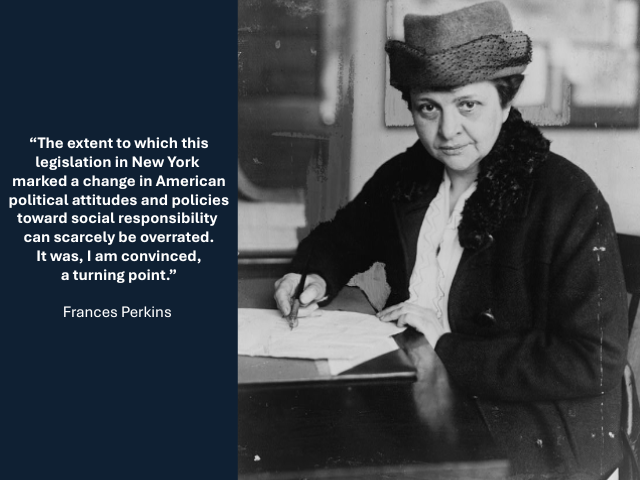
In the years after the fire, Perkins did more than advocate for change. She became directly involved in investigating the conditions that had made the tragedy possible.
She worked with Assemblyman Alfred E. Smith, who later became governor of New York, and Senator Robert F. Wagner on the New York State Factory Investigating Commission. The commission examined factories across New York and documented widespread safety failures in workplaces that employed thousands of workers.
What began as an investigation into the fire quickly expanded into something much larger. The commission broadened its mandate to examine child labor, minimum wages, working hours, and sanitary conditions in factories. The findings were stark. Many workplaces lacked fire exits, ventilation, safety equipment, and even basic protections for workers.
The investigation led to sweeping reforms in New York labor law, including:
These reforms became a model for labor protections across the United States.
The commission also recommended creating an Industrial Commission to oversee workplace standards and enforcement. When Smith became governor, he appointed Perkins to serve on that commission. His successor, Franklin D. Roosevelt, later elevated her to Industrial Commissioner of New York. What began as a response to one devastating fire had become a career dedicated to transforming how the nation protected workers. For Perkins, resilience meant refusing to let tragedy fade into memory. It meant turning it into lasting reform. The scale of these reforms highlights something important: Change did not happen because people simply agreed it was necessary, but because investigation, documentation, and structured analysis made the problems impossible to ignore.
Modern organizations face a similar challenge. Issues often exist, but without clear documentation and analysis, they remain invisible or misunderstood. This is where structured approaches to knowledge and communication become essential. MATC Group helps organizations document current-state processes, identify gaps, and create scalable systems that support compliance, safety, and operational consistency. Without that foundation, even well-intentioned change efforts can stall.
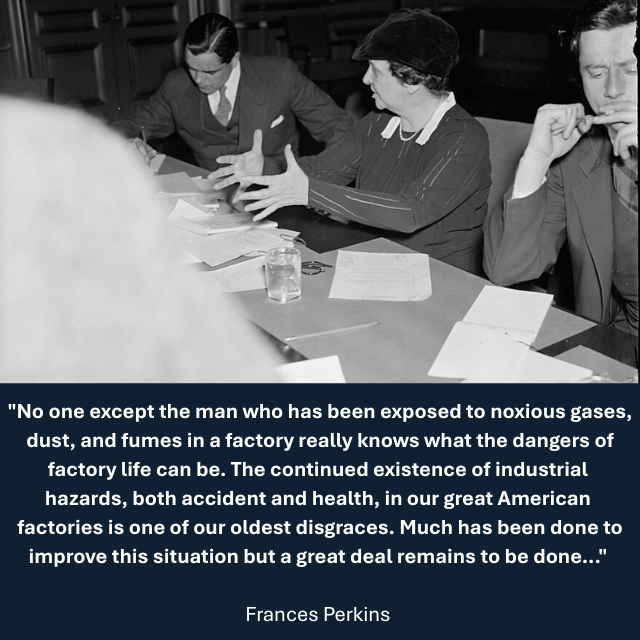
Perkins’ role as Industrial Commissioner of New York led to her appointment in 1933 as President Roosevelt’s Secretary of Labor, making her the first woman to serve in a U.S. presidential cabinet. Her appointment was groundbreaking, but it also came with intense scrutiny.
Perkins faced skepticism from political opponents, labor critics, and members of the press who questioned whether a woman could handle such a high-ranking role. She was often portrayed as radical, unqualified, or overly sympathetic to workers. Yet Roosevelt trusted her judgment and policy expertise. He relied on her heavily during the early years of the New Deal. Perkins approached the role with a clear agenda shaped by decades of labor advocacy.
Her priorities included:
Many of these ideas would become central pillars of modern American labor policy.
Perkins’s success was not just about vision. It was about execution. Her ideas were translated into policies, systems, and enforceable standards. That translation step is where many organizations struggle today. Leaders may have a clear vision for change, but without the right communication frameworks, training programs, and documentation, that vision does not translate into consistent action. MATC Group supports this transition by helping organizations turn strategy into practice through structured learning experiences, clear procedural documentation, and communication frameworks that align teams around change.
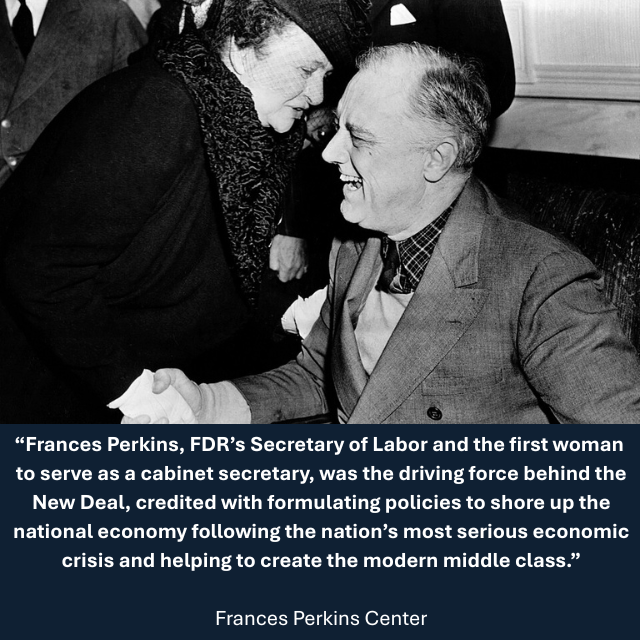
One of Perkins’s most lasting contributions was her role in developing the Social Security Act of 1935. During the Great Depression, millions of Americans faced unemployment, poverty, and financial insecurity in old age. The United States had few national systems to support people during economic collapse.
Perkins helped lead the committee that designed the Social Security program. The legislation established:
Today, Social Security remains one of the most significant public programs in American history.
Perkins also helped shape the Fair Labor Standards Act, which introduced:
These policies transformed the American workplace. They also demonstrated Perkins’s leadership style, focusing less on dramatic speeches and more on building durable systems that improved everyday life.
What made these policies lasting was not just their intent, but their structure. They were designed to be repeatable, understandable, and enforceable at scale. In modern organizations, sustainability often breaks down for the same reason it did before these reforms existed: Systems are either undocumented, inconsistently applied, or difficult for employees to follow. MATC Group focuses on building systems that work in real-world conditions, ensuring that processes are not only defined but also usable, trainable, and adaptable as organizations evolve.

Perkins’s career was not without setbacks. During her time in office, she faced calls for impeachment from political opponents who disagreed with her policies. Critics attacked her labor positions and questioned her loyalty during immigration disputes involving union organizers. Despite these challenges, she remained focused on the work.
Her leadership reflected several qualities that remain relevant today:
Resistance to change is not new. What has changed is the speed and complexity of modern organizations. Today, resistance often stems from confusion rather than disagreement. When employees do not understand what is changing, why it matters, or how it affects their role, hesitation becomes the default response. Addressing this requires structured communication, targeted training, and accessible knowledge systems. This is an area where MATC Group partners with organizations to reduce friction during change initiatives by aligning documentation, learning, and communication strategies so employees can move forward with clarity and confidence.
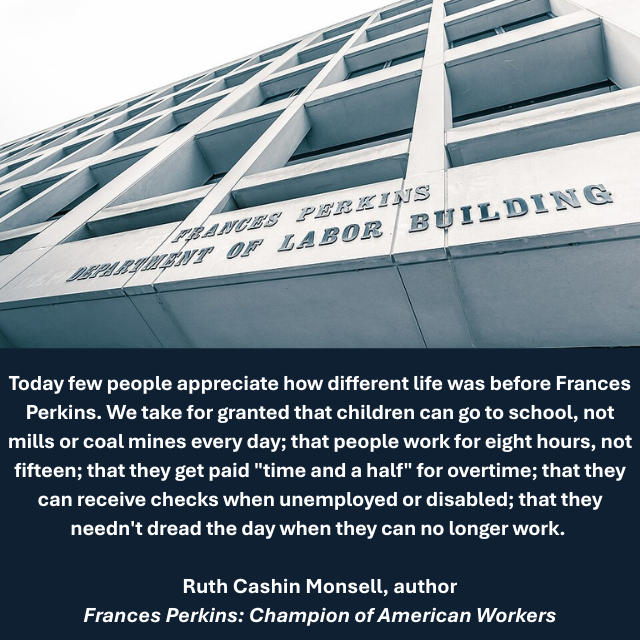
Today’s leaders face many of the same challenges that Perkins encountered: Organizations operate in environments of constant change; crises expose weaknesses in systems that once seemed stable, forcing leaders to respond quickly while thinking long-term.
Perkins did not let urgency fade. She turned it into action by building systems that protected people and improved everyday life. Many of the protections workers rely on today trace back to the structures she helped create. That challenge still exists. Modern organizations often recognize the need for change but struggle to operationalize it. Documentation is incomplete. Training is inconsistent. Knowledge is fragmented. This is where intention breaks down.
Resilience does not come from reacting faster. It comes from building systems that create clarity, consistency, and confidence under pressure. MATC Group helps organizations do exactly that—turning complexity into clear documentation, structured training, and accessible knowledge systems that make change sustainable.
Frances Perkins showed that effective leadership goes beyond solving problems in the moment, building systems that ensure those problems do not return.
Can’t make it to CLO Exchange Austin? You can talk with us at several upcoming events:
Crisis-Ready Learning: Training for Calm when Systems Fail
The Courage to Document Change: Civil Rights Leaders as Knowledge Managers
Leading Through the Storm: Emotional Intelligence in Crisis Leadership
“Frances Perkins Quotes.” Goodreads. Accessed 3/9/26. https://www.goodreads.com/work/quotes/147542701
“The Woman Behind the New Deal.” Frances Perkins Center. Accessed 3/9/26. https://francesperkinscenter.org/learn/her-life/