
The Courage to Document Change: Civil Rights Leaders as Knowledge Managers

When we think about the Civil Rights Movement, we often picture marches, speeches, and moments of protest captured in black-and-white photographs. But behind every one of those moments was something less visible, and just as powerful: documentation. Letters, meeting notes, pamphlets, church bulletins, newsletters, and even hand-drawn maps became the connective tissue of a movement that changed the course of American history.

In many ways, Civil rights leaders were among the most effective knowledge managers of the modern era.
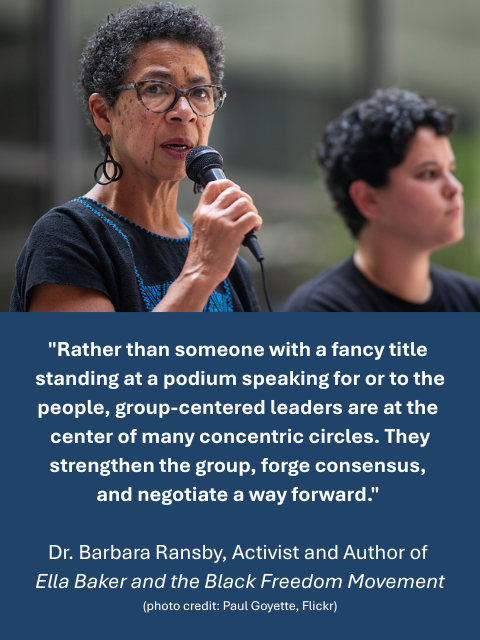
Person of color speaking on a microphone. Caption reads: "Rather than someone with a fancy title standing at a podium speaking for or to the people, group-centered leaders are at the center of many concentric circles. They strengthen the group, forge consensus, and negotiate a way forward." - Dr. Barbara Ransby, Activist and Author of "Ella Baker and the Black Freedom Movement"

Turning Knowledge into Momentum

Every successful movement depends on information: how it’s created, shared, protected, and used to inspire action. Civil rights organizers mastered this. They knew that information was power, and power needed structure.

  • Centralized communication: Organizations like the Southern Christian Leadership Conference (SCLC) and the Student Nonviolent Coordinating Committee (SNCC) maintained detailed records of protests, participants, and logistics. This ensured consistency and coordination across states, long before email or project management software.
  • Documentation as protection: Meeting minutes, letters, and legal paperwork captured decisions and provided evidence of intention and integrity, shielding leaders and activists from misinformation or legal attack.
  • Distributed learning: Training materials for nonviolent protest, voter registration guides, and sermon outlines were copied, mailed, and memorized. These were early examples of scalable learning, long before microlearning became popular.

Knowledge Transfer Under Pressure

The Civil Rights Movement thrived because it was designed for sustainability. Leaders like Rev. Dr. Martin Luther King, Jr.Ella Baker, and Fannie Lou Hamer understood that leadership succession required systems, not just charisma.

  • Ella Baker’s “group-centered leadership” model emphasized documentation and shared decision-making so that no single person held all the knowledge.
  • Freedom Schools used lesson plans, reading lists, and community workshops to teach civic literacy—an instructional design effort built on empowerment and accessibility.
  • Local organizers replicated successful marches, boycotts, and voter drives by adapting written playbooks and reports from other regions, showing how knowledge reuse drove replication and scale.

In essence, these leaders built a living knowledge base that became a dynamic system where information was not only preserved but constantly refined and redistributed.
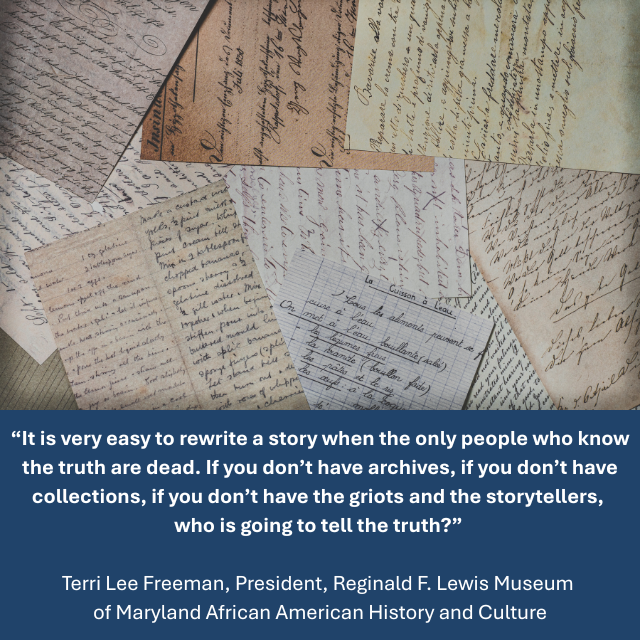
Several scattered handwritten letters. Caption reads: “It is very easy to rewrite a story when the only people who know the truth are dead. If you don’t have archives, if you don’t have collections, if you don’t have the griots and the storytellers, who is going to tell the truth?” Terri Lee Freeman, President, Reginald F. Lewis Museum of Maryland African American History and Culture

Documentation as Cultural Memory

Documentation wasn’t just administrative. It was emotional, historical, and moral. Every speech, flyer, and telegram was a record of courage and collective will. By preserving the “why” and “how” behind the movement, these leaders ensured that the lessons of one generation wouldn’t be lost to the next.

Today’s organizations can learn from that. Whether you’re leading digital transformation or a company-wide culture shift, the same principle applies: document the why, not just the what.

Because when the purpose behind change is clearly recorded and consistently communicated, people believe in it.

What Today’s Leaders Can Learn
  1. Transparency builds trust. Civil rights organizers didn’t hide their intentions; they documented them. Open communication is still the foundation of trust in any change initiative.
  2. Training is empowerment. Well-documented training materials, like those used in Freedom Schools, turn knowledge into agency.
  3. Redundancy is resilience. When everyone has access to the same knowledge, progress doesn’t stop if one leader steps away.
  4. Stories sustain systems. Documentation is more than just process. It’s preservation of culture, purpose, and courage.

The Legacy of Knowledge Management in Action

The Civil Rights Movement wasn’t powered by technology, it was powered by communication.

By documenting their mission, processes, and values, its leaders created a durable framework for action that still inspires today’s movements for equity, inclusion, and justice.

So, as you manage change in your organization—rolling out a new process, restructuring a team, or redefining a culture—remember: leadership is temporary, but documentation is legacy.


Related Blogs

Starfleet’s Approach to Diversity and Inclusion in Knowledge Sharing

Bridging the Gap: Tackling Racial Disparities in Instructional Design

Hidden Strengths: How the Navajo Code Talkers Redefined Leadership in Diversity


References

Brown, Briahnna. “The Importance of Preserving Memory: Baltimore’s Black Archives and Museums are Still Standing Tall.” Baltimore Beat. 10/21/25. Accessed 1/23/26. https://baltimorebeat.com/the-importance-of-preserving-memory-baltimores-black-archives-and-museums-are-still-standing-tall 

Ransby, Dr. Barbara. “Ella Taught Me: Shattering the Myth of the Leaderless Movement.” Colorlines. 6/12/15. Accessed 1/23/26. https://radicaldiscipleship.net/2018/01/07/ella-bakers-group-centered-leadership/ 

Privacy Overview

This website uses cookies so that we can provide you with the best user experience possible. Cookie information is stored in your browser and performs functions such as recognising you when you return to our website and helping our team to understand which sections of the website you find most interesting and useful.